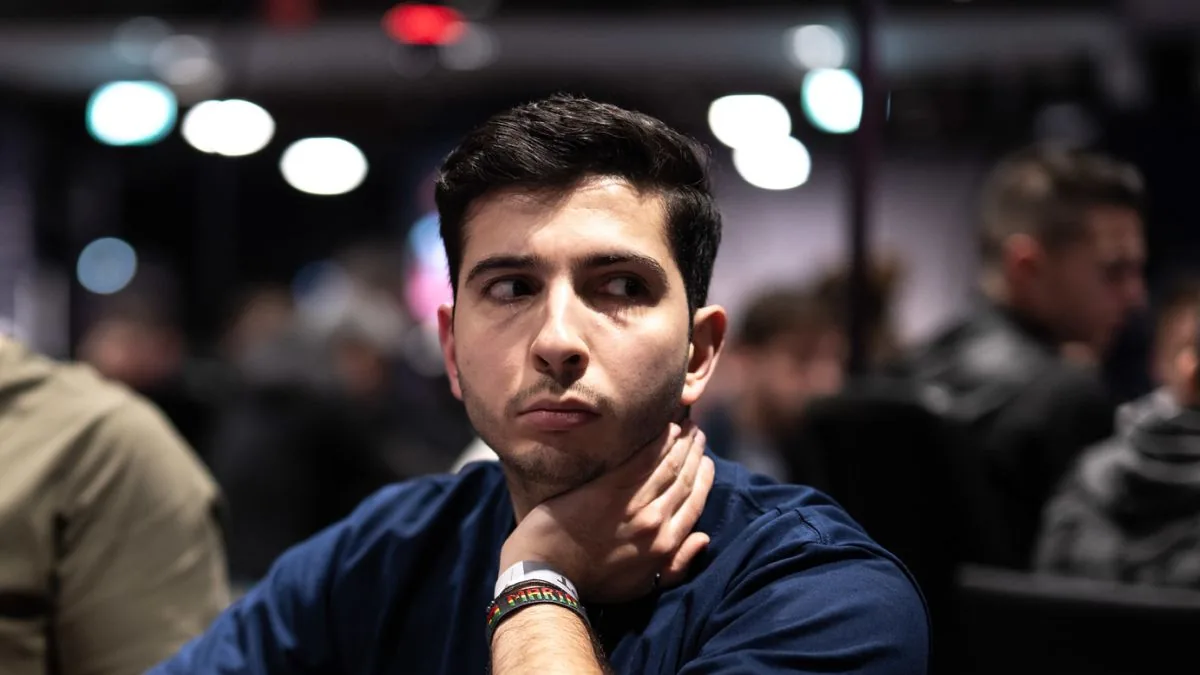










The number 18 must be particularly dear to Mike McDonald. At eighteen, he became the youngest champion in EPT history. Practically eighteen years later, he becomes national chess champion. What happened in between? And what do chess and poker really have in common? Let’s try to answer all the questions.
Read also: Postponement Milan-Como: the reason, when it is played and how the Serie A calendar changes
When Mike McDonald broke an “ultimate” record at the EPT
Born in Waterloo, Canada, on September 11, 1989, Mike McDonald had not yet turned eighteen by three months when he showed up at the Hilton in Prague to play the European Poker Tour Main Event. He finished in fourteenth place out of 555 participants in a tournament won by Frenchman Arnaud Mattern over our Gino Alacqua. Mattern himself, incidentally, was a backgammon professional who had later discovered poker. That 14th place earned young Mike a prize of €20,200, but above all, it gave him the impression that he could be a force in live poker.
Punctually, less than two months later, he would become the youngest ever winner of an EPT Main Event. At the Spielbank Hohensyburg in Dortmund, he impressively dominated a final table that also included Claudio “Swissy” Rinaldi, who would finish in fifth place. Contesting the victory with McDonald was a German amateur of Turkish origin with frankly improbable bet sizes, Andreas Gulunay. Indeed, there was no escape for him, and so, on February 2, 2008, Mike McDonald became the youngest ever to win an EPT, at 18 years and 144 days. One of those records that are very difficult to break, due to obvious age limitations.
Mike McDonald’s talent for poker was evident, as he came very close to winning the same tournament a year later, finishing in fifth place. For the record, the German meteor Sandra Naujoks won.
Despite this, even before the mid-2010s, the Canadian decided to leave poker as a profession, preferring to dedicate his attention to other things. McDonald continued to make occasional appearances here and there, but without the “grind” of the past, and still managed to accumulate over $13 million in gross live tournament winnings.
The king of prop bets
Perhaps Mike McDonald’s greatest talent, however, has always been prop bets. The Canadian has a natural inclination to seek challenges, both physical and mental, and the discipline to do whatever it takes to win. For example, a basketball prop bet has gone down in history. In April 2020, he bet $250,000 that he would make 90 out of 100 free throws by the end of the year. Despite having zero prior experience with basketball, he succeeded before mid-August…
Mike McDonald’s new (won) challenge: chess
Among his interests for years has been cryptocurrencies, while from a competitive standpoint, he has always been fascinated by chess. The fascination reached the point where he managed to win a national championship.
2026 National chess champion pic.twitter.com/nfXeRIeugg
— Mike McDonald (@MikeMcDonald89) February 2, 2026
Note the date: February 2, 2026, exactly eighteen years after triumphing at EPT Dortmund as an eighteen-year-old. An incredible coincidence, which says a lot about the multifaceted talent of this thirty-six-year-old.
The tournament was won in the Cayman Islands, where he triumphed among the men and Zara Majid among the women. FIDE’s Facebook profile states that Mike “fought in chess with determination and quality.” McDonald himself, on his X profile, admitted that he had to take some beatings before winning.
Looking at his graph, however, you wouldn’t say so.
Mike, what a graph!
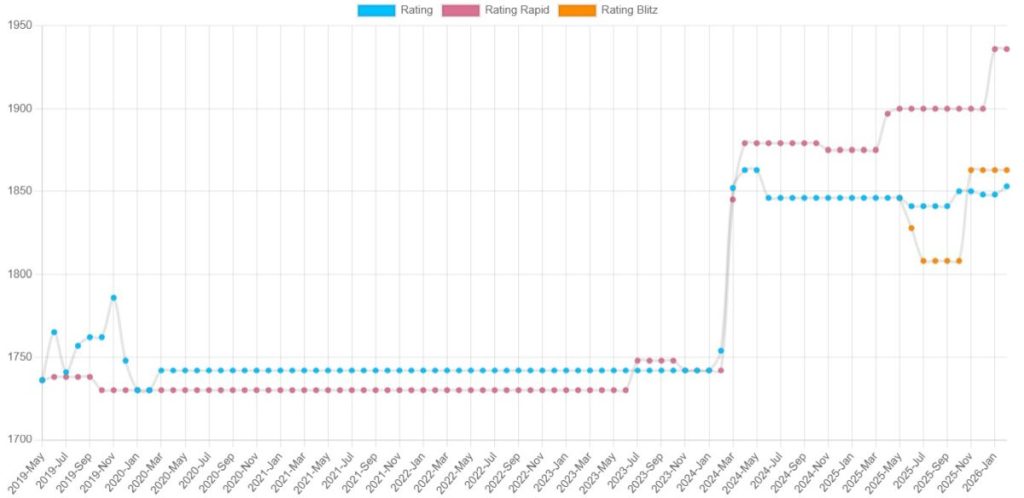
We are used to observing poker graphs from various Sharkscope analyses, but the visual impact of Mike McDonald’s chess rating progression is impressively similar to the graph of a winning poker player.
Here is the progression of his FIDE rating, which is currently 1,853 in standard chess, 1,936 in rapid, and 1,863 in blitz.
Chess and poker, so many common champions!
Over the years, you have read on our pages about chess players who became poker players, or who have cultivated both passions at a high level. Bill Chen is a mathematician and former PokerStars Team Pro who has won two WSOP bracelets, as well as writing a highly regarded book at the time, “The Mathematics of Poker” (2006), and being very knowledgeable about chess.
Read also: The Friday Bet Slip: Wins for Celta and Metz, goals with Leeds and Frankfurt
Speaking of PokerStars testimonials, as much as and more than Chen, the case of Jennifer Shahade is striking. She is an American chess player among the first to receive the “Woman GrandMaster” title but has also dedicated herself to Texas Hold’em for years. Like her, there have also been Almira Skripchenko, Alexander Grischuk, and Jeff Sarwer, whom the author of this article interviewed several years ago, after a fantastic 10th place EPT finish.
And then there are also the inverse cases, like the super chess champion Magnus Carlsen, who has participated in live poker tournaments several times in recent years.
To put things in perspective, Carlsen’s current FIDE rating is 2,840, Jen Shahade’s maximum was 2,366, and Mike McDonald’s current rating is 1,853.
Chess and poker, differences and analogies: what Game Theory says
As Sarwer himself told us, there are unimaginable analogies between poker and chess, particularly in the strategic aspects that tend to put the opponent in a position of pressure, trying to induce them into making mistakes.
The main difference, however, is the complete absence of the random factor in chess, which is instead the “spice” of poker. To better express this difference, we rely on what Game Theory says.
According to Game Theory, both are zero-sum games, meaning that whatever the outcome between two players, there will always be a winner and a loser. Even in the case of a draw in chess, it is still a 0-0.
The difference between the two games is fundamentally given by the type of information. Chess is a game of perfect information, while poker is a game of imperfect information.
In chess, we can always potentially have complete knowledge of the situation and the moves made by our opponent up to that point.
In poker, however, information is imperfect due to a lack of data on the opponent’s cards and, possibly, knowledge of the community cards yet to be dealt and other unknowns.
A huge difference is that a mistake in chess is paid for dearly and immediately and results in an immediate disadvantage, which often leads to defeat. In poker, however, a wrong choice can have an immediate positive effect. Conversely, a correct choice could have a disastrous outcome immediately in a single hand.
Ultimately, it is precisely this random element that makes poker so fascinating to a very large number of people, because it deceives even the less skilled into believing they can compete on equal terms with the strongest. This is an element that is impossible in chess.
Cover image: Mike McDonald (his X account)