



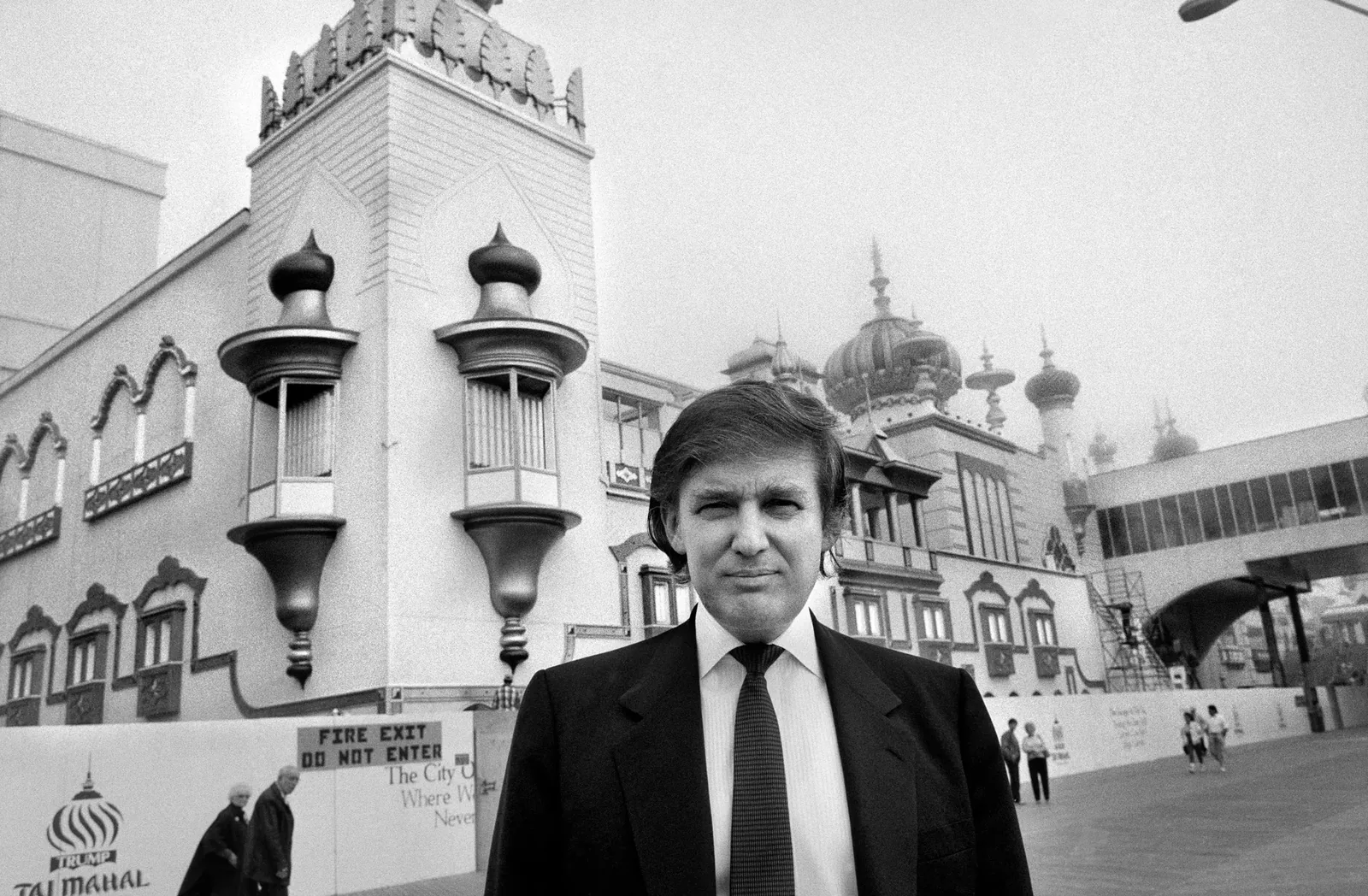
Atlantic City, December 1990. The Trump Plaza was no stranger to big players, but that week the atmosphere was electric. It wasn’t the usual presence of a high roller, one of those clients who arrive, play hard, and disappear just as quickly. The arrival of Akio Kashiwagi transformed the room into something different: no longer a casino but an arena.
Read more PokerStars Network: Online satellites to participate in the Italian Poker Challenge in Campione
Kashiwagi was not a gambler in the traditional sense of the term. He was a Japanese real estate tycoon with a reputation already established in international casinos, especially for his obsession with baccarat. In that world, he was defined as a “whale”: one of those players capable of moving millions with the same naturalness with which others choose a bet of a few dollars. Perhaps he wasn’t just a whale; in 1990, he was the whale.
Let’s remember that in the late 80s and early 90s, Japan was experiencing an unprecedented economic boom with very aggressive financial policies. Japanese businessmen were seen at the time like the Chinese are today. Land-based casinos threw their doors open to them. Today, the dynamics have changed slightly, also due to the presence of competition from online casinos.
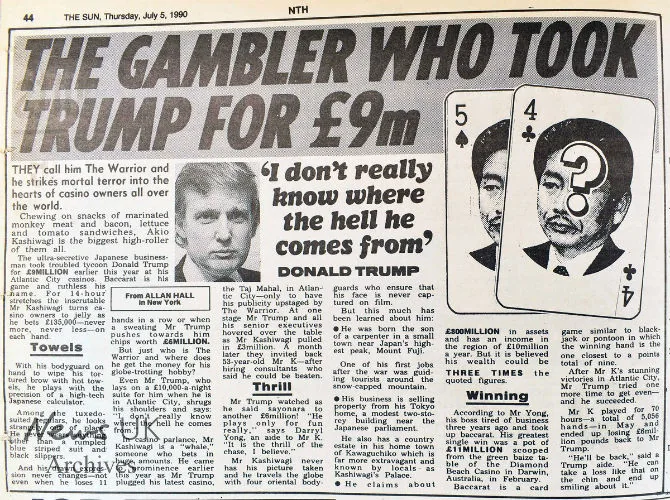
Donald Trump had perfectly sensed the symbolic value of his presence. It wasn’t just a few sessions for a VIP client, but a media and social event; in this, Americans—since the 80s—were and are masters.
He was reserved a dedicated table, a luxury suite, and treatment that transformed his gaming session into a spectacle observed by the curious, journalists, and insiders.
But before talking about the game, we need to rewind the tape and understand how Trump managed to lure him into his net.
Trump flies to Tokyo to meet him
1990 is not over yet, but the world has already changed its skin. Japan is in the midst of its economic bubble and Akio Kashiwagi is one of the most enigmatic creatures of that era: a man who does not appear, does not speak, does not indulge. But he plays.
And he plays baccarat like others breathe. Not as a pastime, not as a whim, but as if it were an ancient craft, almost artisanal. Sessions that can last eighty hours, with bets that in an instant burn or generate fortunes.
In February of that year, Donald Trump lands in Tokyo to promote the match between Mike Tyson and Buster Douglas, the match that a few months later would change the history of boxing. In a party crowded with men of money and power, Trump notices a silent, secluded presence.
A man who does not seek attention. Trump approaches, proposes a photo. The man looks at him and responds with the firmness of someone who needs nothing:
“No photo.” That man is Akio Kashiwagi.
And Trump immediately understands that behind that refusal there is something more precious than any advertisement.
At the time, the tycoon’s casinos were not sailing in calm waters. Liquidity was needed, movement was needed, a whale was needed. And Kashiwagi seemed to embody exactly what Atlantic City needed.
His story
Kashiwagi does not come from an aristocratic dynasty, but from a carpentry shop. The son of a carpenter, he built a real estate fortune that in the early 90s generated about 100 million dollars a year.
His net worth exceeds a billion—a figure that is less striking today, but then belonged to a narrow global aristocracy.
When he travels, he brings a personal chef who prepares his favorite dish: marinated monkey. A detail that says a lot about a man who does not adapt to the world, but demands that the world adapt to him.
Those who know Kashiwagi warn Trump: “He almost blew up the Diamond Beach Casino. He won twenty million.”
Trump listens, but prefers to remember another episode: the six million that Kashiwagi himself had lost at Steve Wynn’s Mirage.
He doesn’t see the danger. He sees the opportunity.
So he prepares a penthouse for him at the Trump Plaza. Kashiwagi accepts the invitation but remains invisible for two days, closed in his rooms.
As if he were taking measurements. On the third day, he comes down. And from that moment, things get interesting.
More than a game, it was a war
Despite the desire for anonymity, Kashiwagi cannot go unnoticed. He is accompanied by a bodyguard and moves with the calm of someone who knows that time is an ally (yes, but for the casino…).
In front of him, he has a mountain of chips.
And he begins. He doesn’t play like a risk tourist. He doesn’t play for emotion. He plays with the discipline of a professional who considers money a tool and not an end.
Trump observes. And he understands that he has in front of him not just a client, but a man capable of winning—or losing—tens of millions in a few hours.
A gambler, in the purest sense of the term. Years later, Trump would recall:
“I was sitting there watching one of the best gamblers in the world play against me for 250 thousand dollars a hand, seventeen times an hour.”
A rhythm that does not belong to the game, but to war. And at that moment, in Atlantic City, the line between entertainment and financial battle had disappeared.

When Trump was the king of Atlantic City
Let’s try to explain the context: in the 90s, Donald Trump’s casinos in Atlantic City represented much more than simple gambling halls: they were the symbol of an economic model based on attracting so-called “whales,” the big international players capable of moving millions in a few hours. The Trump Plaza, along with the Taj Mahal and Trump Castle, operated with a precise strategy: spectacularizing the action and making the high roller a true protagonist to favor storytelling.
The goal was not only to collect money but to compete with Las Vegas on the ground of luxury and exclusivity, offering very high limits and almost regal treatment to the wealthiest clients.
In that context, figures like Akio Kashiwagi were seen not just as a risk, but as an advertising investment: every multi-million dollar session generated media attention, reinforcing the casino’s image as a global stage for whales and finance tycoons.
However, behind the facade of opulence, the model was fragile. The high exposure to big players and the enormous management costs contributed to creating a heavy financial structure, which in the following years would show all its vulnerabilities. Atlantic City in that period thus experienced a season of spectacular but unstable expansion, where the boundary between entertainment and finance was increasingly thin. It is no coincidence that Trump came close to bankruptcy because of those investments.
The match of the century
When Kashiwagi sat at the table, the level of the bets immediately made it clear that this was not a courtesy visit. It quickly reached bets of up to 250,000 dollars per hand. The pace was not frantic, but constant. He played calmly, without any sign of excitement or tension, often sipping green tea as the game proceeded.
The session soon turned into a marathon.
The dealers rotated, while he continued to play for hours and then for days. The audience grew, attracted more by the player’s discipline than by the figures at stake; the Japanese gambler was a sphinx at the table. Neither cheers nor gestures of frustration. Kashiwagi maintained the same expression, both when he was winning millions and when the balance of the table slowly began to change.
Kashiwagi wins (in the first game) $4 million
The first contact with reality for Trump was not very happy, especially when he realized he had burned 4 million dollars. Kashiwagi plays baccarat, which is the game that gives the house the smallest edge among all those present in the casino: just over 1%.
After two days, the Japanese man stood up and said goodbye to everyone, taking 6 million dollars back to Tokyo. Trump had been beaten, but not defeated.
The future president consulted mathematician Jess Marcum, who suggested to Donald the only way to recover the losses: convince Kashiwagi to continue playing, because in the long run, the house advantage will inevitably make itself felt.
Donald accepted the advice and the risk and brought Akio Kashiwagi back to Atlantic City. Marcum’s plan was this: Trump had to convince Kashiwagi to agree to bring 12 million dollars and play until he had lost them all, or had won double. It was an informal agreement; Trump had to trust the Japanese man’s word.
Read more Spin & Go Championship Live Paris: the tournament rules (and what players need to know)
Trump: from nightmare to victory
The whale took the bait and accepted all the terms imposed by the New York shark. Trump was happy, but his mood soon changed when Kashiwagi started by winning another 9 million dollars: another 3, and it would have been late night for Donald. Game over. Adios business.
The tycoon wanted to stop the game, but Marcum convinced him not to deviate from the plan. The game continued for another five days, and the more time passed, the more Kashiwagi began to lose ground. After six days of play at the Trump Plaza, Kashiwagi was down 10 million.
Here Donald decided to stop the game (even if technically the agreement was still 2 million short): the fact of having recovered the losses and, indeed, being up by 4 million was enough for him. Kashiwagi accepted, although later he would publicly complain about how the challenge was interrupted prematurely.
When Hollywood was inspired by the story: the sequence in Casino
Akio Kashiwagi’s marathon at the Trump Plaza entered the imagination of the industry and the general public so much that it inspired one of the most famous sequences in the film Casino by Martin Scorsese.
In the film, the character of K.K. Ichikawa appears, a Japanese high roller who arrives in Las Vegas to play baccarat at very high limits, attracting the attention of the casino and the media. Like Kashiwagi, Ichikawa is also treated as an event rather than a client: dedicated suite, reserved table, constant attention from the staff.
The dynamic is similar:
- huge bets
- prolonged sessions
- the casino not trying to beat him immediately, but trying to let him play
In the film, as in reality, the house strategy is not to stop the player, but to make him stay long enough for the mathematical margin to do its work.
Scorsese transformed that logic into cinematic narrative. Kashiwagi’s story was the real version of it.
And the message remains the same: in big games, the house doesn’t fight the player… it fights and manages time along with him.
The dramatic story of Kashiwagi
He lost a fortune but did so without flashy reactions, with the same composure that had characterized every moment of the session. For those watching, it was a demonstration of how, in high-level gambling, the determining factor is not the single hand but the duration of exposure to risk.
It was not the first time the Japanese tycoon had faced the house with similar figures. Previously, he had achieved multi-million dollar winnings, consolidating his fame among international high rollers. But that week at the Trump Plaza remained in the industry’s memory as one of the most emblematic examples of how time can affect the final result of a high-stakes session of that level.
Two years later, Kashiwagi died in violent circumstances in Japan (struck by about 100 stab wounds), in a case that was never completely clarified. There were even those who claimed it was the Japanese mafia, but no link was ever proven. He had left several debts in other American casinos.
Ironically, in 1992, the year of his death, Trump’s casinos declared bankruptcy.
His figure remained shrouded in an aura of mystery, but the marathon he signed at the Trump Plaza at baccarat continued to be cited as one of the most significant sessions in the history of gambling.
Not so much for the size of the figures at stake, but for what it represented: the demonstration that, even at the highest levels, the result does not depend only on courage or discipline, but on a long-term strategy of the house that must have adequate financial coverage.
The Taj Mahal: the casino that almost went bankrupt after just one year
But Trump’s jewel was not just the theater of the challenge with the Japanese tycoon, the Trump Plaza. The future president of the United States loved another of his creations.
When the Trump Taj Mahal opened in April 1990, it was presented as “the eighth wonder of the world”. It wasn’t just a slogan: with a cost close to a billion dollars, it was the largest and most luxurious casino ever built in Atlantic City. Trump’s idea was clear: to create a destination capable of competing with Las Vegas on the ground of opulence, attracting not only mass tourism but especially big international players.
We know well that the fortunes of Atlantic City in the early 90s were determined by New York players. Trump wanted to go further.
The Taj Mahal was born primarily for the whales.
Very high limits, pharaonic suites, personalized service: everything was designed to make the casino a magnet for high rollers from Asia and the Middle East, willing to move figures that transformed gambling into an almost financial matter. In this sense, the Taj represented the most extreme version of the Atlantic City model of the 90s: fewer slots and more VIP tables, less volume and more concentration of risk, a bit like Macau is today.
But that greatness had a price.
The project had been financed largely through high-yield debt, so-called “junk bonds”, which required enormous cash flows to be sustained. In practice, the casino had to always operate at maximum capacity to stay in balance. A few negative seasons or some unfavorable sessions with big clients were enough to put pressure on the financial structure.
Not surprisingly, as early as 1991, just over a year after opening, the Taj Mahal went bankrupt.
The paradox was evident: the most spectacular casino in Atlantic City was also the most vulnerable. The strategy of betting on high rollers, which seemed winning in terms of image, exposed the business to enormous volatility. A single multi-million dollar session could make the difference between profit and loss.
In that context, figures like Akio Kashiwagi were not simple clients, but systemic variables. Their passage could influence not only the accounts of a week, but the very perception of the solidity of an entire operation.
The Taj Mahal remained for years the symbol of that era: a combination of spectacle, ambition, and financial leverage, where the glamour of high-limit gambling coexisted with a structural fragility destined to emerge over time.
What lesson did Kashiwagi’s High Stakes match teach
Sessions like Akio Kashiwagi’s are not just stories of off-the-chart figures. They are, first of all, lessons on how risk works when taken to the extreme.
1. Time is the most important variable for the casino: at low limits, we talk about luck. At high stakes tables, the duration of the game is decisive for the fate of the room. The longer players remain exposed to a game with a negative margin, the more the result tends to converge toward the house’s mathematics.
2. Discipline does not eliminate the casino’s advantage: Kashiwagi did not play impulsively. He was methodical, calm, almost ascetic. Yet this was not enough to change the final outcome. Emotional management can reduce errors, but it does not change the structural probabilities.
3. The single session doesn’t count: in the short term, you can win a lot, which is why for some players, when they win, there is the saying: “take the money and run.” In the long run, the repetition of hands makes the emergence of the house edge inevitable, the house advantage which in baccarat is minimal (about 1%). A high roller can win millions in a night… and return them perhaps in a week of play.
The long-term strategy of the Trump Plaza
That match was a great lesson (or a confirmation) for American casinos on the strategy to follow against whales.
At the beginning, as we have seen, the session seemed to prove the Japanese gambler right. Winnings accumulated and the advantage reached significant levels, fueling the impression that a systematic and disciplined approach could get the better of the house. But baccarat is a game where the casino’s margin is small (about 1%) and constant, and it tends to emerge over time.
At first, Donald had to endure some very bad losing sessions for millions, but the long term was his precious ally even if—as we have seen—to prolong the game he had to convince the Japanese gambler.
The Trump Plaza did not try to counter him with aggressive strategies or table changes. The choice was simpler: let him play. The more hands were dealt, the more the probability increased that the house’s statistical advantage would manifest.
That was exactly what happened.
There was no decisive hand or dramatic moment. The session did not end with a plot twist, but with a slow return toward the mathematical balance of the game. After days of almost uninterrupted activity, the overall balance flipped.
Kashiwagi left Atlantic City with about 10 million dollars in losses.
Play responsibly
The most important lesson from this story is one and only one: the casino has a mathematical advantage, so you already know how it will end in the long run. For this very reason, fun is the only true impulse you should listen to, but you must do so with maximum responsibility in managing your finances. You can have fun even with a few euros (that you can afford, perhaps), not with figures that can affect your daily life. If you have problems managing yourself, it is better to seek assistance and support from associations. Furthermore, online self-exclusion exists, which is a very effective means to stay out of trouble if you cannot manage your impulses.
Read more Freeroll frenzy! Free tournaments coming Saturday 21 and Sunday 22 February on Italian poker rooms
Thanks to The New Yorker for the cover photo