- Complete integration with US intermediaries.
From Trump to Polymarket’s “hybrid” victory at TAR: the breakthrough of predictive betting in the World and in Italy [EXCLUSIVE]
![From Trump to Polymarket's "hybrid" victory at TAR: the breakthrough of predictive betting in the World and in Italy [EXCLUSIVE]](https://gambleanalytix.com/wp-content/uploads/2026/02/5e9baf0b2fe472df355f3a94d48a5ed6.jpg "From Trump to Polymarket's \"hybrid\" victory at TAR: the breakthrough of predictive betting in the World and in Italy [EXCLUSIVE]")










Kalshi is a fully regulated predictive contract exchange by the Commodity Futures Trading Commission (CFTC) in the United States, becoming one of the most important compliant infrastructure exchanges for institutional and retail traders.
Kalshi, Inc. is a US prediction market platform founded in 2018 by Tarek Mansour and Luana Lopes Lara, two former financial analysts who met at MIT (Massachusetts Institute of Technology). Today it is headquartered in New York City and is a private company with a market valuation of approximately $11 billion after a $1 billion funding round, with investors including Sequoia Capital, Paradigm, Y Combinator, and asset managers like Charles Schwab and Henry Kravis.
Kalshi is not a normal betting site: its offering is based on “event contracts”, financial contracts that allow users to buy/sell predictions on the outcome of real events — from climate and economic data, to politics, as well as sports and legislative results — with the contract price reflecting the market’s perceived probability. Unlike traditional bookmakers, Kalshi does not bet against the user but acts as an organized market where buyers and sellers meet, and it earns profits through transaction commissions.
The company operates as a regulated exchange in the United States under the authority of the Commodity Futures Trading Commission (CFTC), which in 2020 approved Kalshi as a Designated Contract Market — the first platform of its kind to obtain this federal recognition for predictive markets. This status allows it to offer tradable events, but it also entails legal challenges with individual states (especially when Kalshi began offering markets on sports results), because some state regulators believe that certain contracts constitute actual unauthorized sports betting.
In summary, Kalshi is seeking to redefine the boundary between predictive finance and regulated gaming, attracting both institutional liquidity and the attention of regulators, and positioning itself as a global market infrastructure for trading in advance on the outcome of real events.
![From Trump to Polymarket's "hybrid" victory at TAR: the breakthrough of predictive betting in the World and in Italy [EXCLUSIVE]](https://gambleanalytix.com/wp-content/uploads/2026/01/a53ab5d25285f39e081fb2f068694fd9.png)
The currency used by Kalshi ➡️ USD fiat — the main market is in US dollars.
Kalshi also allows deposits via stablecoins or cryptocurrencies in some cases, but these are automatically converted to USD before absorbing trading contracts.
Fiat currency means, from Latin, both made (by decree). When we talk about fiat currencies, we are talking about traditional currencies like the dollar, euro, yen, ruble, etc.
Key features:
👉 Although Kalshi may accept crypto deposits → USD, its core operation is tied to fiat currency markets, not native tokens or stablecoins as the primary market medium.
| Platform | Main Currency | Features | Typical User Type |
|---|---|---|---|
| Polymarket | USDC (stablecoin) | In transition, under CFTC compliance, decentralized structure | Global traders, crypto-native |
| Kalshi | USD (fiat) | CFTC regulated | Institutional / US retail traders |
| PredictIt | USD | It is a site focused on politics | Political bettors |
| Opinion.Trade | Crypto (e.g., BNB Chain token) | Decentralized | Crypto traders / dApp users |
| Crypto.com Markets | Crypto / stablecoin | Integrated exchange | Crypto Ecosystem |
✔️ The main prediction markets use a combination of currencies:
✔️ In the United States, it’s not that platforms have completely eliminated stablecoins, but Kalshi structures the use of cryptocurrencies as a gateway to convert them into fiat market, while Polymarket is trying to balance the use of stablecoins and regulatory compliance to fully re-enter the US market.
Within a few months, the advance of prediction markets (Kalshi, Polymarket, and the “event contracts” ecosystem) has forced the two giants of US betting — FanDuel (Flutter) and DraftKings — to make a choice: suffer competitors who bypass the state borders of traditional betting, or enter it with a proprietary product.
And the answer, today, is clear: they have entered it.
A stablecoin pegged to the dollar is, in essence, a digital dollar: a cryptocurrency designed to maintain a stable value (1 token = 1 USD) thanks to reserves in cash, government bonds, or liquid instruments held by the issuer. It is used to move money on the blockchain with the speed of crypto trading but with the stability of fiat currency, thus becoming the “cash” of digital markets, from payments to prediction markets. The most common are USDT (Tether), the queen for global volumes, USDC (Circle/Coinbase), perceived as more regulated and transparent in the US, and DAI, decentralized and collateralized on-chain. But their weight goes beyond finance: stablecoins have also become a geopolitical tool, as they effectively export the dollar outside the traditional banking system, allowing millions of people — and sometimes countries under sanctions or with weak currencies — to use “digital USD” without going through SWIFT or central banks. For Washington, it is monetary soft power; for regulators, it is also a systemic risk and a control issue: too many dollars circulating outside the banking perimeter mean fewer levers on capital, sanctions, and monetary policy. In short: fintech technology on the surface, but a struggle for economic sovereignty flows underneath.
The question on the minds of many keen observers is: “Are traditional bookmakers just watching while platforms operating (in most cases in markets not yet regulated) ‘eat up’ market share?”
In October 2025, the stock market crash of Flutter (owner of the leading US bookmaker Fanduel) and DraftKings sounded like an alarm bell.
Some stock market analysts were quick to draw a connection between the financial markets’ reaction and the new competition from Polymarket and its peers in sports.
There is also a significant detail, given that the decisive battle for the future of global betting is being fought in the USA (with substantial investments and strong “bets” and investments from Wall Street).
In important states (like California), betting is not legally permitted, but with the loophole of “financial” derivative contracts (recognized at the federal level), Polymarket and Kalshi are effectively collecting bets where no other betting operator is allowed. In the long run, this gap risks becoming insurmountable.
Other observers, however, attributed the causes to the negative results recorded by the house in the NFL (National Football League) in the last quarter, with many favored teams winning. Certainly, the unfavorable payout did not help the big players.
It’s difficult to give definitive answers, but one thing is certain: since then, the two main US bookmakers have announced that they are entering the predictive betting market with their own proprietary platforms.
FanDuel and DraftKings decided to move at that moment.
As I said, event contracts — framed as federally regulated derivatives/contracts — have allowed prediction markets to offer “bets” on sports and events even in states where online sports betting is not legal (California and Texas are among the wealthiest and most populous states). This has created a new competitive front and a jurisdiction war between federal regulation and state authorities.
Initially, prediction market platforms only offered binary options (yes or no, for example), but since 2025, they have introduced multiple options, including for sports, effectively becoming true betting platforms, but unregulated or operating in gray markets, thus having a competitive advantage.
When this step was taken, especially by financial exchanges — as I anticipated — Wall Street reacted negatively and also penalized stocks related to traditional betting, such as Flutter.
Precisely for this reason, the two main US bookmakers, Fanduel (owned by Flutter) and DraftKings, have adapted and are launching their own platforms.
FanDuel has not copied the Polymarket model: it has chosen a hyper-institutional path. At the end of December 2025, FanDuel and CME Group announced the launch of FanDuel Predicts, with an initial rollout in some states, under the umbrella of the federal financial derivatives oversight commission.
In the press release (and in the first public details), the approach is very clear: contracts on financial benchmarks (like stock indices and commodities) and economic indicators, in addition to the “event-based” perimeter. It is a way to:
When FanDuel decided to launch FanDuel Predicts, it didn’t just add a new feature to its app. It did something more subtle, and potentially more disruptive: it tried to shift the cultural boundary between betting and finance. For years, online betting has been presented as entertainment, adrenaline, cheering. Here, however, the grammar changes. You no longer bet on a match: you trade probabilities, buy scenarios, sell expectations. It’s the lexicon of markets, not betting slips. The collaboration with CME Group, the Chicago derivatives giant, is not a technical detail but a political manifesto: it means telling investors and regulators that these contracts resemble simplified futures more than bar bets. And indeed, the regulatory umbrella is not that of state gambling, but that of the federal Commodity Futures Trading Commission, the same authority that oversees commodities and financial markets. Inside FanDuel Predicts, you will find binary markets, yes or no, which can concern the outcome of a match but also the trend of the S&P 500, inflation, the price of oil. It is a silent mutation: the sportsbook becomes a small popular stock exchange, accessible from a smartphone, where the user is not just a fan but a micro-trader. And above all, it is a strategic move to circumvent the fragmented geography of US betting laws: where sports betting is still prohibited, federally regulated event contracts can still pass. Thus, FanDuel not only expands its offering but the very perimeter of the market, intercepting an audience that is not looking for stadium thrills, but for tools to monetize opinions about the world. If prediction markets truly become a new asset class, FanDuel Predicts is the signal that Wall Street and Las Vegas have stopped looking at each other with suspicion and have discreetly started talking to each other.
CME Group is a leading US global derivatives market company, operating major exchanges such as the Chicago Mercantile Exchange (CME), Chicago Board of Trade (CBOT), New York Mercantile Exchange (NYMEX), and COMEX. Through these platforms, it offers trading in futures and options on a wide range of assets — from interest rates and stock indices to currencies, commodities, and energy — enabling institutional investors and traders worldwide to manage risk, hedge positions, and access global benchmarks in financial markets.
DraftKings opted for the intermediary route with its own app. The well-known bookmaker officially entered prediction markets on December 19, 2025 with DraftKings Predictions, explaining that the operation is carried out through a subsidiary registered as an Introducing Broker and NFA member (National Futures Association), and is available in 38 states (including major markets).
For DraftKings, the value is twofold:
It is no coincidence that, as early as 2025, CEO Jason Robins openly spoke about the opportunity in “non-sports-betting states“.
Ultimately, setting aside the dust kicked up by tweets, stock market alarms, and regulatory anxieties, a rather American truth remains: prediction markets make a lot of noise, but little real damage. At least for now.
According to a report released by Citizens Equity Research, prediction markets have diverted about 5% of the regulated gaming volume from traditional bookmakers. Translated into dollars: about $8 billion per year. A figure that seems impressive only until you remember that the handle — the volume of bets — is not revenue, is not margin, is not profit. It’s movement. Like highway traffic: it doesn’t say how much the toll booth earns.
The analysis is signed by Jordan Bender, who immediately gets to the point: that 5% is slightly higher than previously estimated, but it is not an event capable of changing the fundamentals of the sector. No hemorrhage, no systemic business theft.
From the companies’ perspective, says Bender, the impact is a wash, a break-even. DraftKings, FanDuel (and therefore the parent company Flutter Entertainment) are not losing sleep: they are already present, directly or indirectly, in the world of prediction markets. If the game changes form, they change tables.
Some more trouble might come for those who have remained on the sidelines: Bet365, BetMGM, Caesars, Penn Entertainment. But even here, in the analyst’s words, we are talking about “slightly negative” scenarios. Nothing structural, nothing that justifies hysterics.
An exception is Rush Street Interactive: little exposure to prediction markets, excellent stock performance in the last year, and a strategy more focused on iGaming, which offers a certain immunity. On the contrary, paradoxically, the company could even benefit from the phenomenon: if yes/no markets erode the tax revenue from sports betting, they could push more US states to legalize traditional iGaming. The usual America: you lose on one side, you gain on the other.
But if companies manage, players do not. And this is where the story changes tone.
Data shows that retail users of prediction markets burn through money faster than any other form of gambling. In the first 90 days of entering these platforms, the average loss is 7% of bets, compared to 1% recorded in the rest of the online gambling ecosystem.
The reason is simple and cruel: in prediction markets, ordinary players do not compete against the house, but against other players, often much more prepared. “Sharp” bettors — those with models, official data, sophisticated pricing — find an ideal ground here, especially since platforms like Kalshi actively incentivize them.
The damage is amplified by another detail: the average bet. In prediction markets, it exceeds $185, more than triple the average of $55 in regulated sportsbooks. Losing more, more often, and with higher stakes is a lethal combination.
Bender synthesizes it without poetry but effectively: prediction markets are creating worse losses for the worst players, while the more skilled ones win more. Furthermore, the odds are generally worse than traditional bookmakers. Throughout the 2025 NFL season, for example, the prices offered by Kalshi consistently proved less favorable than those of DraftKings and FanDuel.
So why all this panic in the financial markets?
According to the analyst, because the reaction was disproportionate. DraftKings and Flutter stocks lost 33% and 30% respectively from their 52-week highs, but the real impact of prediction markets does not justify such cannibalization even remotely.
To be clear: a single bad Monday Night Football game can have a negative impact on EBITDA equal to — or greater than — everything that prediction markets are currently subtracting from the sector. And in the long run, Bender adds, the expansion of legalized online sports betting will tend to further restrict the space for these alternative markets, simply by offering a better product.
Finally, the map. Not all of America is the same. According to Juice Reel data, Florida, Georgia, and Texas remain on the sidelines of this phenomenon. Leading the way are the usual suspects: New York, New Jersey, California, Washington, and Ohio.
Prediction markets are not the end of bookmakers, nor the beginning of a new golden age. They are a noisy, fascinating, often ruthless experiment for the less equipped. And as always, in the great American casino, the real losers are not those who play the game, but those who think they have understood the rules without ever having read them thoroughly.
In summary:
One thing is evident happening on Wall Street: investors are desperately seeking listed companies that have a connection — even indirect — with this new segment.
The problem concerns the big names in prediction markets, such as Kalshi and Polymarket, which remain private companies. Conversely, some listed companies orbiting the theme, such as Robinhood Markets, are highly diversified financial groups, not platforms dedicated to trading predictive contracts.
The same applies to betting operators like DraftKings and Flutter Entertainment: they are now entering the world of prediction markets, but it is likely that, at least in the short term, this activity will represent only a marginal fraction of their revenues.
In the USA, there is one stock that has caught investors’ attention: High Roller, a company that manages online casinos in Scandinavian markets and is based in Malta.
Investors’ hunger for opportunities in this sector also explains the recent enthusiasm around the High Roller stock. It is not a “pure” prediction market company, but it is one of the few listed companies that allow investors to get close to that world.
When a new idea meets the market, it often happens like this: first euphoria, then selection. The price rises, falls, settles. And in the end, as always, only one question remains: how much of that promise will actually become revenue?
2026 has only completed one month, and the High Roller stock has already given its investors a rollercoaster experience. At the beginning of the year, the price hovered around $2. Then, in a matter of days, the surge: almost $24. Today, the value has halved.
A large part of that rally is concentrated on a single date, January 14, when the stock recorded an incredible +688 percent. That day, High Roller announced a partnership on prediction markets with Crypto.com. From that moment on, many traders began to look at the company not just as a simple online casino operator, but as a possible indirect bet on the world of event contracts.
“We are excited to bring High Roller to the United States through this strategic partnership with Crypto.com,” said CEO Seth Young. “Combining the huge appeal of prediction markets with our distribution capabilities is an extremely exciting opportunity.”
High Roller manages the online casino brands High Roller and Fruta and went public on Wall Street in October 2024, after reducing the size of its initial public offering just a month earlier.
How much of prediction markets will actually enter High Roller’s accounts, and with what margins? Today, no one knows, but the investors’ interest in these stocks remains tangible.
👉 Polymarket continues to operate with stablecoins (USDC) as the “base currency” for international predictive contracts.
Polymarket obtained, in November 2025, CFTC approval for a regulated return to the US market (U.S. Commodity Futures Trading Commission). It had blocked access to US users in 2022 after a regulatory action and a fine from the CFTC for operating as a derivatives market without registration.
✅ After three years, the CFTC issued an Amended Order of Designation allowing Polymarket to:
Why this step is important
🔹 The approval allows Polymarket to operate under the same regulatory framework as US exchanges (at the federal level, but we will see the problems encountered in individual states)
🔹 US users will be able to access prediction markets through regulated channels (no longer just offshore).
🔹 The platform has already enhanced its compliance, supervision, clearing, and regulatory reporting systems to meet the required standards.
How it got there
➡️ Polymarket acquired QCX LLC, a CFTC-licensed derivatives exchange and clearinghouse, thus providing the legal basis to operate in the US market.
Broader implications
👉 The move signals greater regulatory acceptance of prediction markets in the USA (undoubtedly Trump’s election facilitated this process).
👉 Potential increase in trading volume in the sector compared to the previous situation.
👉 Polymarket’s return contributes to pushing prediction markets into the traditional financial ecosystem.
Next steps
⏳ Before regulated trading becomes fully active, Polymarket must:
Kalshi is a fully regulated predictive contract exchange by the Commodity Futures Trading Commission (CFTC) in the United States, becoming one of the most important compliant infrastructure exchanges for institutional and retail traders.
Kalshi, Inc. is a US prediction market platform founded in 2018 by Tarek Mansour and Luana Lopes Lara, two former financial analysts who met at MIT (Massachusetts Institute of Technology). Today it is headquartered in New York City and is a private company with a market valuation of approximately $11 billion after a $1 billion funding round, with investors including Sequoia Capital, Paradigm, Y Combinator, and asset managers like Charles Schwab and Henry Kravis.
Kalshi is not a normal betting site: its offering is based on “event contracts”, financial contracts that allow users to buy/sell predictions on the outcome of real events — from climate and economic data, to politics, as well as sports and legislative results — with the contract price reflecting the market’s perceived probability. Unlike traditional bookmakers, Kalshi does not bet against the user but acts as an organized market where buyers and sellers meet, and it earns profits through transaction commissions.
The company operates as a regulated exchange in the United States under the authority of the Commodity Futures Trading Commission (CFTC), which in 2020 approved Kalshi as a Designated Contract Market — the first platform of its kind to obtain this federal recognition for predictive markets. This status allows it to offer tradable events, but it also entails legal challenges with individual states (especially when Kalshi began offering markets on sports results), because some state regulators believe that certain contracts constitute actual unauthorized sports betting.
In summary, Kalshi is seeking to redefine the boundary between predictive finance and regulated gaming, attracting both institutional liquidity and the attention of regulators, and positioning itself as a global market infrastructure for trading in advance on the outcome of real events.
The currency used by Kalshi ➡️ USD fiat — the main market is in US dollars.
Kalshi also allows deposits via stablecoins or cryptocurrencies in some cases, but these are automatically converted to USD before absorbing trading contracts.
Fiat currency means, from Latin, both made (by decree). When we talk about fiat currencies, we are talking about traditional currencies like the dollar, euro, yen, ruble, etc.
Key features:
👉 Although Kalshi may accept crypto deposits → USD, its core operation is tied to fiat currency markets, not native tokens or stablecoins as the primary market medium.
| Platform | Main Currency | Features | Typical User Type |
|---|---|---|---|
| Polymarket | USDC (stablecoin) | In transition, under CFTC compliance, decentralized structure | Global traders, crypto-native |
| Kalshi | USD (fiat) | CFTC regulated | Institutional / US retail traders |
| PredictIt | USD | It is a site focused on politics | Political bettors |
| Opinion.Trade | Crypto (e.g., BNB Chain token) | Decentralized | Crypto traders / dApp users |
| Crypto.com Markets | Crypto / stablecoin | Integrated exchange | Crypto Ecosystem |
✔️ The main prediction markets use a combination of currencies:
✔️ In the United States, it’s not that platforms have completely eliminated stablecoins, but Kalshi structures the use of cryptocurrencies as a gateway to convert them into fiat market, while Polymarket is trying to balance the use of stablecoins and regulatory compliance to fully re-enter the US market.
Within a few months, the advance of prediction markets (Kalshi, Polymarket, and the “event contracts” ecosystem) has forced the two giants of US betting — FanDuel (Flutter) and DraftKings — to make a choice: suffer competitors who bypass the state borders of traditional betting, or enter it with a proprietary product.
And the answer, today, is clear: they have entered it.
A stablecoin pegged to the dollar is, in essence, a digital dollar: a cryptocurrency designed to maintain a stable value (1 token = 1 USD) thanks to reserves in cash, government bonds, or liquid instruments held by the issuer. It is used to move money on the blockchain with the speed of crypto trading but with the stability of fiat currency, thus becoming the “cash” of digital markets, from payments to prediction markets. The most common are USDT (Tether), the queen for global volumes, USDC (Circle/Coinbase), perceived as more regulated and transparent in the US, and DAI, decentralized and collateralized on-chain. But their weight goes beyond finance: stablecoins have also become a geopolitical tool, as they effectively export the dollar outside the traditional banking system, allowing millions of people — and sometimes countries under sanctions or with weak currencies — to use “digital USD” without going through SWIFT or central banks. For Washington, it is monetary soft power; for regulators, it is also a systemic risk and a control issue: too many dollars circulating outside the banking perimeter mean fewer levers on capital, sanctions, and monetary policy. In short: fintech technology on the surface, but a struggle for economic sovereignty flows underneath.
The question on the minds of many keen observers is: “Are traditional bookmakers just watching while platforms operating (in most cases in markets not yet regulated) ‘eat up’ market share?”
In October 2025, the stock market crash of Flutter (owner of the leading US bookmaker Fanduel) and DraftKings sounded like an alarm bell.
Some stock market analysts were quick to draw a connection between the financial markets’ reaction and the new competition from Polymarket and its peers in sports.
There is also a significant detail, given that the decisive battle for the future of global betting is being fought in the USA (with substantial investments and strong “bets” and investments from Wall Street).
In important states (like California), betting is not legally permitted, but with the loophole of “financial” derivative contracts (recognized at the federal level), Polymarket and Kalshi are effectively collecting bets where no other betting operator is allowed. In the long run, this gap risks becoming insurmountable.
Other observers, however, attributed the causes to the negative results recorded by the house in the NFL (National Football League) in the last quarter, with many favored teams winning. Certainly, the unfavorable payout did not help the big players.
It’s difficult to give definitive answers, but one thing is certain: since then, the two main US bookmakers have announced that they are entering the predictive betting market with their own proprietary platforms.
FanDuel and DraftKings decided to move at that moment.
As I said, event contracts — framed as federally regulated derivatives/contracts — have allowed prediction markets to offer “bets” on sports and events even in states where online sports betting is not legal (California and Texas are among the wealthiest and most populous states). This has created a new competitive front and a jurisdiction war between federal regulation and state authorities.
Initially, prediction market platforms only offered binary options (yes or no, for example), but since 2025, they have introduced multiple options, including for sports, effectively becoming true betting platforms, but unregulated or operating in gray markets, thus having a competitive advantage.
When this step was taken, especially by financial exchanges — as I anticipated — Wall Street reacted negatively and also penalized stocks related to traditional betting, such as Flutter.
Precisely for this reason, the two main US bookmakers, Fanduel (owned by Flutter) and DraftKings, have adapted and are launching their own platforms.
FanDuel has not copied the Polymarket model: it has chosen a hyper-institutional path. At the end of December 2025, FanDuel and CME Group announced the launch of FanDuel Predicts, with an initial rollout in some states, under the umbrella of the federal financial derivatives oversight commission.
In the press release (and in the first public details), the approach is very clear: contracts on financial benchmarks (like stock indices and commodities) and economic indicators, in addition to the “event-based” perimeter. It is a way to:
When FanDuel decided to launch FanDuel Predicts, it didn’t just add a new feature to its app. It did something more subtle, and potentially more disruptive: it tried to shift the cultural boundary between betting and finance. For years, online betting has been presented as entertainment, adrenaline, cheering. Here, however, the grammar changes. You no longer bet on a match: you trade probabilities, buy scenarios, sell expectations. It’s the lexicon of markets, not betting slips. The collaboration with CME Group, the Chicago derivatives giant, is not a technical detail but a political manifesto: it means telling investors and regulators that these contracts resemble simplified futures more than bar bets. And indeed, the regulatory umbrella is not that of state gambling, but that of the federal Commodity Futures Trading Commission, the same authority that oversees commodities and financial markets. Inside FanDuel Predicts, you will find binary markets, yes or no, which can concern the outcome of a match but also the trend of the S&P 500, inflation, the price of oil. It is a silent mutation: the sportsbook becomes a small popular stock exchange, accessible from a smartphone, where the user is not just a fan but a micro-trader. And above all, it is a strategic move to circumvent the fragmented geography of US betting laws: where sports betting is still prohibited, federally regulated event contracts can still pass. Thus, FanDuel not only expands its offering but the very perimeter of the market, intercepting an audience that is not looking for stadium thrills, but for tools to monetize opinions about the world. If prediction markets truly become a new asset class, FanDuel Predicts is the signal that Wall Street and Las Vegas have stopped looking at each other with suspicion and have discreetly started talking to each other.
CME Group is a leading US global derivatives market company, operating major exchanges such as the Chicago Mercantile Exchange (CME), Chicago Board of Trade (CBOT), New York Mercantile Exchange (NYMEX), and COMEX. Through these platforms, it offers trading in futures and options on a wide range of assets — from interest rates and stock indices to currencies, commodities, and energy — enabling institutional investors and traders worldwide to manage risk, hedge positions, and access global benchmarks in financial markets.
DraftKings opted for the intermediary route with its own app. The well-known bookmaker officially entered prediction markets on December 19, 2025 with DraftKings Predictions, explaining that the operation is carried out through a subsidiary registered as an Introducing Broker and NFA member (National Futures Association), and is available in 38 states (including major markets).
For DraftKings, the value is twofold:
It is no coincidence that, as early as 2025, CEO Jason Robins openly spoke about the opportunity in “non-sports-betting states“.
Ultimately, setting aside the dust kicked up by tweets, stock market alarms, and regulatory anxieties, a rather American truth remains: prediction markets make a lot of noise, but little real damage. At least for now.
According to a report released by Citizens Equity Research, prediction markets have diverted about 5% of the regulated gaming volume from traditional bookmakers. Translated into dollars: about $8 billion per year. A figure that seems impressive only until you remember that the handle — the volume of bets — is not revenue, is not margin, is not profit. It’s movement. Like highway traffic: it doesn’t say how much the toll booth earns.
The analysis is signed by Jordan Bender, who immediately gets to the point: that 5% is slightly higher than previously estimated, but it is not an event capable of changing the fundamentals of the sector. No hemorrhage, no systemic business theft.
From the companies’ perspective, says Bender, the impact is a wash, a break-even. DraftKings, FanDuel (and therefore the parent company Flutter Entertainment) are not losing sleep: they are already present, directly or indirectly, in the world of prediction markets. If the game changes form, they change tables.
Some more trouble might come for those who have remained on the sidelines: Bet365, BetMGM, Caesars, Penn Entertainment. But even here, in the analyst’s words, we are talking about “slightly negative” scenarios. Nothing structural, nothing that justifies hysterics.
An exception is Rush Street Interactive: little exposure to prediction markets, excellent stock performance in the last year, and a strategy more focused on iGaming, which offers a certain immunity. On the contrary, paradoxically, the company could even benefit from the phenomenon: if yes/no markets erode the tax revenue from sports betting, they could push more US states to legalize traditional iGaming. The usual America: you lose on one side, you gain on the other.
But if companies manage, players do not. And this is where the story changes tone.
Data shows that retail users of prediction markets burn through money faster than any other form of gambling. In the first 90 days of entering these platforms, the average loss is 7% of bets, compared to 1% recorded in the rest of the online gambling ecosystem.
The reason is simple and cruel: in prediction markets, ordinary players do not compete against the house, but against other players, often much more prepared. “Sharp” bettors — those with models, official data, sophisticated pricing — find an ideal ground here, especially since platforms like Kalshi actively incentivize them.
The damage is amplified by another detail: the average bet. In prediction markets, it exceeds $185, more than triple the average of $55 in regulated sportsbooks. Losing more, more often, and with higher stakes is a lethal combination.
Bender synthesizes it without poetry but effectively: prediction markets are creating worse losses for the worst players, while the more skilled ones win more. Furthermore, the odds are generally worse than traditional bookmakers. Throughout the 2025 NFL season, for example, the prices offered by Kalshi consistently proved less favorable than those of DraftKings and FanDuel.
So why all this panic in the financial markets?
According to the analyst, because the reaction was disproportionate. DraftKings and Flutter stocks lost 33% and 30% respectively from their 52-week highs, but the real impact of prediction markets does not justify such cannibalization even remotely.
To be clear: a single bad Monday Night Football game can have a negative impact on EBITDA equal to — or greater than — everything that prediction markets are currently subtracting from the sector. And in the long run, Bender adds, the expansion of legalized online sports betting will tend to further restrict the space for these alternative markets, simply by offering a better product.
Finally, the map. Not all of America is the same. According to Juice Reel data, Florida, Georgia, and Texas remain on the sidelines of this phenomenon. Leading the way are the usual suspects: New York, New Jersey, California, Washington, and Ohio.
Prediction markets are not the end of bookmakers, nor the beginning of a new golden age. They are a noisy, fascinating, often ruthless experiment for the less equipped. And as always, in the great American casino, the real losers are not those who play the game, but those who think they have understood the rules without ever having read them thoroughly.
In summary:
One thing is evident happening on Wall Street: investors are desperately seeking listed companies that have a connection — even indirect — with this new segment.
The problem concerns the big names in prediction markets, such as Kalshi and Polymarket, which remain private companies. Conversely, some listed companies orbiting the theme, such as Robinhood Markets, are highly diversified financial groups, not platforms dedicated to trading predictive contracts.
The same applies to betting operators like DraftKings and Flutter Entertainment: they are now entering the world of prediction markets, but it is likely that, at least in the short term, this activity will represent only a marginal fraction of their revenues.
In the USA, there is one stock that has caught investors’ attention: High Roller, a company that manages online casinos in Scandinavian markets and is based in Malta.
Investors’ hunger for opportunities in this sector also explains the recent enthusiasm around the High Roller stock. It is not a “pure” prediction market company, but it is one of the few listed companies that allow investors to get close to that world.
When a new idea meets the market, it often happens like this: first euphoria, then selection. The price rises, falls, settles. And in the end, as always, only one question remains: how much of that promise will actually become revenue?
2026 has only completed one month, and the High Roller stock has already given its investors a rollercoaster experience. At the beginning of the year, the price hovered around $2. Then, in a matter of days, the surge: almost $24. Today, the value has halved.
A large part of that rally is concentrated on a single date, January 14, when the stock recorded an incredible +688 percent. That day, High Roller announced a partnership on prediction markets with Crypto.com. From that moment on, many traders began to look at the company not just as a simple online casino operator, but as a possible indirect bet on the world of event contracts.
“We are excited to bring High Roller to the United States through this strategic partnership with Crypto.com,” said CEO Seth Young. “Combining the huge appeal of prediction markets with our distribution capabilities is an extremely exciting opportunity.”
High Roller manages the online casino brands High Roller and Fruta and went public on Wall Street in October 2024, after reducing the size of its initial public offering just a month earlier.
How much of prediction markets will actually enter High Roller’s accounts, and with what margins? Today, no one knows, but the investors’ interest in these stocks remains tangible.
Polymarket is considered one of the leading global prediction markets with a crypto-native approach.
Currency/Asset used:
➡️ USD Coin (USDC), a stablecoin pegged to the US dollar. Users buy and sell contracts using USDC as a deposit and settlement medium, with technical scaffolding on networks like Polygon. After three years of suspension, Polymarket was authorized in 2025 to re-enter the official US market.
Key features:
👉 Polymarket continues to operate with stablecoins (USDC) as the “base currency” for international predictive contracts.
Polymarket obtained, in November 2025, CFTC approval for a regulated return to the US market (U.S. Commodity Futures Trading Commission). It had blocked access to US users in 2022 after a regulatory action and a fine from the CFTC for operating as a derivatives market without registration.
✅ After three years, the CFTC issued an Amended Order of Designation allowing Polymarket to:
Why this step is important
🔹 The approval allows Polymarket to operate under the same regulatory framework as US exchanges (at the federal level, but we will see the problems encountered in individual states)
🔹 US users will be able to access prediction markets through regulated channels (no longer just offshore).
🔹 The platform has already enhanced its compliance, supervision, clearing, and regulatory reporting systems to meet the required standards.
How it got there
➡️ Polymarket acquired QCX LLC, a CFTC-licensed derivatives exchange and clearinghouse, thus providing the legal basis to operate in the US market.
Broader implications
👉 The move signals greater regulatory acceptance of prediction markets in the USA (undoubtedly Trump’s election facilitated this process).
👉 Potential increase in trading volume in the sector compared to the previous situation.
👉 Polymarket’s return contributes to pushing prediction markets into the traditional financial ecosystem.
Next steps
⏳ Before regulated trading becomes fully active, Polymarket must:
Kalshi is a fully regulated predictive contract exchange by the Commodity Futures Trading Commission (CFTC) in the United States, becoming one of the most important compliant infrastructure exchanges for institutional and retail traders.
Kalshi, Inc. is a US prediction market platform founded in 2018 by Tarek Mansour and Luana Lopes Lara, two former financial analysts who met at MIT (Massachusetts Institute of Technology). Today it is headquartered in New York City and is a private company with a market valuation of approximately $11 billion after a $1 billion funding round, with investors including Sequoia Capital, Paradigm, Y Combinator, and asset managers like Charles Schwab and Henry Kravis.
Kalshi is not a normal betting site: its offering is based on “event contracts”, financial contracts that allow users to buy/sell predictions on the outcome of real events — from climate and economic data, to politics, as well as sports and legislative results — with the contract price reflecting the market’s perceived probability. Unlike traditional bookmakers, Kalshi does not bet against the user but acts as an organized market where buyers and sellers meet, and it earns profits through transaction commissions.
The company operates as a regulated exchange in the United States under the authority of the Commodity Futures Trading Commission (CFTC), which in 2020 approved Kalshi as a Designated Contract Market — the first platform of its kind to obtain this federal recognition for predictive markets. This status allows it to offer tradable events, but it also entails legal challenges with individual states (especially when Kalshi began offering markets on sports results), because some state regulators believe that certain contracts constitute actual unauthorized sports betting.
In summary, Kalshi is seeking to redefine the boundary between predictive finance and regulated gaming, attracting both institutional liquidity and the attention of regulators, and positioning itself as a global market infrastructure for trading in advance on the outcome of real events.
The currency used by Kalshi ➡️ USD fiat — the main market is in US dollars.
Kalshi also allows deposits via stablecoins or cryptocurrencies in some cases, but these are automatically converted to USD before absorbing trading contracts.
Fiat currency means, from Latin, both made (by decree). When we talk about fiat currencies, we are talking about traditional currencies like the dollar, euro, yen, ruble, etc.
Key features:
👉 Although Kalshi may accept crypto deposits → USD, its core operation is tied to fiat currency markets, not native tokens or stablecoins as the primary market medium.
| Platform | Main Currency | Features | Typical User Type |
|---|---|---|---|
| Polymarket | USDC (stablecoin) | In transition, under CFTC compliance, decentralized structure | Global traders, crypto-native |
| Kalshi | USD (fiat) | CFTC regulated | Institutional / US retail traders |
| PredictIt | USD | It is a site focused on politics | Political bettors |
| Opinion.Trade | Crypto (e.g., BNB Chain token) | Decentralized | Crypto traders / dApp users |
| Crypto.com Markets | Crypto / stablecoin | Integrated exchange | Crypto Ecosystem |
✔️ The main prediction markets use a combination of currencies:
✔️ In the United States, it’s not that platforms have completely eliminated stablecoins, but Kalshi structures the use of cryptocurrencies as a gateway to convert them into fiat market, while Polymarket is trying to balance the use of stablecoins and regulatory compliance to fully re-enter the US market.
Within a few months, the advance of prediction markets (Kalshi, Polymarket, and the “event contracts” ecosystem) has forced the two giants of US betting — FanDuel (Flutter) and DraftKings — to make a choice: suffer competitors who bypass the state borders of traditional betting, or enter it with a proprietary product.
And the answer, today, is clear: they have entered it.
A stablecoin pegged to the dollar is, in essence, a digital dollar: a cryptocurrency designed to maintain a stable value (1 token = 1 USD) thanks to reserves in cash, government bonds, or liquid instruments held by the issuer. It is used to move money on the blockchain with the speed of crypto trading but with the stability of fiat currency, thus becoming the “cash” of digital markets, from payments to prediction markets. The most common are USDT (Tether), the queen for global volumes, USDC (Circle/Coinbase), perceived as more regulated and transparent in the US, and DAI, decentralized and collateralized on-chain. But their weight goes beyond finance: stablecoins have also become a geopolitical tool, as they effectively export the dollar outside the traditional banking system, allowing millions of people — and sometimes countries under sanctions or with weak currencies — to use “digital USD” without going through SWIFT or central banks. For Washington, it is monetary soft power; for regulators, it is also a systemic risk and a control issue: too many dollars circulating outside the banking perimeter mean fewer levers on capital, sanctions, and monetary policy. In short: fintech technology on the surface, but a struggle for economic sovereignty flows underneath.
The question on the minds of many keen observers is: “Are traditional bookmakers just watching while platforms operating (in most cases in markets not yet regulated) ‘eat up’ market share?”
In October 2025, the stock market crash of Flutter (owner of the leading US bookmaker Fanduel) and DraftKings sounded like an alarm bell.
Some stock market analysts were quick to draw a connection between the financial markets’ reaction and the new competition from Polymarket and its peers in sports.
There is also a significant detail, given that the decisive battle for the future of global betting is being fought in the USA (with substantial investments and strong “bets” and investments from Wall Street).
In important states (like California), betting is not legally permitted, but with the loophole of “financial” derivative contracts (recognized at the federal level), Polymarket and Kalshi are effectively collecting bets where no other betting operator is allowed. In the long run, this gap risks becoming insurmountable.
Other observers, however, attributed the causes to the negative results recorded by the house in the NFL (National Football League) in the last quarter, with many favored teams winning. Certainly, the unfavorable payout did not help the big players.
It’s difficult to give definitive answers, but one thing is certain: since then, the two main US bookmakers have announced that they are entering the predictive betting market with their own proprietary platforms.
FanDuel and DraftKings decided to move at that moment.
As I said, event contracts — framed as federally regulated derivatives/contracts — have allowed prediction markets to offer “bets” on sports and events even in states where online sports betting is not legal (California and Texas are among the wealthiest and most populous states). This has created a new competitive front and a jurisdiction war between federal regulation and state authorities.
Initially, prediction market platforms only offered binary options (yes or no, for example), but since 2025, they have introduced multiple options, including for sports, effectively becoming true betting platforms, but unregulated or operating in gray markets, thus having a competitive advantage.
When this step was taken, especially by financial exchanges — as I anticipated — Wall Street reacted negatively and also penalized stocks related to traditional betting, such as Flutter.
Precisely for this reason, the two main US bookmakers, Fanduel (owned by Flutter) and DraftKings, have adapted and are launching their own platforms.
FanDuel has not copied the Polymarket model: it has chosen a hyper-institutional path. At the end of December 2025, FanDuel and CME Group announced the launch of FanDuel Predicts, with an initial rollout in some states, under the umbrella of the federal financial derivatives oversight commission.
In the press release (and in the first public details), the approach is very clear: contracts on financial benchmarks (like stock indices and commodities) and economic indicators, in addition to the “event-based” perimeter. It is a way to:
When FanDuel decided to launch FanDuel Predicts, it didn’t just add a new feature to its app. It did something more subtle, and potentially more disruptive: it tried to shift the cultural boundary between betting and finance. For years, online betting has been presented as entertainment, adrenaline, cheering. Here, however, the grammar changes. You no longer bet on a match: you trade probabilities, buy scenarios, sell expectations. It’s the lexicon of markets, not betting slips. The collaboration with CME Group, the Chicago derivatives giant, is not a technical detail but a political manifesto: it means telling investors and regulators that these contracts resemble simplified futures more than bar bets. And indeed, the regulatory umbrella is not that of state gambling, but that of the federal Commodity Futures Trading Commission, the same authority that oversees commodities and financial markets. Inside FanDuel Predicts, you will find binary markets, yes or no, which can concern the outcome of a match but also the trend of the S&P 500, inflation, the price of oil. It is a silent mutation: the sportsbook becomes a small popular stock exchange, accessible from a smartphone, where the user is not just a fan but a micro-trader. And above all, it is a strategic move to circumvent the fragmented geography of US betting laws: where sports betting is still prohibited, federally regulated event contracts can still pass. Thus, FanDuel not only expands its offering but the very perimeter of the market, intercepting an audience that is not looking for stadium thrills, but for tools to monetize opinions about the world. If prediction markets truly become a new asset class, FanDuel Predicts is the signal that Wall Street and Las Vegas have stopped looking at each other with suspicion and have discreetly started talking to each other.
CME Group is a leading US global derivatives market company, operating major exchanges such as the Chicago Mercantile Exchange (CME), Chicago Board of Trade (CBOT), New York Mercantile Exchange (NYMEX), and COMEX. Through these platforms, it offers trading in futures and options on a wide range of assets — from interest rates and stock indices to currencies, commodities, and energy — enabling institutional investors and traders worldwide to manage risk, hedge positions, and access global benchmarks in financial markets.
DraftKings opted for the intermediary route with its own app. The well-known bookmaker officially entered prediction markets on December 19, 2025 with DraftKings Predictions, explaining that the operation is carried out through a subsidiary registered as an Introducing Broker and NFA member (National Futures Association), and is available in 38 states (including major markets).
For DraftKings, the value is twofold:
It is no coincidence that, as early as 2025, CEO Jason Robins openly spoke about the opportunity in “non-sports-betting states“.
Ultimately, setting aside the dust kicked up by tweets, stock market alarms, and regulatory anxieties, a rather American truth remains: prediction markets make a lot of noise, but little real damage. At least for now.
According to a report released by Citizens Equity Research, prediction markets have diverted about 5% of the regulated gaming volume from traditional bookmakers. Translated into dollars: about $8 billion per year. A figure that seems impressive only until you remember that the handle — the volume of bets — is not revenue, is not margin, is not profit. It’s movement. Like highway traffic: it doesn’t say how much the toll booth earns.
The analysis is signed by Jordan Bender, who immediately gets to the point: that 5% is slightly higher than previously estimated, but it is not an event capable of changing the fundamentals of the sector. No hemorrhage, no systemic business theft.
From the companies’ perspective, says Bender, the impact is a wash, a break-even. DraftKings, FanDuel (and therefore the parent company Flutter Entertainment) are not losing sleep: they are already present, directly or indirectly, in the world of prediction markets. If the game changes form, they change tables.
Some more trouble might come for those who have remained on the sidelines: Bet365, BetMGM, Caesars, Penn Entertainment. But even here, in the analyst’s words, we are talking about “slightly negative” scenarios. Nothing structural, nothing that justifies hysterics.
An exception is Rush Street Interactive: little exposure to prediction markets, excellent stock performance in the last year, and a strategy more focused on iGaming, which offers a certain immunity. On the contrary, paradoxically, the company could even benefit from the phenomenon: if yes/no markets erode the tax revenue from sports betting, they could push more US states to legalize traditional iGaming. The usual America: you lose on one side, you gain on the other.
But if companies manage, players do not. And this is where the story changes tone.
Data shows that retail users of prediction markets burn through money faster than any other form of gambling. In the first 90 days of entering these platforms, the average loss is 7% of bets, compared to 1% recorded in the rest of the online gambling ecosystem.
The reason is simple and cruel: in prediction markets, ordinary players do not compete against the house, but against other players, often much more prepared. “Sharp” bettors — those with models, official data, sophisticated pricing — find an ideal ground here, especially since platforms like Kalshi actively incentivize them.
The damage is amplified by another detail: the average bet. In prediction markets, it exceeds $185, more than triple the average of $55 in regulated sportsbooks. Losing more, more often, and with higher stakes is a lethal combination.
Bender synthesizes it without poetry but effectively: prediction markets are creating worse losses for the worst players, while the more skilled ones win more. Furthermore, the odds are generally worse than traditional bookmakers. Throughout the 2025 NFL season, for example, the prices offered by Kalshi consistently proved less favorable than those of DraftKings and FanDuel.
So why all this panic in the financial markets?
According to the analyst, because the reaction was disproportionate. DraftKings and Flutter stocks lost 33% and 30% respectively from their 52-week highs, but the real impact of prediction markets does not justify such cannibalization even remotely.
To be clear: a single bad Monday Night Football game can have a negative impact on EBITDA equal to — or greater than — everything that prediction markets are currently subtracting from the sector. And in the long run, Bender adds, the expansion of legalized online sports betting will tend to further restrict the space for these alternative markets, simply by offering a better product.
Finally, the map. Not all of America is the same. According to Juice Reel data, Florida, Georgia, and Texas remain on the sidelines of this phenomenon. Leading the way are the usual suspects: New York, New Jersey, California, Washington, and Ohio.
Prediction markets are not the end of bookmakers, nor the beginning of a new golden age. They are a noisy, fascinating, often ruthless experiment for the less equipped. And as always, in the great American casino, the real losers are not those who play the game, but those who think they have understood the rules without ever having read them thoroughly.
In summary:
One thing is evident happening on Wall Street: investors are desperately seeking listed companies that have a connection — even indirect — with this new segment.
The problem concerns the big names in prediction markets, such as Kalshi and Polymarket, which remain private companies. Conversely, some listed companies orbiting the theme, such as Robinhood Markets, are highly diversified financial groups, not platforms dedicated to trading predictive contracts.
The same applies to betting operators like DraftKings and Flutter Entertainment: they are now entering the world of prediction markets, but it is likely that, at least in the short term, this activity will represent only a marginal fraction of their revenues.
In the USA, there is one stock that has caught investors’ attention: High Roller, a company that manages online casinos in Scandinavian markets and is based in Malta.
Investors’ hunger for opportunities in this sector also explains the recent enthusiasm around the High Roller stock. It is not a “pure” prediction market company, but it is one of the few listed companies that allow investors to get close to that world.
When a new idea meets the market, it often happens like this: first euphoria, then selection. The price rises, falls, settles. And in the end, as always, only one question remains: how much of that promise will actually become revenue?
2026 has only completed one month, and the High Roller stock has already given its investors a rollercoaster experience. At the beginning of the year, the price hovered around $2. Then, in a matter of days, the surge: almost $24. Today, the value has halved.
A large part of that rally is concentrated on a single date, January 14, when the stock recorded an incredible +688 percent. That day, High Roller announced a partnership on prediction markets with Crypto.com. From that moment on, many traders began to look at the company not just as a simple online casino operator, but as a possible indirect bet on the world of event contracts.
“We are excited to bring High Roller to the United States through this strategic partnership with Crypto.com,” said CEO Seth Young. “Combining the huge appeal of prediction markets with our distribution capabilities is an extremely exciting opportunity.”
High Roller manages the online casino brands High Roller and Fruta and went public on Wall Street in October 2024, after reducing the size of its initial public offering just a month earlier.
How much of prediction markets will actually enter High Roller’s accounts, and with what margins? Today, no one knows, but the investors’ interest in these stocks remains tangible.
📍 1789 Capital and prediction markets
🚀 Investment in Polymarket:
1789 Capital made a multi-million dollar investment in Polymarket (in the order of “double-digit millions“, i.e., tens of millions), one of the world’s leading prediction markets, and at the same time Donald Trump Jr. joined the company’s advisory board.
📈 Role in Kalshi:
In parallel, Trump Jr. was appointed strategic advisor of Kalshi, the main competitor platform to Polymarket in the United States, although there is no direct investment from the 1789 Capital fund in Kalshi (at least according to publicly available information).
💡 Therefore, the link with both major operators of prediction markets — Polymarket and Kalshi — passes mainly through Donald Trump Jr. and his position in 1789 Capital, which invested in Polymarket and brought Trump Jr. as a key figure also to Kalshi.
📌 Why it is relevant
This link between a fund connected to the Trump family and the main prediction market operators has attracted attention for several reasons:
Prediction markets, due to the subject of their bets, open up an enormous potential risk for insider trading incidents. One of the most striking examples occurred with the arrest (for some observers, it is actually the kidnapping of a head of state) of Venezuelan President Nicolas Maduro.
On Polymarket, some accounts began betting on the blitz and arrest of Maduro a few hours before the secret operation by US special forces in the South American country began.
The fact is that, since the market on the potential capture of the Venezuelan president by January 31 was opened, the probabilities provided were very low. The event was judged improbable. But a few hours before the US special forces’ raid in Caracas, on Polymarket, the probabilities suddenly moved, and the event — quite suddenly and “unexpectedly” — became increasingly likely, while on other platforms everything remained unchanged.
The numbers speak for themselves and “predict” the future: an account created just a few hours earlier invested $30,000 and cashed out over $436,000. Not a stroke of luck, but seemingly a surgical operation, timed with a disquieting precision by some well-informed source. The witch hunt has also begun: some pointed fingers at officials close to Trump, while exponents close to the US administration accused Venezuelan insiders (did they know beforehand?).
That insider trading is one of the dangers of predictive betting markets is like discovering hot water, but after this episode, the red light has flashed.
One of the revealing details is the comparison with competing platforms like Kalshi, where probabilities remained low until the last moment, almost indifferent to the impending earthquake.
Two markets, two readings of reality. And an inevitable question: who knew what, and when?
It should also be noted: Kalshi treats the exchange of user predictions as financial instruments and is under the supervision of a federal agency, the Commodity Futures Trading Commission (CFTC), which oversees derivatives (as predictive markets are also treated by some states in the USA). Therefore, it is much more difficult to carry out operations that could arouse suspicion. The real risk is ending up in jail.
Polymarket is still in a regulatory limbo. At the moment, it operates in a sort of unregulated market, but it is close to federal commission CFTC supervision.
Among traders, opaque practices by some users are known: from “wash trading” to artificially inflate volumes, to suspiciously accurate bets on technological events, corporate decisions, and even updates to platform algorithms and search engines. Each time, the same shadow: the use of confidential information by some accounts, given that there is the problem — on most of these platforms — of anonymous accounts.
The Maduro case, however, raises the stakes. Here we are not talking about quarterly profits or product launches, but about a militarily explosive geopolitical operation and arrest that few knew about. This is the point where the market stops being a thermometer and risks becoming an insider club.
It is no coincidence that Democratic Representative Ritchie Torres has announced a new legislative proposal, the Public Integrity in Financial Prediction Markets Act of 2026, aimed at prohibiting or limiting the participation of public officials and political figures in these markets. The principle is simple: those with access to power should not be able to monetize advance knowledge of their decisions.
Prediction markets were born as transparency tools, capable — at least in theory — of predicting the future better than polls and traditional intelligence. But when the future becomes a source of income for a well-informed few, the line between prediction and manipulation becomes dangerously thin. And at that point, it is democracy, more than the market, that demands guarantees.
As we have seen, prediction markets (predictive markets) are markets where users buy and sell financial contracts that pay out based on the outcome of real events — such as political elections, economic results, sports, etc. — with the aim of translating the implicit probability of an event into prices. Let’s discover the main players, the most important platforms.
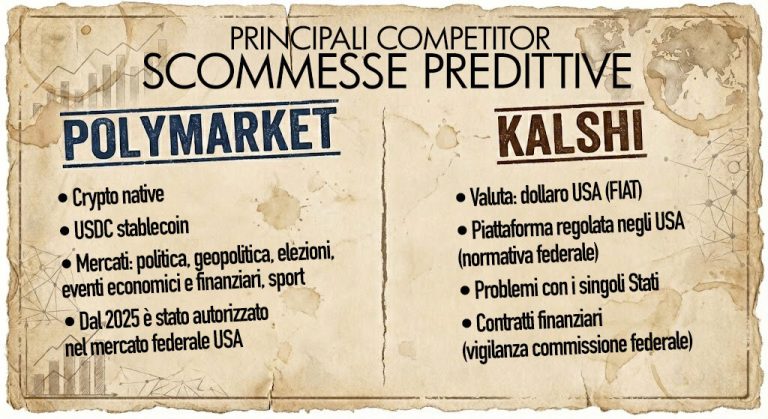
Polymarket — as you have gathered — is the American prediction market platform based on blockchain technology, founded in 2020 by Shayne Coplan with headquarters in New York City. Unlike traditional online bookmakers, Polymarket offers a decentralized prediction market where users can buy and sell shares (“shares”) related to the outcome of future events — from politics and the real economy, to sports, weather, and pop culture — using stablecoins (USDC) on the Polygon network, a scaling layer of Ethereum.
Polymarket’s operational structure is inherently decentralized and crypto-native, with transactions on the markets occurring on-chain and share prices reflecting the implicit probability of outcomes based on the “wisdom of crowds”. Users buy “Yes” or “No” positions, and if the outcome is correct, each share resolves to $1 USDC, while incorrect ones expire at zero — a mechanism similar to a binary contract that serves as a real-time probability signal.
Polymarket has attracted significant institutional investment, including a deal with Intercontinental Exchange (ICE) — owner of the New York Stock Exchange — which brought a commitment of up to $2 billion, valuing the platform at around $8 billion and marking one of the largest endorsements from a traditional financial institution in the prediction market sector.
Regulators and markets, however, have represented a complex terrain: after an initial agreement with the CFTC in 2022 that limited access for US users due to registration issues, Polymarket has taken steps towards regulatory compliance by acquiring a licensed derivatives exchange (QCEX) to fully re-enter the US market and expand its reach into regulated markets.
In summary, Polymarket positions itself as the world’s largest blockchain-based prediction market, combining Web3 technology, crypto liquidity, and collective market signals to transform future events into tradable assets, but always operating on the edge between financial innovation and global regulatory complexity.
The currency that holds everything together is USD Coin (USDC), a stablecoin pegged to the US dollar. It is the silent fuel of the platform: deposit, medium of exchange, and settlement instrument. Every contract goes through it, as if it were a digital dollar flowing faster and without intermediaries. The technical infrastructure relies on networks like Polygon, chosen for its low costs and execution speed: fundamental characteristics when the market needs to react in real time to breaking news or election results.
Everything works through smart contracts. No discretion, no cash. If the event occurs, payment is automatic. A binary logic, almost mathematical: yes or no. 1 or 0. It is this simplicity that makes Polymarket global and immediate, capable of attracting users from all over the world, even if not all jurisdictions look upon it favorably. Some countries and several US states, as well as stricter regulatory markets like France, the UK, or Singapore, limit or block direct access, reminding us that the line between financial prediction and betting remains politically very sensitive.
The real breakthrough, however, is not technological. It is regulatory, as we have just mentioned. In 2022, Polymarket had to close its doors to US users after an intervention by the Commodity Futures Trading Commission, which contested its operation without registration. Fine, forced stop, exit from the richest market in the world. For a platform born in the USA, it was almost an exile.
Politics in the USA influences everything, even business and justice. The President has — among his powers — significant influence (with ad hoc appointments) over the federal Attorneys General of the Department of Justice, and under the Biden administration, Polymarket did not fare well. In 2024, an FBI raid under a warrant from the DOJ itself destabilized the company.
Fortunately for the platform, in July 2025, the Department of Justice (DOJ) and the Commodity Futures Trading Commission (CFTC) officially closed the civil and criminal investigations into the company without proceeding with further charges.
The investigations were initiated after Polymarket received a visit from the FBI in 2024 and underwent searches for suspected continued acceptance of bets from US users, despite the previous agreement with the CFTC in 2022 which had required it to cease operations in the USA and pay a $1.4 million fine for operating as a derivatives market without registration.
The core of the accusation was that Polymarket had violated that agreement by continuing to access the US market — a potential infraction both civilly and criminally.
With the Trump administration, the wind changed. In the summer of 2025, both the DOJ and the CFTC notified Polymarket of the closure of their respective investigations and the decision not to file further charges. This was a significant turn of events, especially considering that one of the investigations also included a criminal component.
The authorities did not release details on the outcome of the investigations or the specific reasons for the decision, but the epilogue marked the end of months of regulatory uncertainty for the company.
The closure of the investigations came at a time of strong growth for the platform and regulatory change in the prediction market sector.
Not long after, Polymarket concluded the acquisition of the US derivatives exchange and clearinghouse QCX for approximately $112 million — a fundamental strategic move to re-enter the US market in compliance with CFTC regulations.
In fact, Polymarket not only avoided criminal or civil charges but is now on the path to re-establishing its presence in the USA in a more rigorous and formally approved regulatory context.
Three years later, the return. In November 2025, the CFTC granted Polymarket formal approval, an Amended Order of Designation that allows it to re-enter the United States as a regulated operator. No longer a gray area, no longer offshore. But the same legal perimeter as US derivatives exchanges. In practice, Polymarket can operate as a true exchange, offering trading to US users through authorized intermediaries, traditional brokers, and futures commission merchants. In 2026, Polymarket is in a due diligence phase in the USA.
This is a step that changes perception even more than numbers. Because it means institutional legitimacy.
To get there, the company chose a strategic shortcut: the acquisition — as we recalled — of QCX LLC, an exchange and clearinghouse already holding a CFTC license. By buying the regulated infrastructure, Polymarket also bought the legal basis to operate in the United States. A textbook finance operation, rather than a crypto startup.
Since then, the project has changed its skin. Strengthened compliance systems, internal supervision, clearing, regulatory reporting: everything needed to speak the language of federal authorities. The goal is clear: to transform a market born on the fringes into an infrastructure capable of dialoguing with Wall Street.
The implications go beyond the single company. Polymarket’s return signals growing acceptance of prediction markets by US regulators and suggests a possible increase in the sector’s overall liquidity. More legal certainty, less reputational risk, more institutional capital. In other words: more volumes.
Now, the final stretch remains, the operational one. Before regulated trading is fully active, Polymarket will have to complete integration with US intermediaries and define precise procedures for mediated user access. But the direction is set.
From a frontier platform to a recognized financial infrastructure.
And for a market that sells probabilities about the future, it is perhaps the most important prediction of all.
Polymarket is considered one of the leading global prediction markets with a crypto-native approach.
Currency/Asset used:
➡️ USD Coin (USDC), a stablecoin pegged to the US dollar. Users buy and sell contracts using USDC as a deposit and settlement medium, with technical scaffolding on networks like Polygon. After three years of suspension, Polymarket was authorized in 2025 to re-enter the official US market.
Key features:
👉 Polymarket continues to operate with stablecoins (USDC) as the “base currency” for international predictive contracts.
Polymarket obtained, in November 2025, CFTC approval for a regulated return to the US market (U.S. Commodity Futures Trading Commission). It had blocked access to US users in 2022 after a regulatory action and a fine from the CFTC for operating as a derivatives market without registration.
✅ After three years, the CFTC issued an Amended Order of Designation allowing Polymarket to:
Why this step is important
🔹 The approval allows Polymarket to operate under the same regulatory framework as US exchanges (at the federal level, but we will see the problems encountered in individual states)
🔹 US users will be able to access prediction markets through regulated channels (no longer just offshore).
🔹 The platform has already enhanced its compliance, supervision, clearing, and regulatory reporting systems to meet the required standards.
How it got there
➡️ Polymarket acquired QCX LLC, a CFTC-licensed derivatives exchange and clearinghouse, thus providing the legal basis to operate in the US market.
Broader implications
👉 The move signals greater regulatory acceptance of prediction markets in the USA (undoubtedly Trump’s election facilitated this process).
👉 Potential increase in trading volume in the sector compared to the previous situation.
👉 Polymarket’s return contributes to pushing prediction markets into the traditional financial ecosystem.
Next steps
⏳ Before regulated trading becomes fully active, Polymarket must:
Kalshi is a fully regulated predictive contract exchange by the Commodity Futures Trading Commission (CFTC) in the United States, becoming one of the most important compliant infrastructure exchanges for institutional and retail traders.
Kalshi, Inc. is a US prediction market platform founded in 2018 by Tarek Mansour and Luana Lopes Lara, two former financial analysts who met at MIT (Massachusetts Institute of Technology). Today it is headquartered in New York City and is a private company with a market valuation of approximately $11 billion after a $1 billion funding round, with investors including Sequoia Capital, Paradigm, Y Combinator, and asset managers like Charles Schwab and Henry Kravis.
Kalshi is not a normal betting site: its offering is based on “event contracts”, financial contracts that allow users to buy/sell predictions on the outcome of real events — from climate and economic data, to politics, as well as sports and legislative results — with the contract price reflecting the market’s perceived probability. Unlike traditional bookmakers, Kalshi does not bet against the user but acts as an organized market where buyers and sellers meet, and it earns profits through transaction commissions.
The company operates as a regulated exchange in the United States under the authority of the Commodity Futures Trading Commission (CFTC), which in 2020 approved Kalshi as a Designated Contract Market — the first platform of its kind to obtain this federal recognition for predictive markets. This status allows it to offer tradable events, but it also entails legal challenges with individual states (especially when Kalshi began offering markets on sports results), because some state regulators believe that certain contracts constitute actual unauthorized sports betting.
In summary, Kalshi is seeking to redefine the boundary between predictive finance and regulated gaming, attracting both institutional liquidity and the attention of regulators, and positioning itself as a global market infrastructure for trading in advance on the outcome of real events.
The currency used by Kalshi ➡️ USD fiat — the main market is in US dollars.
Kalshi also allows deposits via stablecoins or cryptocurrencies in some cases, but these are automatically converted to USD before absorbing trading contracts.
Fiat currency means, from Latin, both made (by decree). When we talk about fiat currencies, we are talking about traditional currencies like the dollar, euro, yen, ruble, etc.
Key features:
👉 Although Kalshi may accept crypto deposits → USD, its core operation is tied to fiat currency markets, not native tokens or stablecoins as the primary market medium.
| Platform | Main Currency | Features | Typical User Type |
|---|---|---|---|
| Polymarket | USDC (stablecoin) | In transition, under CFTC compliance, decentralized structure | Global traders, crypto-native |
| Kalshi | USD (fiat) | CFTC regulated | Institutional / US retail traders |
| PredictIt | USD | It is a site focused on politics | Political bettors |
| Opinion.Trade | Crypto (e.g., BNB Chain token) | Decentralized | Crypto traders / dApp users |
| Crypto.com Markets | Crypto / stablecoin | Integrated exchange | Crypto Ecosystem |
✔️ The main prediction markets use a combination of currencies:
✔️ In the United States, it’s not that platforms have completely eliminated stablecoins, but Kalshi structures the use of cryptocurrencies as a gateway to convert them into fiat market, while Polymarket is trying to balance the use of stablecoins and regulatory compliance to fully re-enter the US market.
Within a few months, the advance of prediction markets (Kalshi, Polymarket, and the “event contracts” ecosystem) has forced the two giants of US betting — FanDuel (Flutter) and DraftKings — to make a choice: suffer competitors who bypass the state borders of traditional betting, or enter it with a proprietary product.
And the answer, today, is clear: they have entered it.
A stablecoin pegged to the dollar is, in essence, a digital dollar: a cryptocurrency designed to maintain a stable value (1 token = 1 USD) thanks to reserves in cash, government bonds, or liquid instruments held by the issuer. It is used to move money on the blockchain with the speed of crypto trading but with the stability of fiat currency, thus becoming the “cash” of digital markets, from payments to prediction markets. The most common are USDT (Tether), the queen for global volumes, USDC (Circle/Coinbase), perceived as more regulated and transparent in the US, and DAI, decentralized and collateralized on-chain. But their weight goes beyond finance: stablecoins have also become a geopolitical tool, as they effectively export the dollar outside the traditional banking system, allowing millions of people — and sometimes countries under sanctions or with weak currencies — to use “digital USD” without going through SWIFT or central banks. For Washington, it is monetary soft power; for regulators, it is also a systemic risk and a control issue: too many dollars circulating outside the banking perimeter mean fewer levers on capital, sanctions, and monetary policy. In short: fintech technology on the surface, but a struggle for economic sovereignty flows underneath.
The question on the minds of many keen observers is: “Are traditional bookmakers just watching while platforms operating (in most cases in markets not yet regulated) ‘eat up’ market share?”
In October 2025, the stock market crash of Flutter (owner of the leading US bookmaker Fanduel) and DraftKings sounded like an alarm bell.
Some stock market analysts were quick to draw a connection between the financial markets’ reaction and the new competition from Polymarket and its peers in sports.
There is also a significant detail, given that the decisive battle for the future of global betting is being fought in the USA (with substantial investments and strong “bets” and investments from Wall Street).
In important states (like California), betting is not legally permitted, but with the loophole of “financial” derivative contracts (recognized at the federal level), Polymarket and Kalshi are effectively collecting bets where no other betting operator is allowed. In the long run, this gap risks becoming insurmountable.
Other observers, however, attributed the causes to the negative results recorded by the house in the NFL (National Football League) in the last quarter, with many favored teams winning. Certainly, the unfavorable payout did not help the big players.
It’s difficult to give definitive answers, but one thing is certain: since then, the two main US bookmakers have announced that they are entering the predictive betting market with their own proprietary platforms.
FanDuel and DraftKings decided to move at that moment.
As I said, event contracts — framed as federally regulated derivatives/contracts — have allowed prediction markets to offer “bets” on sports and events even in states where online sports betting is not legal (California and Texas are among the wealthiest and most populous states). This has created a new competitive front and a jurisdiction war between federal regulation and state authorities.
Initially, prediction market platforms only offered binary options (yes or no, for example), but since 2025, they have introduced multiple options, including for sports, effectively becoming true betting platforms, but unregulated or operating in gray markets, thus having a competitive advantage.
When this step was taken, especially by financial exchanges — as I anticipated — Wall Street reacted negatively and also penalized stocks related to traditional betting, such as Flutter.
Precisely for this reason, the two main US bookmakers, Fanduel (owned by Flutter) and DraftKings, have adapted and are launching their own platforms.
FanDuel has not copied the Polymarket model: it has chosen a hyper-institutional path. At the end of December 2025, FanDuel and CME Group announced the launch of FanDuel Predicts, with an initial rollout in some states, under the umbrella of the federal financial derivatives oversight commission.
In the press release (and in the first public details), the approach is very clear: contracts on financial benchmarks (like stock indices and commodities) and economic indicators, in addition to the “event-based” perimeter. It is a way to:
When FanDuel decided to launch FanDuel Predicts, it didn’t just add a new feature to its app. It did something more subtle, and potentially more disruptive: it tried to shift the cultural boundary between betting and finance. For years, online betting has been presented as entertainment, adrenaline, cheering. Here, however, the grammar changes. You no longer bet on a match: you trade probabilities, buy scenarios, sell expectations. It’s the lexicon of markets, not betting slips. The collaboration with CME Group, the Chicago derivatives giant, is not a technical detail but a political manifesto: it means telling investors and regulators that these contracts resemble simplified futures more than bar bets. And indeed, the regulatory umbrella is not that of state gambling, but that of the federal Commodity Futures Trading Commission, the same authority that oversees commodities and financial markets. Inside FanDuel Predicts, you will find binary markets, yes or no, which can concern the outcome of a match but also the trend of the S&P 500, inflation, the price of oil. It is a silent mutation: the sportsbook becomes a small popular stock exchange, accessible from a smartphone, where the user is not just a fan but a micro-trader. And above all, it is a strategic move to circumvent the fragmented geography of US betting laws: where sports betting is still prohibited, federally regulated event contracts can still pass. Thus, FanDuel not only expands its offering but the very perimeter of the market, intercepting an audience that is not looking for stadium thrills, but for tools to monetize opinions about the world. If prediction markets truly become a new asset class, FanDuel Predicts is the signal that Wall Street and Las Vegas have stopped looking at each other with suspicion and have discreetly started talking to each other.
CME Group is a leading US global derivatives market company, operating major exchanges such as the Chicago Mercantile Exchange (CME), Chicago Board of Trade (CBOT), New York Mercantile Exchange (NYMEX), and COMEX. Through these platforms, it offers trading in futures and options on a wide range of assets — from interest rates and stock indices to currencies, commodities, and energy — enabling institutional investors and traders worldwide to manage risk, hedge positions, and access global benchmarks in financial markets.
DraftKings opted for the intermediary route with its own app. The well-known bookmaker officially entered prediction markets on December 19, 2025 with DraftKings Predictions, explaining that the operation is carried out through a subsidiary registered as an Introducing Broker and NFA member (National Futures Association), and is available in 38 states (including major markets).
For DraftKings, the value is twofold:
It is no coincidence that, as early as 2025, CEO Jason Robins openly spoke about the opportunity in “non-sports-betting states“.
Ultimately, setting aside the dust kicked up by tweets, stock market alarms, and regulatory anxieties, a rather American truth remains: prediction markets make a lot of noise, but little real damage. At least for now.
According to a report released by Citizens Equity Research, prediction markets have diverted about 5% of the regulated gaming volume from traditional bookmakers. Translated into dollars: about $8 billion per year. A figure that seems impressive only until you remember that the handle — the volume of bets — is not revenue, is not margin, is not profit. It’s movement. Like highway traffic: it doesn’t say how much the toll booth earns.
The analysis is signed by Jordan Bender, who immediately gets to the point: that 5% is slightly higher than previously estimated, but it is not an event capable of changing the fundamentals of the sector. No hemorrhage, no systemic business theft.
From the companies’ perspective, says Bender, the impact is a wash, a break-even. DraftKings, FanDuel (and therefore the parent company Flutter Entertainment) are not losing sleep: they are already present, directly or indirectly, in the world of prediction markets. If the game changes form, they change tables.
Some more trouble might come for those who have remained on the sidelines: Bet365, BetMGM, Caesars, Penn Entertainment. But even here, in the analyst’s words, we are talking about “slightly negative” scenarios. Nothing structural, nothing that justifies hysterics.
An exception is Rush Street Interactive: little exposure to prediction markets, excellent stock performance in the last year, and a strategy more focused on iGaming, which offers a certain immunity. On the contrary, paradoxically, the company could even benefit from the phenomenon: if yes/no markets erode the tax revenue from sports betting, they could push more US states to legalize traditional iGaming. The usual America: you lose on one side, you gain on the other.
But if companies manage, players do not. And this is where the story changes tone.
Data shows that retail users of prediction markets burn through money faster than any other form of gambling. In the first 90 days of entering these platforms, the average loss is 7% of bets, compared to 1% recorded in the rest of the online gambling ecosystem.
The reason is simple and cruel: in prediction markets, ordinary players do not compete against the house, but against other players, often much more prepared. “Sharp” bettors — those with models, official data, sophisticated pricing — find an ideal ground here, especially since platforms like Kalshi actively incentivize them.
The damage is amplified by another detail: the average bet. In prediction markets, it exceeds $185, more than triple the average of $55 in regulated sportsbooks. Losing more, more often, and with higher stakes is a lethal combination.
Bender synthesizes it without poetry but effectively: prediction markets are creating worse losses for the worst players, while the more skilled ones win more. Furthermore, the odds are generally worse than traditional bookmakers. Throughout the 2025 NFL season, for example, the prices offered by Kalshi consistently proved less favorable than those of DraftKings and FanDuel.
So why all this panic in the financial markets?
According to the analyst, because the reaction was disproportionate. DraftKings and Flutter stocks lost 33% and 30% respectively from their 52-week highs, but the real impact of prediction markets does not justify such cannibalization even remotely.
To be clear: a single bad Monday Night Football game can have a negative impact on EBITDA equal to — or greater than — everything that prediction markets are currently subtracting from the sector. And in the long run, Bender adds, the expansion of legalized online sports betting will tend to further restrict the space for these alternative markets, simply by offering a better product.
Finally, the map. Not all of America is the same. According to Juice Reel data, Florida, Georgia, and Texas remain on the sidelines of this phenomenon. Leading the way are the usual suspects: New York, New Jersey, California, Washington, and Ohio.
Prediction markets are not the end of bookmakers, nor the beginning of a new golden age. They are a noisy, fascinating, often ruthless experiment for the less equipped. And as always, in the great American casino, the real losers are not those who play the game, but those who think they have understood the rules without ever having read them thoroughly.
In summary:
One thing is evident happening on Wall Street: investors are desperately seeking listed companies that have a connection — even indirect — with this new segment.
The problem concerns the big names in prediction markets, such as Kalshi and Polymarket, which remain private companies. Conversely, some listed companies orbiting the theme, such as Robinhood Markets, are highly diversified financial groups, not platforms dedicated to trading predictive contracts.
The same applies to betting operators like DraftKings and Flutter Entertainment: they are now entering the world of prediction markets, but it is likely that, at least in the short term, this activity will represent only a marginal fraction of their revenues.
In the USA, there is one stock that has caught investors’ attention: High Roller, a company that manages online casinos in Scandinavian markets and is based in Malta.
Investors’ hunger for opportunities in this sector also explains the recent enthusiasm around the High Roller stock. It is not a “pure” prediction market company, but it is one of the few listed companies that allow investors to get close to that world.
When a new idea meets the market, it often happens like this: first euphoria, then selection. The price rises, falls, settles. And in the end, as always, only one question remains: how much of that promise will actually become revenue?
2026 has only completed one month, and the High Roller stock has already given its investors a rollercoaster experience. At the beginning of the year, the price hovered around $2. Then, in a matter of days, the surge: almost $24. Today, the value has halved.
A large part of that rally is concentrated on a single date, January 14, when the stock recorded an incredible +688 percent. That day, High Roller announced a partnership on prediction markets with Crypto.com. From that moment on, many traders began to look at the company not just as a simple online casino operator, but as a possible indirect bet on the world of event contracts.
“We are excited to bring High Roller to the United States through this strategic partnership with Crypto.com,” said CEO Seth Young. “Combining the huge appeal of prediction markets with our distribution capabilities is an extremely exciting opportunity.”
High Roller manages the online casino brands High Roller and Fruta and went public on Wall Street in October 2024, after reducing the size of its initial public offering just a month earlier.
How much of prediction markets will actually enter High Roller’s accounts, and with what margins? Today, no one knows, but the investors’ interest in these stocks remains tangible.
1789 Capital Management, LLC is an American venture capital firm based in Palm Beach, Florida. Among its partners is Donald Trump Jr., son of the current President of the United States, who is actively involved in the fund’s management and strategies.
👉 Key features of 1789 Capital:
📍 1789 Capital and prediction markets
🚀 Investment in Polymarket:
1789 Capital made a multi-million dollar investment in Polymarket (in the order of “double-digit millions“, i.e., tens of millions), one of the world’s leading prediction markets, and at the same time Donald Trump Jr. joined the company’s advisory board.
📈 Role in Kalshi:
In parallel, Trump Jr. was appointed strategic advisor of Kalshi, the main competitor platform to Polymarket in the United States, although there is no direct investment from the 1789 Capital fund in Kalshi (at least according to publicly available information).
💡 Therefore, the link with both major operators of prediction markets — Polymarket and Kalshi — passes mainly through Donald Trump Jr. and his position in 1789 Capital, which invested in Polymarket and brought Trump Jr. as a key figure also to Kalshi.
📌 Why it is relevant
This link between a fund connected to the Trump family and the main prediction market operators has attracted attention for several reasons:
Prediction markets, due to the subject of their bets, open up an enormous potential risk for insider trading incidents. One of the most striking examples occurred with the arrest (for some observers, it is actually the kidnapping of a head of state) of Venezuelan President Nicolas Maduro.
On Polymarket, some accounts began betting on the blitz and arrest of Maduro a few hours before the secret operation by US special forces in the South American country began.
The fact is that, since the market on the potential capture of the Venezuelan president by January 31 was opened, the probabilities provided were very low. The event was judged improbable. But a few hours before the US special forces’ raid in Caracas, on Polymarket, the probabilities suddenly moved, and the event — quite suddenly and “unexpectedly” — became increasingly likely, while on other platforms everything remained unchanged.
The numbers speak for themselves and “predict” the future: an account created just a few hours earlier invested $30,000 and cashed out over $436,000. Not a stroke of luck, but seemingly a surgical operation, timed with a disquieting precision by some well-informed source. The witch hunt has also begun: some pointed fingers at officials close to Trump, while exponents close to the US administration accused Venezuelan insiders (did they know beforehand?).
That insider trading is one of the dangers of predictive betting markets is like discovering hot water, but after this episode, the red light has flashed.
One of the revealing details is the comparison with competing platforms like Kalshi, where probabilities remained low until the last moment, almost indifferent to the impending earthquake.
Two markets, two readings of reality. And an inevitable question: who knew what, and when?
It should also be noted: Kalshi treats the exchange of user predictions as financial instruments and is under the supervision of a federal agency, the Commodity Futures Trading Commission (CFTC), which oversees derivatives (as predictive markets are also treated by some states in the USA). Therefore, it is much more difficult to carry out operations that could arouse suspicion. The real risk is ending up in jail.
Polymarket is still in a regulatory limbo. At the moment, it operates in a sort of unregulated market, but it is close to federal commission CFTC supervision.
Among traders, opaque practices by some users are known: from “wash trading” to artificially inflate volumes, to suspiciously accurate bets on technological events, corporate decisions, and even updates to platform algorithms and search engines. Each time, the same shadow: the use of confidential information by some accounts, given that there is the problem — on most of these platforms — of anonymous accounts.
The Maduro case, however, raises the stakes. Here we are not talking about quarterly profits or product launches, but about a militarily explosive geopolitical operation and arrest that few knew about. This is the point where the market stops being a thermometer and risks becoming an insider club.
It is no coincidence that Democratic Representative Ritchie Torres has announced a new legislative proposal, the Public Integrity in Financial Prediction Markets Act of 2026, aimed at prohibiting or limiting the participation of public officials and political figures in these markets. The principle is simple: those with access to power should not be able to monetize advance knowledge of their decisions.
Prediction markets were born as transparency tools, capable — at least in theory — of predicting the future better than polls and traditional intelligence. But when the future becomes a source of income for a well-informed few, the line between prediction and manipulation becomes dangerously thin. And at that point, it is democracy, more than the market, that demands guarantees.
As we have seen, prediction markets (predictive markets) are markets where users buy and sell financial contracts that pay out based on the outcome of real events — such as political elections, economic results, sports, etc. — with the aim of translating the implicit probability of an event into prices. Let’s discover the main players, the most important platforms.
Polymarket — as you have gathered — is the American prediction market platform based on blockchain technology, founded in 2020 by Shayne Coplan with headquarters in New York City. Unlike traditional online bookmakers, Polymarket offers a decentralized prediction market where users can buy and sell shares (“shares”) related to the outcome of future events — from politics and the real economy, to sports, weather, and pop culture — using stablecoins (USDC) on the Polygon network, a scaling layer of Ethereum.
Polymarket’s operational structure is inherently decentralized and crypto-native, with transactions on the markets occurring on-chain and share prices reflecting the implicit probability of outcomes based on the “wisdom of crowds”. Users buy “Yes” or “No” positions, and if the outcome is correct, each share resolves to $1 USDC, while incorrect ones expire at zero — a mechanism similar to a binary contract that serves as a real-time probability signal.
Polymarket has attracted significant institutional investment, including a deal with Intercontinental Exchange (ICE) — owner of the New York Stock Exchange — which brought a commitment of up to $2 billion, valuing the platform at around $8 billion and marking one of the largest endorsements from a traditional financial institution in the prediction market sector.
Regulators and markets, however, have represented a complex terrain: after an initial agreement with the CFTC in 2022 that limited access for US users due to registration issues, Polymarket has taken steps towards regulatory compliance by acquiring a licensed derivatives exchange (QCEX) to fully re-enter the US market and expand its reach into regulated markets.
In summary, Polymarket positions itself as the world’s largest blockchain-based prediction market, combining Web3 technology, crypto liquidity, and collective market signals to transform future events into tradable assets, but always operating on the edge between financial innovation and global regulatory complexity.
The currency that holds everything together is USD Coin (USDC), a stablecoin pegged to the US dollar. It is the silent fuel of the platform: deposit, medium of exchange, and settlement instrument. Every contract goes through it, as if it were a digital dollar flowing faster and without intermediaries. The technical infrastructure relies on networks like Polygon, chosen for its low costs and execution speed: fundamental characteristics when the market needs to react in real time to breaking news or election results.
Everything works through smart contracts. No discretion, no cash. If the event occurs, payment is automatic. A binary logic, almost mathematical: yes or no. 1 or 0. It is this simplicity that makes Polymarket global and immediate, capable of attracting users from all over the world, even if not all jurisdictions look upon it favorably. Some countries and several US states, as well as stricter regulatory markets like France, the UK, or Singapore, limit or block direct access, reminding us that the line between financial prediction and betting remains politically very sensitive.
The real breakthrough, however, is not technological. It is regulatory, as we have just mentioned. In 2022, Polymarket had to close its doors to US users after an intervention by the Commodity Futures Trading Commission, which contested its operation without registration. Fine, forced stop, exit from the richest market in the world. For a platform born in the USA, it was almost an exile.
Politics in the USA influences everything, even business and justice. The President has — among his powers — significant influence (with ad hoc appointments) over the federal Attorneys General of the Department of Justice, and under the Biden administration, Polymarket did not fare well. In 2024, an FBI raid under a warrant from the DOJ itself destabilized the company.
Fortunately for the platform, in July 2025, the Department of Justice (DOJ) and the Commodity Futures Trading Commission (CFTC) officially closed the civil and criminal investigations into the company without proceeding with further charges.
The investigations were initiated after Polymarket received a visit from the FBI in 2024 and underwent searches for suspected continued acceptance of bets from US users, despite the previous agreement with the CFTC in 2022 which had required it to cease operations in the USA and pay a $1.4 million fine for operating as a derivatives market without registration.
The core of the accusation was that Polymarket had violated that agreement by continuing to access the US market — a potential infraction both civilly and criminally.
With the Trump administration, the wind changed. In the summer of 2025, both the DOJ and the CFTC notified Polymarket of the closure of their respective investigations and the decision not to file further charges. This was a significant turn of events, especially considering that one of the investigations also included a criminal component.
The authorities did not release details on the outcome of the investigations or the specific reasons for the decision, but the epilogue marked the end of months of regulatory uncertainty for the company.
The closure of the investigations came at a time of strong growth for the platform and regulatory change in the prediction market sector.
Not long after, Polymarket concluded the acquisition of the US derivatives exchange and clearinghouse QCX for approximately $112 million — a fundamental strategic move to re-enter the US market in compliance with CFTC regulations.
In fact, Polymarket not only avoided criminal or civil charges but is now on the path to re-establishing its presence in the USA in a more rigorous and formally approved regulatory context.
Three years later, the return. In November 2025, the CFTC granted Polymarket formal approval, an Amended Order of Designation that allows it to re-enter the United States as a regulated operator. No longer a gray area, no longer offshore. But the same legal perimeter as US derivatives exchanges. In practice, Polymarket can operate as a true exchange, offering trading to US users through authorized intermediaries, traditional brokers, and futures commission merchants. In 2026, Polymarket is in a due diligence phase in the USA.
This is a step that changes perception even more than numbers. Because it means institutional legitimacy.
To get there, the company chose a strategic shortcut: the acquisition — as we recalled — of QCX LLC, an exchange and clearinghouse already holding a CFTC license. By buying the regulated infrastructure, Polymarket also bought the legal basis to operate in the United States. A textbook finance operation, rather than a crypto startup.
Since then, the project has changed its skin. Strengthened compliance systems, internal supervision, clearing, regulatory reporting: everything needed to speak the language of federal authorities. The goal is clear: to transform a market born on the fringes into an infrastructure capable of dialoguing with Wall Street.
The implications go beyond the single company. Polymarket’s return signals growing acceptance of prediction markets by US regulators and suggests a possible increase in the sector’s overall liquidity. More legal certainty, less reputational risk, more institutional capital. In other words: more volumes.
Now, the final stretch remains, the operational one. Before regulated trading is fully active, Polymarket will have to complete integration with US intermediaries and define precise procedures for mediated user access. But the direction is set.
From a frontier platform to a recognized financial infrastructure.
And for a market that sells probabilities about the future, it is perhaps the most important prediction of all.
Polymarket is considered one of the leading global prediction markets with a crypto-native approach.
Currency/Asset used:
➡️ USD Coin (USDC), a stablecoin pegged to the US dollar. Users buy and sell contracts using USDC as a deposit and settlement medium, with technical scaffolding on networks like Polygon. After three years of suspension, Polymarket was authorized in 2025 to re-enter the official US market.
Key features:
👉 Polymarket continues to operate with stablecoins (USDC) as the “base currency” for international predictive contracts.
Polymarket obtained, in November 2025, CFTC approval for a regulated return to the US market (U.S. Commodity Futures Trading Commission). It had blocked access to US users in 2022 after a regulatory action and a fine from the CFTC for operating as a derivatives market without registration.
✅ After three years, the CFTC issued an Amended Order of Designation allowing Polymarket to:
Why this step is important
🔹 The approval allows Polymarket to operate under the same regulatory framework as US exchanges (at the federal level, but we will see the problems encountered in individual states)
🔹 US users will be able to access prediction markets through regulated channels (no longer just offshore).
🔹 The platform has already enhanced its compliance, supervision, clearing, and regulatory reporting systems to meet the required standards.
How it got there
➡️ Polymarket acquired QCX LLC, a CFTC-licensed derivatives exchange and clearinghouse, thus providing the legal basis to operate in the US market.
Broader implications
👉 The move signals greater regulatory acceptance of prediction markets in the USA (undoubtedly Trump’s election facilitated this process).
👉 Potential increase in trading volume in the sector compared to the previous situation.
👉 Polymarket’s return contributes to pushing prediction markets into the traditional financial ecosystem.
Next steps
⏳ Before regulated trading becomes fully active, Polymarket must:
Kalshi is a fully regulated predictive contract exchange by the Commodity Futures Trading Commission (CFTC) in the United States, becoming one of the most important compliant infrastructure exchanges for institutional and retail traders.
Kalshi, Inc. is a US prediction market platform founded in 2018 by Tarek Mansour and Luana Lopes Lara, two former financial analysts who met at MIT (Massachusetts Institute of Technology). Today it is headquartered in New York City and is a private company with a market valuation of approximately $11 billion after a $1 billion funding round, with investors including Sequoia Capital, Paradigm, Y Combinator, and asset managers like Charles Schwab and Henry Kravis.
Kalshi is not a normal betting site: its offering is based on “event contracts”, financial contracts that allow users to buy/sell predictions on the outcome of real events — from climate and economic data, to politics, as well as sports and legislative results — with the contract price reflecting the market’s perceived probability. Unlike traditional bookmakers, Kalshi does not bet against the user but acts as an organized market where buyers and sellers meet, and it earns profits through transaction commissions.
The company operates as a regulated exchange in the United States under the authority of the Commodity Futures Trading Commission (CFTC), which in 2020 approved Kalshi as a Designated Contract Market — the first platform of its kind to obtain this federal recognition for predictive markets. This status allows it to offer tradable events, but it also entails legal challenges with individual states (especially when Kalshi began offering markets on sports results), because some state regulators believe that certain contracts constitute actual unauthorized sports betting.
In summary, Kalshi is seeking to redefine the boundary between predictive finance and regulated gaming, attracting both institutional liquidity and the attention of regulators, and positioning itself as a global market infrastructure for trading in advance on the outcome of real events.
The currency used by Kalshi ➡️ USD fiat — the main market is in US dollars.
Kalshi also allows deposits via stablecoins or cryptocurrencies in some cases, but these are automatically converted to USD before absorbing trading contracts.
Fiat currency means, from Latin, both made (by decree). When we talk about fiat currencies, we are talking about traditional currencies like the dollar, euro, yen, ruble, etc.
Key features:
👉 Although Kalshi may accept crypto deposits → USD, its core operation is tied to fiat currency markets, not native tokens or stablecoins as the primary market medium.
| Platform | Main Currency | Features | Typical User Type |
|---|---|---|---|
| Polymarket | USDC (stablecoin) | In transition, under CFTC compliance, decentralized structure | Global traders, crypto-native |
| Kalshi | USD (fiat) | CFTC regulated | Institutional / US retail traders |
| PredictIt | USD | It is a site focused on politics | Political bettors |
| Opinion.Trade | Crypto (e.g., BNB Chain token) | Decentralized | Crypto traders / dApp users |
| Crypto.com Markets | Crypto / stablecoin | Integrated exchange | Crypto Ecosystem |
✔️ The main prediction markets use a combination of currencies:
✔️ In the United States, it’s not that platforms have completely eliminated stablecoins, but Kalshi structures the use of cryptocurrencies as a gateway to convert them into fiat market, while Polymarket is trying to balance the use of stablecoins and regulatory compliance to fully re-enter the US market.
Within a few months, the advance of prediction markets (Kalshi, Polymarket, and the “event contracts” ecosystem) has forced the two giants of US betting — FanDuel (Flutter) and DraftKings — to make a choice: suffer competitors who bypass the state borders of traditional betting, or enter it with a proprietary product.
And the answer, today, is clear: they have entered it.
A stablecoin pegged to the dollar is, in essence, a digital dollar: a cryptocurrency designed to maintain a stable value (1 token = 1 USD) thanks to reserves in cash, government bonds, or liquid instruments held by the issuer. It is used to move money on the blockchain with the speed of crypto trading but with the stability of fiat currency, thus becoming the “cash” of digital markets, from payments to prediction markets. The most common are USDT (Tether), the queen for global volumes, USDC (Circle/Coinbase), perceived as more regulated and transparent in the US, and DAI, decentralized and collateralized on-chain. But their weight goes beyond finance: stablecoins have also become a geopolitical tool, as they effectively export the dollar outside the traditional banking system, allowing millions of people — and sometimes countries under sanctions or with weak currencies — to use “digital USD” without going through SWIFT or central banks. For Washington, it is monetary soft power; for regulators, it is also a systemic risk and a control issue: too many dollars circulating outside the banking perimeter mean fewer levers on capital, sanctions, and monetary policy. In short: fintech technology on the surface, but a struggle for economic sovereignty flows underneath.
The question on the minds of many keen observers is: “Are traditional bookmakers just watching while platforms operating (in most cases in markets not yet regulated) ‘eat up’ market share?”
In October 2025, the stock market crash of Flutter (owner of the leading US bookmaker Fanduel) and DraftKings sounded like an alarm bell.
Some stock market analysts were quick to draw a connection between the financial markets’ reaction and the new competition from Polymarket and its peers in sports.
There is also a significant detail, given that the decisive battle for the future of global betting is being fought in the USA (with substantial investments and strong “bets” and investments from Wall Street).
In important states (like California), betting is not legally permitted, but with the loophole of “financial” derivative contracts (recognized at the federal level), Polymarket and Kalshi are effectively collecting bets where no other betting operator is allowed. In the long run, this gap risks becoming insurmountable.
Other observers, however, attributed the causes to the negative results recorded by the house in the NFL (National Football League) in the last quarter, with many favored teams winning. Certainly, the unfavorable payout did not help the big players.
It’s difficult to give definitive answers, but one thing is certain: since then, the two main US bookmakers have announced that they are entering the predictive betting market with their own proprietary platforms.
FanDuel and DraftKings decided to move at that moment.
As I said, event contracts — framed as federally regulated derivatives/contracts — have allowed prediction markets to offer “bets” on sports and events even in states where online sports betting is not legal (California and Texas are among the wealthiest and most populous states). This has created a new competitive front and a jurisdiction war between federal regulation and state authorities.
Initially, prediction market platforms only offered binary options (yes or no, for example), but since 2025, they have introduced multiple options, including for sports, effectively becoming true betting platforms, but unregulated or operating in gray markets, thus having a competitive advantage.
When this step was taken, especially by financial exchanges — as I anticipated — Wall Street reacted negatively and also penalized stocks related to traditional betting, such as Flutter.
Precisely for this reason, the two main US bookmakers, Fanduel (owned by Flutter) and DraftKings, have adapted and are launching their own platforms.
FanDuel has not copied the Polymarket model: it has chosen a hyper-institutional path. At the end of December 2025, FanDuel and CME Group announced the launch of FanDuel Predicts, with an initial rollout in some states, under the umbrella of the federal financial derivatives oversight commission.
In the press release (and in the first public details), the approach is very clear: contracts on financial benchmarks (like stock indices and commodities) and economic indicators, in addition to the “event-based” perimeter. It is a way to:
When FanDuel decided to launch FanDuel Predicts, it didn’t just add a new feature to its app. It did something more subtle, and potentially more disruptive: it tried to shift the cultural boundary between betting and finance. For years, online betting has been presented as entertainment, adrenaline, cheering. Here, however, the grammar changes. You no longer bet on a match: you trade probabilities, buy scenarios, sell expectations. It’s the lexicon of markets, not betting slips. The collaboration with CME Group, the Chicago derivatives giant, is not a technical detail but a political manifesto: it means telling investors and regulators that these contracts resemble simplified futures more than bar bets. And indeed, the regulatory umbrella is not that of state gambling, but that of the federal Commodity Futures Trading Commission, the same authority that oversees commodities and financial markets. Inside FanDuel Predicts, you will find binary markets, yes or no, which can concern the outcome of a match but also the trend of the S&P 500, inflation, the price of oil. It is a silent mutation: the sportsbook becomes a small popular stock exchange, accessible from a smartphone, where the user is not just a fan but a micro-trader. And above all, it is a strategic move to circumvent the fragmented geography of US betting laws: where sports betting is still prohibited, federally regulated event contracts can still pass. Thus, FanDuel not only expands its offering but the very perimeter of the market, intercepting an audience that is not looking for stadium thrills, but for tools to monetize opinions about the world. If prediction markets truly become a new asset class, FanDuel Predicts is the signal that Wall Street and Las Vegas have stopped looking at each other with suspicion and have discreetly started talking to each other.
CME Group is a leading US global derivatives market company, operating major exchanges such as the Chicago Mercantile Exchange (CME), Chicago Board of Trade (CBOT), New York Mercantile Exchange (NYMEX), and COMEX. Through these platforms, it offers trading in futures and options on a wide range of assets — from interest rates and stock indices to currencies, commodities, and energy — enabling institutional investors and traders worldwide to manage risk, hedge positions, and access global benchmarks in financial markets.
DraftKings opted for the intermediary route with its own app. The well-known bookmaker officially entered prediction markets on December 19, 2025 with DraftKings Predictions, explaining that the operation is carried out through a subsidiary registered as an Introducing Broker and NFA member (National Futures Association), and is available in 38 states (including major markets).
For DraftKings, the value is twofold:
It is no coincidence that, as early as 2025, CEO Jason Robins openly spoke about the opportunity in “non-sports-betting states“.
Ultimately, setting aside the dust kicked up by tweets, stock market alarms, and regulatory anxieties, a rather American truth remains: prediction markets make a lot of noise, but little real damage. At least for now.
According to a report released by Citizens Equity Research, prediction markets have diverted about 5% of the regulated gaming volume from traditional bookmakers. Translated into dollars: about $8 billion per year. A figure that seems impressive only until you remember that the handle — the volume of bets — is not revenue, is not margin, is not profit. It’s movement. Like highway traffic: it doesn’t say how much the toll booth earns.
The analysis is signed by Jordan Bender, who immediately gets to the point: that 5% is slightly higher than previously estimated, but it is not an event capable of changing the fundamentals of the sector. No hemorrhage, no systemic business theft.
From the companies’ perspective, says Bender, the impact is a wash, a break-even. DraftKings, FanDuel (and therefore the parent company Flutter Entertainment) are not losing sleep: they are already present, directly or indirectly, in the world of prediction markets. If the game changes form, they change tables.
Some more trouble might come for those who have remained on the sidelines: Bet365, BetMGM, Caesars, Penn Entertainment. But even here, in the analyst’s words, we are talking about “slightly negative” scenarios. Nothing structural, nothing that justifies hysterics.
An exception is Rush Street Interactive: little exposure to prediction markets, excellent stock performance in the last year, and a strategy more focused on iGaming, which offers a certain immunity. On the contrary, paradoxically, the company could even benefit from the phenomenon: if yes/no markets erode the tax revenue from sports betting, they could push more US states to legalize traditional iGaming. The usual America: you lose on one side, you gain on the other.
But if companies manage, players do not. And this is where the story changes tone.
Data shows that retail users of prediction markets burn through money faster than any other form of gambling. In the first 90 days of entering these platforms, the average loss is 7% of bets, compared to 1% recorded in the rest of the online gambling ecosystem.
The reason is simple and cruel: in prediction markets, ordinary players do not compete against the house, but against other players, often much more prepared. “Sharp” bettors — those with models, official data, sophisticated pricing — find an ideal ground here, especially since platforms like Kalshi actively incentivize them.
The damage is amplified by another detail: the average bet. In prediction markets, it exceeds $185, more than triple the average of $55 in regulated sportsbooks. Losing more, more often, and with higher stakes is a lethal combination.
Bender synthesizes it without poetry but effectively: prediction markets are creating worse losses for the worst players, while the more skilled ones win more. Furthermore, the odds are generally worse than traditional bookmakers. Throughout the 2025 NFL season, for example, the prices offered by Kalshi consistently proved less favorable than those of DraftKings and FanDuel.
So why all this panic in the financial markets?
According to the analyst, because the reaction was disproportionate. DraftKings and Flutter stocks lost 33% and 30% respectively from their 52-week highs, but the real impact of prediction markets does not justify such cannibalization even remotely.
To be clear: a single bad Monday Night Football game can have a negative impact on EBITDA equal to — or greater than — everything that prediction markets are currently subtracting from the sector. And in the long run, Bender adds, the expansion of legalized online sports betting will tend to further restrict the space for these alternative markets, simply by offering a better product.
Finally, the map. Not all of America is the same. According to Juice Reel data, Florida, Georgia, and Texas remain on the sidelines of this phenomenon. Leading the way are the usual suspects: New York, New Jersey, California, Washington, and Ohio.
Prediction markets are not the end of bookmakers, nor the beginning of a new golden age. They are a noisy, fascinating, often ruthless experiment for the less equipped. And as always, in the great American casino, the real losers are not those who play the game, but those who think they have understood the rules without ever having read them thoroughly.
In summary:
One thing is evident happening on Wall Street: investors are desperately seeking listed companies that have a connection — even indirect — with this new segment.
The problem concerns the big names in prediction markets, such as Kalshi and Polymarket, which remain private companies. Conversely, some listed companies orbiting the theme, such as Robinhood Markets, are highly diversified financial groups, not platforms dedicated to trading predictive contracts.
The same applies to betting operators like DraftKings and Flutter Entertainment: they are now entering the world of prediction markets, but it is likely that, at least in the short term, this activity will represent only a marginal fraction of their revenues.
In the USA, there is one stock that has caught investors’ attention: High Roller, a company that manages online casinos in Scandinavian markets and is based in Malta.
Investors’ hunger for opportunities in this sector also explains the recent enthusiasm around the High Roller stock. It is not a “pure” prediction market company, but it is one of the few listed companies that allow investors to get close to that world.
When a new idea meets the market, it often happens like this: first euphoria, then selection. The price rises, falls, settles. And in the end, as always, only one question remains: how much of that promise will actually become revenue?
2026 has only completed one month, and the High Roller stock has already given its investors a rollercoaster experience. At the beginning of the year, the price hovered around $2. Then, in a matter of days, the surge: almost $24. Today, the value has halved.
A large part of that rally is concentrated on a single date, January 14, when the stock recorded an incredible +688 percent. That day, High Roller announced a partnership on prediction markets with Crypto.com. From that moment on, many traders began to look at the company not just as a simple online casino operator, but as a possible indirect bet on the world of event contracts.
“We are excited to bring High Roller to the United States through this strategic partnership with Crypto.com,” said CEO Seth Young. “Combining the huge appeal of prediction markets with our distribution capabilities is an extremely exciting opportunity.”
High Roller manages the online casino brands High Roller and Fruta and went public on Wall Street in October 2024, after reducing the size of its initial public offering just a month earlier.
How much of prediction markets will actually enter High Roller’s accounts, and with what margins? Today, no one knows, but the investors’ interest in these stocks remains tangible.
When will the war in Ukraine end? Will the United States return to bombing Iran? Will the dollar continue to devalue against other currencies or appreciate? Will Bitcoin continue its descent? Until yesterday, these were questions for analysts, diplomats, generals. Or for fortune tellers. Today, however, they have become odds expressed in percentage probabilities.
Read also: Bodo Glimt-Inter Prediction: first knockout match in Champions League, Goal-Goal on the odds
Numbers that rise and fall in real time, like on Wall Street. Percentages that measure the odds of a geopolitical crisis, a military turning point, a currency shock. We are not talking about fantasy politics, but about real money — or almost — changing hands. About traders operating on these exchanges, dealing in the most diverse commodities.
Welcome to the era of prediction markets: platforms where the future is bought and sold. Where a war is worth as much as a Champions League final (forgive the stretch). Where a White House decision is traded like a tech stock. Where traders, bettors, and investors speculate on world events with the same naturalness with which they bet on a derby.
It is the meeting point — and clash — between finance and gambling, between information and speculation, between democracy and regulators. Because if the future becomes a market, then the question is no longer “who will win?”, but “who will control the house?”.
And here the real game begins: the one about rules, and Assopoker will reveal to you in absolute preview and exclusivity the current regulatory and jurisprudential framework of the market in Italy following the appeal to the TAR Lazio, with the provisions of the regional administrative judges, the revocation of a prohibition measure by the Customs and Monopolies Agency following the appeal by Polymarket, one of the world’s leading platforms. Furthermore, in exclusive, we interviewed the authoritative lawyer of the US company, Attorney Roberto Cursano, who revealed all the details of the matter and outlined some scenarios on what the future regulatory framework for prediction markets in our country could be.
Not only that: Assopoker will provide you with a complete overview of the global market, an analysis of the various regulatory frameworks in the main European countries, and federal and state regulation in the USA, where these new instruments were born.
To truly understand what we are talking about, you need to forget the old mental categories that clearly separate investment from betting. You need to accept “hybridization”.
Predictive betting markets, or predictive markets (prediction markets), are technically exchange platforms. Virtual places where users buy and sell contracts linked to the future outcome of real events: politics, sports, economy, current affairs, pop culture.
The idea is radical but linear: to transform every divergence of opinion into a market price. As the CEO of Kalshi, Tarek Mansour, said without mincing words in a recent interview that caused a stir: the goal is to “financialize everything”.
Not for fun. But to create higher quality information. What until a few years ago was an academic niche laboratory or an experiment for a few insiders — often associated with the crypto world or the most speculative areas of the markets — has today become a global infrastructure capable of moving billions of dollars every month.
On Polymarket you can bet on the fate of a political regime, on Oscar nominations, on how many times the Fed will cut rates or how many degrees it will be tomorrow in New York. In the USA, you can even bet on the dismissal of top managers or people holding prestigious positions in listed companies (opening, as we will see later, significant ethical and legal chasms).
The platforms were initially born as a sort of 2.0 information sites, functional for conducting more accurate political polls than telephone surveys. It is no coincidence that the Trump family showed early interest and invested in this sector, both in Polymarket and Kalshi, at least indirectly through “friendly” funds and venture capital linked to the conservative sphere.
The fundamental difference compared to classic polls is only one, but it weighs like a ton of bricks: in polls, people answer for free, often distractedly or by lying for “social desirability” (perhaps ashamed to admit an extreme vote). Here they bet their own money. They have “skin in the game”. And when there is money on the table, the result tends to be terribly more honest and credible.
The heart of the system is the pricing mechanism. In a predictive bet, you don’t just say “in my opinion, team A wins”. You bet on the real probability that that event will happen.
The operation is identical to that of Betting Exchange (like Betfair), but with a substantial visual difference that changes the user’s perception: prices are not defined in decimal odds (e.g., 1.50, 3.00), but in percentage probabilities (e.g., 66%, 33%).
It almost always works in a binary way, or at least that’s how the standard model was born: Yes/No. Above/Below. It will happen/It will not happen.
Let’s take a standard contract. The final value is fixed and predetermined: 1 dollar (or 1 euro, or 1 USDC stablecoin) if the event occurs. Zero if it does not occur.
In between, there is the market. The price fluctuates between 0 and 100 cents based on the meeting of supply and demand.
If a contract on “Trump President in 2028” is traded at 40 cents, the market is collectively saying that there is a 40% probability that it will happen.
If you buy at 40 cents and the event occurs, the contract expires at 1 dollar: you have earned 60 cents net (minus platform commissions). If the event does not occur, the contract is worth zero: you have lost your 40 cents.
But be careful: it is not a static system where you wait for expiration. Just like a stock, you can resell that contract in a minute, a day, or a month, if the price has gone up. If Trump’s chances of winning rise to 60% (and therefore the price reaches 60 cents) following a favorable poll or news, you can sell and cash in the profit without waiting for the elections. It’s pure trading on the volatility of opinions.
In the second half of 2025, there was a further technical evolution: in addition to the simple binary system, the possibility of multiple options for each market arrived. No longer just black or white, but a scale of grays that makes the instrument even more similar to complex financial derivatives.
If the bet concerns the trend of the dollar, can it be considered a financial product? The doubt is legitimate. If the subject is a football match, it looks like a betting slip. And it is precisely on this structural ambiguity — bet or derivative? — that the legal battle of the century is being played out.
In the last twelve months, prediction markets have not remained a peripheral curiosity of fintech: they have transformed into a mass phenomenon in the United States and Western countries, a market that churns out tens of billions of dollars annually and which now ranks alongside a large-scale global bookmaker — but with a radically different soul, more akin to financial derivatives than betting slips.
According to a Forbes estimate, global volumes traded in 2025 reached approximately $44 billion, summing the activity of the main platforms like Kalshi and Polymarket (which uses a stablecoin), with impressive expansion compared to levels of just one year earlier.
And this is not a flash in the pan: the Financial Times* describes the growth as a veritable market explosion, going from less than $100 million in monthly volumes at the beginning of 2024 to over $13 billion per month towards the end of 2025, a pace that signals structural and no longer episodic liquidity.
Leading the charge is primarily Kalshi, the exchange regulated by the Commodity Futures Trading Commission of the United States, which in 2025 processed approximately $23.8 billion in volumes, with daily peaks in the order of hundreds of millions and records exceeding $700 million in a single trading day.
*Financial Times: December 2025 editorial (paid), titled “Betting on prediction markets has exploded over past two years”
But the figure that tells the true “economic weight” of this ecosystem is not the simple turnover, but the actual revenue from commissions: according to the latest estimates, Kalshi’s total fee revenue stands at around a few hundred million dollars (263 million to be precise) — a fraction of the volumes, certainly, but already comparable to the revenues of medium-sized traditional bookmakers.
According to a KPMG analysis, the contracts traded on prediction platforms are technically comparable to regulated binary derivatives rather than classic bets, and they are rewriting the boundary between finance and gambling, attracting the attention of professional traders, institutional investors, and historical gaming operators, while remaining a challenge for state and federal regulators.
In summary: what until a few years ago was a niche laboratory — often associated with the crypto world or the most speculative areas of the markets — is today a global infrastructure that moves tens of billions a year, with high growth potential and a direct impact on the competitive balance between bookmakers, financial exchanges, and traditional trading platforms.
These platforms also have another advantage: they do not have to cover the house, so they need less liquidity to operate in the betting market, just like Betfair Exchange, which is a traditional betting exchange born in the early 2000s. Prediction markets are — in fact — its evolution.
| Data | Value (2025) | Description / Note | Cited Source |
|---|---|---|---|
| Total Global Volume 2025 | $44 billion | Estimate of total volumes traded on the two main platforms in 2025 | Forbes: How Prediction Markets Actually Grew in 2025 |
| Kalshi Volume 2025 | $23.8 billion | Full-year trading volume with strong YoY growth | Kalshi data report (KuCoin) |
| Polymarket Volume 2025 | $21.5 billion (estimate) | Estimate of full-year volume for Polymarket | Forbes |
| Daily Volume Peak | $702 million | Maximum trading days recorded in January 2026 | Finance Magnates |
| Record Weekly Volume | $3.7 billion | Record weekly volumes on Dune data and aggregators | Yahoo Finance |
| Average Weekly Volume Kalshi | $307.6 million | Average weekly volume on Kalshi, strong QoQ growth | KuCoin |
| Trading Fee Revenue Kalshi 2025 | $263.5 million | Kalshi’s commission revenue in 2025 (with a focus on sports) | BJ21 report |
| Dominant Kalshi Market Share | >60 % | Kalshi holds the majority of global market volumes | Ledger |
| Kalshi YoY Volume Growth | +1108 % | Impressive annual growth compared to 2024 | KuCoin |
| Monthly Volume Trend End-2025 | $13 billion in one month | Total volume across all platforms in one month at the end of 2025 | Aggregated data and market reports: William Yasdick – The Block |
Some notes on how to interpret the table numbers:
Even in Europe, prediction markets tell the story of our time perfectly: fast, global, technological… and helpless against old, solid legal rules.
Anyone who thinks they can grow them without a regulatory framework is mistaken. After the US military operation that led to the removal of Nicolás Maduro, a flurry of geopolitical bets exploded on some platforms: when will the United States invade Venezuela? When will oil come under American control? Will Colombia be next?
Questions that would once have been confined to the corridors of think tanks or the editorial offices of major newspapers. Today they become tradable contracts.
Prediction markets almost always work in a binary way: yes/no, above/below (although in the second half of 2025 there was an evolution with the possibility of multiple options for each market).
On Polymarket you can bet on the fate of a political regime, on Oscar nominations, or on the maximum temperature in Toronto.
The idea is radical but linear: to transform every divergence of opinion into a price. As the CEO of Kalshi, Tarek Mansour, said without mincing words, “to financialize everything”. Not for fun, but to create information, at least in theory.
The numbers help to understand the scope of the phenomenon: according to industry analyses, the monthly volume traded on the main prediction markets has gone from 100 million to over 14 billion dollars in just over a year (from 2024 to 2025). This is not a fad: it is a growing infrastructure.
Here lies the cultural knot. Unlike traditional bookmakers, in prediction markets there is no “house” that wins against the player. You bet against other users or against a market maker. The platform collects commissions, it does not expose its balance sheet to the risk of the event. They are exchanges.
On a practical level, it is still a bet. But on an informational level, it is something different: a dynamic synthesis of collective expectations. The famous wisdom of crowds (the theory of the wisdom of crowds with the meeting of supply and demand in a market). It is no coincidence that major media outlets like CNN, CNBC, and Dow Jones have begun to use this data as indicators, on par with polls or financial spreads.
At the moment, they are considered gray markets that do not have complete regulation.
The issue is not whether these platforms are “good” or “bad”. As often happens, they are an accelerator. They make visible what was previously opaque: expectations, cynicism, intuitions, sometimes even dirty information. Ignoring or demonizing them will not make them disappear. Understanding them — and regulating them intelligently — is the only way to prevent them from becoming yet another financial wild west disguised as a game.
And perhaps there is a final paradox: never has the future been so uncertain. And never before has anyone tried to put a price on it.
It is not easy to find the right focus because these markets have a mix of intertwined components: they are bets, they have the functioning of an exchange (stock market) but they also have the structure of a financial contract (stipulated between two people who exchange bullish or bearish predictions, for example). If the bet concerns the trend of the dollar, can it be considered a financial derivative product? The doubt is legitimate.
To further complicate the picture, these bets deal with all possible subjects: from sports to politics (platforms were created with the intention of offering polls), to information (therefore, the constitutional right to freedom of expression is also involved and must be protected), to financial trading and therefore also psychology. In the USA, you can even bet on the dismissal of people holding prestigious positions in a company. And here ethical issues also arise.
But states must not lose sight of the protection of the consumer-saver-trader. There is an intertwining and commingling of interests that does not make the regulators’ approach easy, even if the pressure from legal gaming operators (bookmakers and casinos) is becoming increasingly tangible towards national governments, which also have fiscal interests in protecting legal betting markets.
On the other hand, however, investment funds very influential on Wall Street are investing in Polymarket, Kalshi, and the most important platforms, and above all, the Trump family believes in these markets. Donald Trump Junior has joined the boards of directors of the two most important companies, thanks also to the investment made by a fund very close to the MAGA movement (one of the topics addressed in this article).
In the background, there is also a power and political struggle in the United States, between the various lobbies of legal gambling and Wall Street, but also between individual states and the federal government, precisely on the interpretation of the nature of these platforms but also on the regulation to be applied.
Before proceeding with the market analysis and legal implications, let’s try to understand how predictive bets work.
Predictive betting markets, or predictive markets (prediction markets), are exchange platforms in which users buy and sell contracts linked to the future outcome of real events: politics, sports, economy, current affairs. You don’t play against the house, but against other users, therefore against the market. They are real exchanges, like Betfair Exchange for sports. The operation is similar.
In simple terms, a predictive bet is a way to put a price on a future event. Instead of just saying “in my opinion, team A wins”, you bet on the real probability that that event will happen.
The underlying idea is the “Wisdom of Crowds”: if thousands of people put their money on a result, the price of that bet will reflect the reality of the facts very precisely, often better than any single expert.
The difference compared to traditional bets is substantial. Here there is no bookmaker who sets the odds: the price of the contract arises from the meeting of supply and demand and ends up representing a collective probability, a synthesis of the information, beliefs, and — sometimes — illusions of those participating.
The mechanism is the same as Betting Exchange, the only difference is that the prices are defined not in decimal odds (as in traditional bets) but in probabilities.
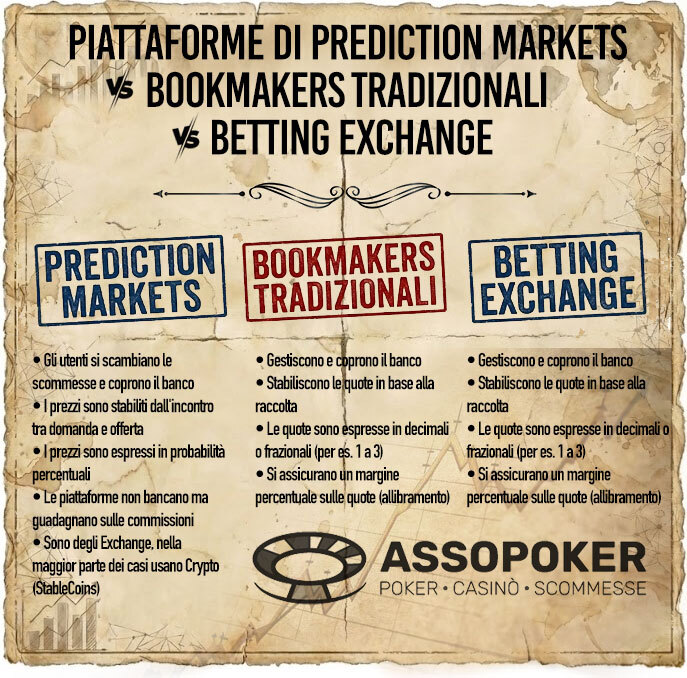
The platforms were born as a sort of information sites functional for conducting political polls (and it is no coincidence that the Trump family showed interest and invested in Polymarket and Kalshi, at least indirectly through “friendly” funds), with a difference: if in classic polls the people surveyed could answer without criteria, in these “markets” they bet money, so the result could be much more credible.
Subsequently, in this investigative article, we will show you concretely how individual operations work.
Placing a bet is the easy part. Understanding who won, paradoxically, is the hardest part. In blockchain jargon, this is known as “The Oracle Problem”.
Imagine betting on: “Will the Fed cut rates in March?”. It seems like a simple binary question. But what happens if the Fed announces a 0.25% cut that will only take effect in April? Or if it uses ambiguous language? Who presses the button that moves millions of dollars from the accounts of losers to those of winners?
Here a philosophical and technological fracture opens up between the two dominant models: centralized justice (Kalshi) and decentralized tribunal (Polymarket).
On platforms like Kalshi (or traditional bookmakers), the oracle is the company itself. Or rather, it is a certified data source defined a priori in the contract.
If the market concerns inflation, the contract specifies that the only source of truth will be the report from the Bureau of Labor Statistics published at 8:30 AM. If the government site says “3.2%”, the market pays 3.2%. There are no discussions. It is fast, efficient, but requires blind trust in the intermediary and the data source.
On Polymarket, which lives on the blockchain and does not want central points of failure, the issue is much more complex. Who decides the truth if there is no CEO?
The answer is UMA (Universal Market Access), an “optimistic oracle”. It works like this:
Game Theory suggests that voters will be honest because, if they voted falsely, they would destroy the system’s reputation and cause the value of the token they own to collapse. It is a fascinating system: truth is established by economic consensus.
However, it is not without risks. Disputes can last for days, freezing user funds. And there is always the terror of the “51% attack”: if a whale bought the majority of UMA tokens, it could theoretically rewrite reality at its whim, deciding that the Earth is flat just to win a million-dollar bet.
Should predictive bets be classified as traditional bets (therefore, according to the approach of most Governments, they should be regulated as gambling) or are they financial instruments and can they be equated to derivative products as decided in Washington at the federal level?
Prediction markets have returned to the center of global debate. Politics, sports, economy, even geopolitics: everything can become an “event” to bet on. But the real game, today, is not just technological. It is regulatory.
In the United States as in Europe, regulators struggle to categorize a product that lives halfway between financial derivatives and gambling. And where there is no clear definition, conflicts, selective enforcement, and regulatory arbitrage thrive.
In summary, as you may have guessed, in the United States there is a split between the federal discipline (which authorizes and frames these platforms under the supervision of the Commodity Futures Trading Commission – CFTC) and, instead, the political and legal stance (through attorneys general and gaming regulatory bodies) of individual states.
In Europe, on the other hand, the attitude is one of total closure and restriction to protect legal betting markets, with some exceptions.
First of all, however, let’s analyze Italy, which differs from other European countries because we already have a first recent jurisprudential precedent concerning the Tar Lazio that could guide the sector, with a tailor-made solution that we will explain.
In Italy, prediction markets are going through a transitional phase, awaiting probable legislative intervention.
The legal situation is currently hybrid, and Assopoker can reveal it to you in absolute preview and exclusively.
Polymarket is currently visible in our country, like all prediction market platforms in Italy. However, the platform was blocked by the Customs and Monopolies Agency (ADM) in October 2025. However, following the appeal to the TAR Lazio (competent for the matter), in December of the same year, there was a U-turn with a decree revoking the prohibition and restoring online access regarding the part concerning all the information and news on the site.
In fact, after the TAR’s intervention, Italy currently has a hybrid model (the sites are visible but trading is not possible), but for some platforms it is a gray market (still without effective rules).
Let’s retrace the legal steps to get an idea of the Italian state’s approach to these new platforms.
We wanted to delve deeper and ask Attorney Roberto Cursano for confirmation, who explained the entire matter in detail: from the blocking to its revocation, with the appeal to the TAR and the active collaboration of the State Monopolies.
Lawyer, I thank you on behalf of the entire Assopoker community and our readers. You and your team, representing Studio Delfino e Associati Willkie Farr & Gallagher LLP, obtained an important provision from the Lazio Regional Administrative Court in December in favor of your client Polymarket. The Customs and Monopolies Agency finally revoked the inhibitory measure of blocking towards the well-known predictive betting site; undoubtedly, this can be considered a great success given the previous decision taken by ADM. Can you explain the judicial process and the strengths of your defense line?
“Good afternoon to you Dr. Del Frate and to the Assopoker community. The provision revoking the original blocking of the polymarket.com site, obtained following the appeal filed before the TAR Lazio, which you mention, represents a precedent of particular importance in the context of regulating digital services, confirming the need for a rigorous application that responds to criteria of proportionality of restrictive measures adopted by administrative authorities, especially when they affect access to online services and freedom of information and economic initiative.”
“The case in question concerns a platform that, as many members of the Assopoker community know, hosts two functionalities: (i) the so-called prediction market, i.e., the generation of real-time statistics and polls on everyday events, ranging from politics and current affairs to the economy and sports, and (ii) the possibility of betting on the outcome of the aforementioned events, using cryptocurrencies (in particular the stablecoin USDC)”.
“Well, the Agency had originally blocked the entire Polymarket website, prohibiting both functionalities, including the one related to the so-called prediction markets and preventing users from accessing all the news, polls, and information on the site.”
“The arguments — comments the lawyer — supporting our appeal, which were taken up by the Customs and Monopolies Agency (“ADM”) on the indication of the TAR Lazio itself, were those contesting the prohibition measure for violation of the principles of reasonableness and proportionality. In essence, we complained about an incorrect exercise of power by ADM, which had gone far beyond prohibiting the exercise of games of skill and prediction contests, going so far as to prohibit the dissemination of news, polls, and information.”

“Noting the prompt collaboration of ADM and the swift revocation of its measure regarding the publication of polls and news, the TAR Lazio took note of the lack of interest on the part of the platform operator Polymarket in continuing the proceedings.”
“Therefore, there was no judicial ruling on other more substantial grounds for dispute, relating to the prohibition of trading activities when they occur without users paying a stake in money to the organizing entity and exercising the aforementioned activity, and without the latter paying any reward of any kind to the participant. On these issues, which are not expressly regulated by Italian law, jurisprudence has not yet ruled.”
“The arguments supporting our appeal, which were taken up by the Customs and Monopolies Agency (“ADM”) on the indication of the TAR Lazio itself, were those contesting the prohibition measure for violation of the principles of reasonableness and proportionality.”
Lawyer Roberto Cursano – legal counsel for Polymarket in the appeal to the TAR Lazio
Considering this important precedent, how will Polymarket operate in Italy today? Has it become visible again with all the information but cannot offer predictive bets, do you confirm?
“Yes, I confirm. The Polymarket site has become visible again, although the trading function remains unavailable for users connecting from Italy.”
In your expert opinion, from a regulatory perspective, is it more appropriate to regulate these platforms as betting sites or should they be treated as exchanges for financial products, as is the case (at the federal level) in the United States?
“In Italy, the activity of these platforms, which allow users to use cryptocurrencies as payment systems, is not expressly regulated. Framing these activities as financial services would be a viable path, but in this regard, legislative intervention would be necessary. At the moment, operators authorized by ADM avoid the use of cryptocurrencies, since the applicable regulation for such platforms is considered to be that of games and bets, subject to anti-money laundering regulations that impose obligations to verify user identity (KYC), record financial flows, and trace payment instruments.”
“I hope for legislative intervention that can more clearly regulate online trading platforms, distinguishing those that operate in a traditional manner, and therefore subject to ADM’s control, from those that operate in an innovative manner, including through the use of cryptocurrencies.”
Lawyer Roberto Cursano – Legal counsel for Polymarket
In your opinion, can the blocking and prohibition of these predictive platforms be considered an unjustified restriction of freedom of information and enterprise in the European Union? Many EU countries have adopted a very restrictive approach.
“These are, in fact, measures that in my opinion limit freedom of information and enterprise. Regarding the latter aspect, it is sufficient to note the different treatment reserved for the management of platforms for the (allegedly abusive) sale of tickets online by hosting providers that operate very similarly to peer-to-peer trading platforms, where transactions always occur solely between users and never between users and the platform operator. Well, with regard to this hosting provider figure and the activity of selling tickets on online platforms (which in the relevant administrative litigation was contested as abusive because it was not authorized), in Italy the Council of State has clarified that this does not constitute an unfair commercial practice.”
Even in light of the position taken by the TAR judges, do you expect other appeals, and how do you foresee the future of predictive betting in Italy? Will there be a need for legislative and/or regulatory intervention, or will these platforms have to fall under the regulatory umbrella of ADM or Consob?
Avv. Roberto Cursano: “I hope for legislative intervention that can more clearly regulate online trading platforms, distinguishing those that operate in a traditional manner, and therefore subject to ADM’s control, from those that operate in an innovative manner, including through the use of cryptocurrencies.”
“The Polymarket site has become visible again, although the trading function remains unavailable for users connecting from Italy.”
Lawyer Roberto Cursano – Legal counsel for Polymarket
Lawyer Roberto Cursano clarified every aspect for us, and in the end, the collaboration between the TAR Lazio, the Customs and Monopolies Agency, and Polymarket (which waived further action in the appeal) led to a sensible solution. ADM itself showed willingness to understand the reasons while also protecting Italian players.
Polymarket’s legal defense line is clear: it invokes the criterion of proportionality to protect constitutionally protected values such as freedom of information and economic initiative. It is likely that — even in the eyes of the regional administrative judges — the blocking was considered a disproportionate measure, given the constitutional values at stake. They are peer-to-peer platforms (P2P).
There is also another point that Lawyer Cursano highlights and which could influence future regulation: ultimately, the betting (or financial, depending on the point of view) contracts occur between users and not between users and the platform. Polymarket and Kalshi, in the end, are nothing more than providers; they behave like a sort of peer-to-peer platforms. This technical detail — indicated by Polymarket’s legal counsel — could be decisive for future regulation.
This legal scenario has emerged, which in the coming months could also guide other platforms:
What will be the approach of the Italian authorities? Will Polymarket have to acquire a 7 million euro concession (as a betting provider) or will the path of financial instruments be tried? Italian regulation on binary options, on the other hand, is very restrictive (closed to the public, only to intermediaries).
In the United States, some state judges have focused on the nature of the contracts: if the bet concerns a sporting event, the applicable regulation must be that of traditional betting (with state licensing). If, however, the subject of the contract concerns, for example, the trend of the Nasdaq index, the product is considered financial with all the consequences of the case.
We are still in a transitional phase, but in Italy, compared to other European countries, the game is currently open and yet to be written.
The final word rests with Parliament and the Government (with the central role of the Ministry of Economy and Finance) on how to regulate predictive betting: through ADM concessions, as financial instruments, or as service provider platforms? Assopoker will always be at the forefront to update you and follow every political and regulatory phase.
When you look closely at their functioning, the similarity with old binary options was evident, especially at the beginning, although it is important to remember that the platform does not cover the house but only offers a service to facilitate predictive exchange between two users.
There is a contract. There is negotiation. There is a binary outcome. There is a monetary payoff, so there are both common points and others that are less so.
However, if you look closely at the structure of these products, everything needed to trigger the definition of a financial derivative is present. And this is where the short circuit arises.
If a prediction market replicates that same “all or nothing” structure, then it risks being assimilated not to gambling, but to finance, especially if it deals with bets like those on the dollar or stock indices. And therefore, the risk is to suffer the same fate as binary options: prohibited for retail customers, perhaps allowed only for professionals.
This is not a theoretical issue. It is the very concrete reason why many prediction market platforms do not officially operate in Italy today. Not because of a lack of interest or demand, but because the regulatory framework is slippery: a restrictive interpretation is enough to transform an innovative product into a prohibited financial instrument. Intervention by the Ministry of Economy and Finance at the regulatory level is necessary.
Ultimately, the question is not technological, but political. Are they bets disguised as markets? Or markets disguised as bets?
Depending on how the legislator responds, the future of the entire sector in our country will depend.
A parenthesis should also be opened regarding the regulation of binary options, especially if the Italian legislator were to treat prediction markets as financial instruments, given that these sites started precisely as binary options (we will see that in 2025 they also offer multiple options for betting on an event).
In Italy, binary options are prohibited for retail clients (therefore, the B2C scheme, i.e., for the end consumer, is rejected) because they are considered a financial instrument. This is not a gray area; in this case, it is a clear regulatory and political choice, given that many people and users have been badly hurt, losing a lot of money in the past.
The central reference is CONSOB, which applies and enforces European decisions on financial instruments in Italy.
There was a specific moment in Europe when the legislator decided that certain financial products were not simply risky, but structurally wrong for the public.
That moment came in 2018, when the European Securities and Markets Authority (ESMA) intervened with a drastic measure: prohibiting the marketing, distribution, and sale of binary options to retail clients.
Not a warning, not new disclosures, not some technical hurdle. A ban.
The reasoning was simple and, in some ways, ruthless. Binary options were not seen as investment instruments, but as mathematically unfavorable mechanisms for the average client. “All or nothing” structures, where the outcome is binary — you win or lose the entire stake — with enormous information asymmetry between who issues the product and who buys it. In other words: the house knows the game, the client doesn’t. And in the long run, the result is almost always the same, a systematic loss for the public.
What was intended as a temporary emergency measure has, over time, become the new normal. National authorities have incorporated the ban in a stable manner. Among these is also the Italian National Commission for Companies and the Stock Exchange (CONSOB), which has secured the market in Italy.
Today, the picture is clear, almost without gray areas.
For retail clients, binary options simply no longer exist. No authorized intermediary can legally offer them. If they appear online, it means we are outside the regulated perimeter: abusive operators, often offshore, whom Consob can block in a few hours by adding them to the blacklist. This is one of the few areas where the authority intervenes with a heavy hand and without nuances.
Theoretically, a loophole remains for professional clients — institutional, qualified operators, sophisticated counterparties — but in practice in Italy, even there, the offer is almost non-existent. Compliance is too complex, reputational risk too high. And so the product, in fact, disappears.
The distinction then becomes almost philosophical, as well as legal.
On the one hand, there are sports bets, which fall within the scope of public gambling regulated by the Customs and Monopolies Agency: concessions, licenses, betting pools, payouts, gambling taxation.
On the other hand, binary options, which are not gambling but pure finance, derivative instruments subject to the Consolidated Law on Finance and Consob supervision. Here, a betting license is not needed, but a financial authorization is. And precisely because they are considered finance — and not entertainment — the doors are closed to retail.
It is only an apparent paradox: you can bet on a Serie A match, but you cannot trade a “yes/no” contract on the trend of a stock.
And it is precisely on this ridge that the more modern and ambiguous issue is placed today: prediction markets.
The boom in predictive betting in the United States occurred in 2024 (according to the KPMG report) when Kalshi was legally recognized as a platform for financial derivative products, under the supervision of the CFTC. From a federal perspective, therefore, there are no obstacles, but individual states claim regulatory competence, recognizing them as actual bets.
The issue between the federal government and individual states is now a debated topic in the USA in almost all areas. In the last 10 years, states have claimed greater autonomy in almost all areas of the economy as well as civil society.
The issue is explosive because it pits two levels of power against each other:
The distinction would theoretically be simple:
In practice, however, the line is very thin, and this distinction is not always respected.
However, there has been a strong stance in recent days by the new chairman of the Commodity Futures Trading Commission, who reiterated federal jurisdiction in the matter.
The new chairman Michael S. Selig, upon taking office on January 31, breaks the ambiguity that has paralyzed the sector for years, particularly due to a regulatory proposal against predictive markets presented by the Biden administration.
His message is simple, direct, political even before it is technical: “It’s time for clear rules.” A way to better regulate the sector but above all to claim primary jurisdiction in the matter.
The CFTC is disavowing previous proposals and consultations that aimed to limit contracts related to political and sporting events, reducing regulatory uncertainty for operators and participants. The Trump administration is, in fact, disavowing what the Democrats did under Biden. This is not only a legal but also a political conflict, and the current government is in favor of these markets.
New CFTC Chairman – Michael S. Selig
“We will withdraw a 2024 regulatory proposal that would have prohibited the listing of contracts related to political and sporting events. I have ordered the cancellation of a 2025 staff notice that warned registrants against offering contracts related to sports due to pending and potential litigation.”
As can be seen, new rules are imminent to establish clear standards for event contracts, which should provide a more favorable and less ambiguous regulatory environment for prediction markets.
The CFTC has reiterated its exclusive jurisdiction over commodity derivatives, demonstrating strong support for legal innovation in the prediction markets sector, and this will have an impact on ongoing litigation.
President Selig’s announcements mark a significant shift towards regulatory clarity and support for prediction markets and event contracts. The CFTC is committed to modernizing its approach and promoting innovation in this dynamic sector.
In summary, the CFTC:
Translated: the CFTC is trying to make prediction markets no longer a gray limbo between finance and gambling, but wants to make them federally regulated financial instruments. The feeling is that the states will continue to put up barricades, and in the end, only the Supreme Court will be able to resolve the dispute.
Of course, the CFTC’s stance also carries weight in ongoing litigation — including those involving operators like Kalshi against states and gaming authorities. We will see, to date, that predictive platforms are engaged in tough legal battles not only in the USA but also in Europe (and in Italy).
Testifying to the multi-level conflict between federal regulation and state authorities (both political and technical and legal), the strong stance of the New York Attorney General on the eve of the Super Bowl should be noted.
Letitia James issued a new consumer alert and a warning to the industry about the risks of prediction markets.
In a consumer alert issued on February 2, 2026, James emphasizes that many prediction market platforms operate without any supervision from the New York State Gaming Commission (NYSGC) and do not offer the minimum protections guaranteed by regulated sports betting markets:
• no consumer protection;
• absence of anti-gambling controls for vulnerable users;
• no filter for underage gambling;
• advertising and promotions that may resemble unauthorized bets.
The text of the alert insists: “so-called prediction markets do not have the same consumer protections as regulated platforms”, meaning that so-called prediction markets do not offer the same legal and operational protections as regulated markets.
For James, these services — although presented as “speculation or forecasting” tools — in practice function as channels for unregulated gambling. Especially in view of major events like the Super Bowl, the alert clarifies that some operators may be violating state laws if their business model and advertising come too close to unauthorized sports betting.
The message is not only to the public: it is a clear signal to the industry that the judicial and regulatory authority of New York will not stand idly by if activities of promotion or revenue collection lead to illegal practices. James stated that conduct, advertising, and promotion of products that “appear to be sports bets” could incur civil and even criminal penalties.
The alert is primarily addressed to users: James urges players to be aware of the financial risks, reminding them that these platforms are not subject to the same controls and protections as authorized markets.
The recommendation is simple, but crucial:
✔️ understand if you are using a site/product regulated by state law;
✔️ avoid products promoted in ways similar to unauthorized bets;
✔️ beware of advertising that disguises bets as “trading or investment”.
The regulatory issue remains open. This stance highlights once again the rift between state regulators and innovative business models in the world of federally regulated prediction markets. While some platforms insist on their status as financial instruments, authorities like New York’s view their growing similarity to unauthorized gambling products with suspicion.
For operators, insiders, and enthusiasts, the message is clear: regulatory uncertainty can quickly turn into active enforcement. And in a sector where trust and legal compliance are fundamental, it is always worth keeping a close eye.
But the clash between the Federal Government and the authorities of individual states is evident.
As reiterated, platforms like Kalshi (registered with the CFTC) claim to offer federally regulated derivative contracts, therefore potentially preempting state laws (federal pre-emption).
States retort, and their position is clear:
“you can call the product whatever you want, but if you are betting on sporting events, without a state license, for us it is illegal gambling.”
The result? A barrage of cease-and-desist orders, administrative orders, and legal actions.
The political message is very clear: on sports contracts, the states do not intend to back down an inch.
The Massachusetts Ruling
Kalshi is on the verge of losing the ability to offer contracts on sporting events in the state of Massachusetts. A judge has indeed granted the state’s request, issuing a preliminary injunction against the prediction market operator.
The decision came from Suffolk County Superior Court Judge Christopher Barry-Smith, after Massachusetts Attorney General Andrea Campbell filed a lawsuit in September 2025 against the platform. According to the prosecution, Kalshi is effectively operating an unlicensed and unregulated betting business.
“Requiring Kalshi to obtain a license to offer contracts on sporting events in Massachusetts is in the public interest,” wrote the judge in the reasoning.
Barry-Smith added that the court is moving towards prohibiting the offering of contracts related to sports in the absence of the license required by the sports betting law. The injunction will take effect on Friday, although Kalshi may appeal.
Kalshi, for its part, has bet everything on the federal jurisdiction argument: the company insists that its markets are derivatives regulated by the Commodity Futures Trading Commission (CFTC), and therefore exempt from state gambling regulations.
But in the USA, both regarding predictive betting and other issues (for example, illegal immigration), there is an open conflict between the Government (and its regulations) and individual states.
However, Judge Christopher Barry-Smith deemed this interpretation provided by Kalshi’s lawyers insufficient, stating that federal supervision of derivatives does not preclude states from regulating activities that fall within their definition of gambling.
According to the judge, however, Kalshi’s sports markets “walk and talk” like sports bets in all respects, not like atypical financial instruments.
Kalshi had offered sports contracts without a state license, even after regulatory warnings and enforcement actions in other states.
If Kalshi wants to operate legally in the sports betting field, it must obtain a license from the Massachusetts Gaming Commission.
The injunction — which will fully take effect if lower courts and the Court of Appeals do not suspend it — could require Kalshi to implement technical geolocation to block Massachusetts users from accessing sports results prediction platforms.
Kalshi is not the only operator experiencing difficult times. Polymarket has also come under the scrutiny of authorities: on January 16, the Nevada Gaming Control Board initiated a civil enforcement action against the platform. Following this decision, Fanduel also decided to leave Nevada.
According to the state’s regulatory authority, Polymarket operates a derivatives and event contract market offered via mobile app to Nevada residents as well. For the Board, the sale of contracts on sporting events — and other similar events — falls squarely within the scope of betting activity provided for by state law, and therefore requires a specific license.
A complicated January, therefore, for prediction markets. In Portugal, Polymarket received an order to cease operations on the eve of the national elections (second round). In Ukraine, on the other hand, the authorities ordered internet providers to block access to the platform’s website.
Different signals, from different countries, but all in the same direction: when the line between prediction and betting becomes too thin, it is the law and the judges who intervene.
| State | Type of intervention | Authority |
|---|---|---|
| New Jersey | Stop on NCAA contracts | Division of Gaming Enforcement |
| New York | Cease-and-desist | State Attorney General |
| Illinois | Block order | Gaming Board (regulatory body) |
| Maryland | Administrative ban | Lottery & Gaming (regulatory body) |
| Ohio | Formal enforcement | Casino Control Commission (regulatory body) |
| Nevada | Challenge for unauthorized gambling | NGCB (regulatory body) |
| Massachusetts | Activity suspension ruling | Suffolk County Judge |
This is just the tip of the iceberg. Contracts on sporting events have brought prediction markets into the spotlight, but at the same time, they have ignited a long series of legal disputes involving companies like Kalshi, Crypto.com, and Polymarket.
Those States where sports betting is already legal have been particularly decisive. According to local authorities, contracts on sporting events are nothing more than bets disguised as financial instruments and, as such, should be subject to the same rules and licenses as traditional bookmakers.
In essence, states are applying a simple principle: if it walks like a duck and quacks like a duck, then it’s a duck. And this line, so far, is working.
With the injunction against Kalshi, prediction market platforms have collected six consecutive legal defeats at the state level in Massachusetts, Maryland, Ohio, and Nevada.
The same Judge Barry-Smith explicitly invoked this logic in his decision, observing that Kalshi offers multiple bets (called “combos” in prediction market language), bets on individual players, and that the platform “reproduces other digital gaming experiences” and uses terminology typical of gambling.
If the United States is a legal battlefield with political and legal clashes on two levels (federal and state), in Europe everything is more straightforward because the European Union’s policy on gambling has always been to grant full regulatory autonomy to member countries. Therefore, there is no clash between Brussels and the states.
Having now fully regulated online and land-based gambling, EU countries have a very restrictive stance towards Polymarket and other platforms.
In theory, a dual approach very similar to that of the USA can coexist, but in reality, the gambling aspect prevails on the Old Continent.
The two major legal classifications in Europe:
The second model is followed more for reasons of convenience not only for the states but also for the platforms themselves. But let’s analyze in more detail.
Games and Bets – Many EU States treat prediction markets as bets on events (politics, sports, news, etc.). If the site does not have a national gaming license (or does not fall into the permitted categories), the offer is considered illegal gambling and is combated with typical tools: blacklists, ISP blocking, payment blocking, warnings, sanctions.
A very clear example: in France, a major scandal occurred after Donald Trump’s election with a French whale (in jargon, “whale” refers to a very rich high roller bettor) who won 85 million euros on the presidential elections. The reaction of the transalpine authorities was immediate with an injunction to Polymarket at the end of 2024 and the seizure of the winnings.
ANJ communicated that, after its intervention, Polymarket stopped offering services in French territory and recalls blocking powers and criminal profiles related to the offer of illegal gambling.
Financial instrument/derivative (rarer in the EU) – Here the question is: is the contract a derivative (or in any case a “financial instrument”) and is the platform a trading venue subject to MiFID/MiFIR rules, the two European directives issued in 2014 that constitute the EU’s regulatory framework, in force since 2018, to regulate financial markets, increase transparency, improve efficiency, and strengthen investor protection. In the EU, this interpretation is more complicated in practice, because contracts on sporting and political events in predictive betting often do not have a linear classification as retail financial instruments.
In the United Kingdom, on the other hand, the debate is more explicit: the analysis distinguishes between “financial” products and “gambling” products (on sporting/political events) and emphasizes that the scope changes depending on the nature of the contract and the risk to consumers.
In the European Union, there is no single discipline for prediction markets (yet): the matter, when it is “gambling,” remains strongly national (licenses, permitted betting pools, bans on politics, etc.). The line of the Brussels Commission has always been to respect the autonomy of individual states in gambling matters since the early 2000s. Only the European Court of Justice has intervened with important rulings, but to protect certain principles of the EU Treaties such as freedom of enterprise and establishment.
Therefore, even if a platform is “global” like Polymarket and Kalshi, in Europe it clashes with 27 different regimes plus local enforcement (ISP, payments, advertising). This explains the wave of national blocks/actions seen between late 2024 and 2026.
These States have taken official measures, such as blocking access, cease and desist orders, blacklisting, or specific restrictions, against platforms like Polymarket:
As you can see, in Europe there is no “Kalshi case”: no regulator has seriously accepted the “retail financial derivative” thesis. At least not yet. In Italy, however, as we have analyzed, there is a hybrid model: platforms are visible (to protect the right to information) but trading is not possible.
Let’s summarize the various positions in a table:
Country Type of measure Authority involved Reason / legal basis Operational effect
Portugal Cease and desist order + access block SRIJ (Serviço de Regulação e Inspeção de Jogos) Illegal political betting, unlicensed operator Polymarket closed in 48 hours, ISP block
Romania National blacklist ONJN (National Office for Gambling) Unauthorized bets on elections Polymarket blocked
France Geo-blocking / access block ANJ (Autorité Nationale des Jeux) Gambling offer without license Access unavailable to residents
Belgium Registry of prohibited operators Belgian Gaming Commission Violation of Gambling Act (no license) Polymarket is illegal
Poland Block / restrictions Polish Ministry of Finance Activities as unauthorized bets Limited/barred access
Hungary Ban / ISP blocks (reported) National regulatory authority Unauthorized organized wagering Barred access
Ukraine Platform block National Commission for Regulation of Electronic Communications Considered illegal gambling Polymarket included in blocked list
The United Kingdom deserves a separate discussion. The Financial Conduct Authority (FCA) has permanently banned binary options to retail clients, as in Italy and Europe.
Brutal translation: prediction markets in yes/no format do not pass (binary options).
Result: in the United Kingdom, it is not easy for platforms to operate, either on the gambling side (they do not have licenses) or as financial trading platforms.
In Portugal, politics has once again crossed paths with prediction markets. And the encounter did not go unnoticed.
The socialist candidate António José Seguro finished the first round of the general elections in the lead with 31 percent of the vote. Behind him, with 24 percent, was the far-right leader André Ventura. However, neither reached the 50 percent threshold needed for immediate victory. Therefore, there will be a runoff: a second round, reserved only for the top two.
So far, normal democracy. But in the hours preceding the closing of the polls, something happened that attracted the attention of the authorities.
On the Polymarket prediction market platform, odds on Seguro began to rise sharply. In the early afternoon, his implied probability was around 60 percent. By six in the evening, about an hour before the polls closed, it had already reached 95 percent. Shortly after, as the first exit poll projections began to circulate but before the official results, it approached absolute certainty.
In that short time window, according to Portuguese broadcaster Renascença, over 4 million euros were bet on the platform’s electoral markets. A figure sufficient to raise questions: did someone already know how it would turn out?
There is no evidence of insider trading. Exit poll projections began to circulate around the same time as the odds surge. It is possible that the market simply did what all markets do: rapidly absorb new information. However, a question remains open, which does not concern finance but transparency: was that information public for everyone?
The Portuguese gambling regulator, the SRIJ, intervened and ordered Polymarket to immediately cease operations in the country. According to the authority, the platform is illegal: national regulations only allow sports betting, casino games, and horse racing with a license. In Portugal, there are no authorized markets for betting on political outcomes. The regulator itself admitted to only recently noticing the platform’s operations.
Predictive bets are not a game, but for European governments, they are a serious matter. The four main reasons are:
This is why regulators are no longer standing by and watching but are intervening.
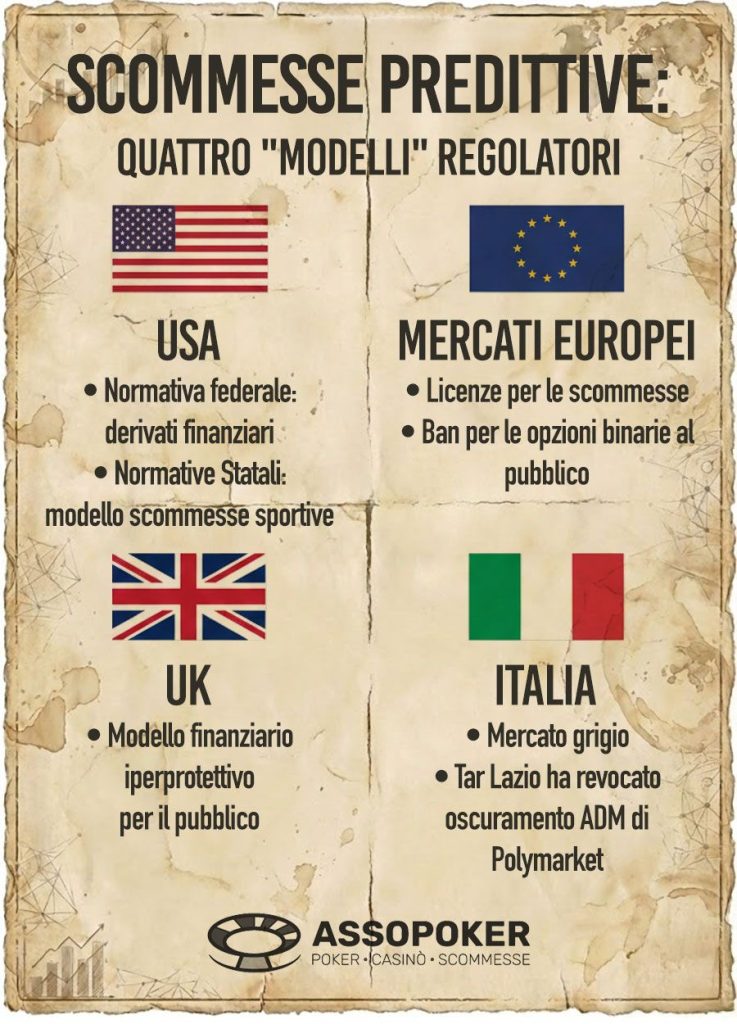
They were born as information sites (for this reason they operated in a gray area) and political polling sites, but they have taken a very different turn and now behave like proper and true betting exchange sites, albeit with decentralized blockchain technology. Unlike bookmakers, the house is managed by users; it is through the exchange of user predictions that a “price” expressed in probability is set. Platforms earn from commissions applied to transactions, just like in Betfair’s betting exchange.
The mechanism is simple, almost brutal in its transparency. Let’s take the prediction market on Polymarket (updated as of January 25, 2026, 9:41 AM) for the US Presidential Elections 2028, which has already seen over $214.1 million in trades.
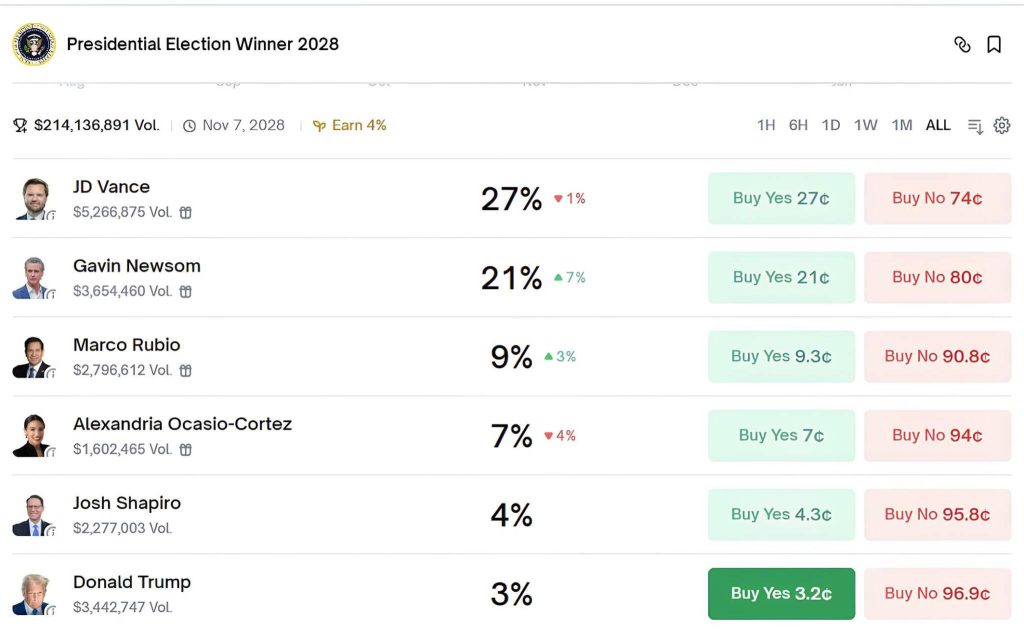
According to the US Constitution, Donald Trump could not run again because a third term is not allowed. For his supporters, however, the rule should be interpreted differently (according to the MAGA movement, it should concern two consecutive terms). In any case, for Polymarket users, Trump has a 3.2% chance of being re-elected.
More precisely, the price is 3.2 cents (meeting of supply and demand). What does this mean? First of all, if we were to reason according to traditional decimal odds, the odds should be 31.25.
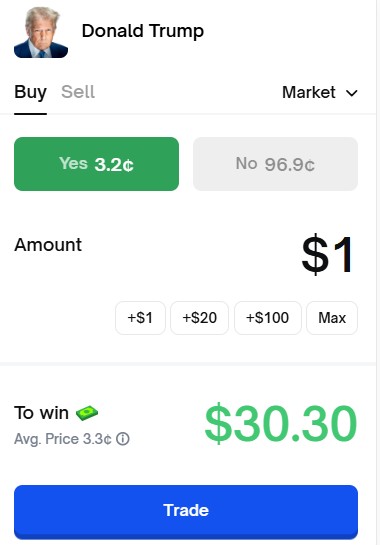
On the platform, the value of the contract is set, generally $1.
In the case of a $1 bet on Trump, the potential net winnings would be approximately $30.30 (the commission also needs to be calculated).
But you can also do the opposite, i.e., as on a Betting Exchange platform, you can say NO to Trump’s election and lay the hypothesis (although financially more demanding, about 1:31).
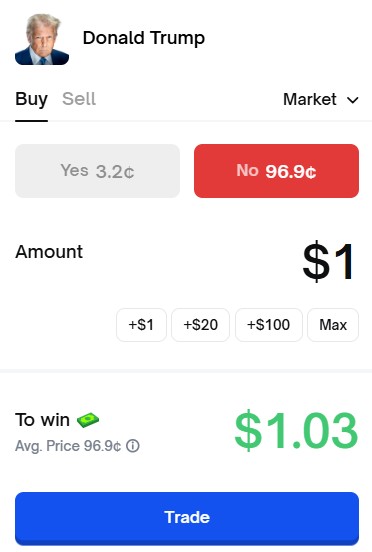
To win about $1, I have to cover the risk of the lay bet for 96.9 points.
As you can see, these are bets in the true sense of the word and should be regulated as such. However, supporters of prediction markets try to leverage (also for convenience) the purely informational aspect.
In this case, we have a real poll with Vice President of the United States JD Vance having 27% on an already significant sample. The liquidity of the traded money exceeds 214 million dollars.
The declared purpose of these instruments is also information aggregation. The underlying idea is that a market, when liquid and open, can produce more reliable forecasts than a poll, because it forces participants to assume economic risk. It’s not enough to “think right”: you have to believe in it enough to put money on it.
The contract structure, on the other hand, suggests that they are more financial instruments. If the event occurs, the contract expires at full value (1). If it does not occur, it is worth zero.
In between, there is trading: positions can be closed early, monetizing a correct forecast or limiting a wrong reading. Exactly like in a financial market and in betting exchanges, only that the underlying asset is not a stock or a commodity, but a real-world fact.
The most common applications are well-known: political elections, sports competitions, macroeconomic data, cultural and media events. It is precisely this thematic expansion that has ignited the regulatory debate.
In summary, prediction markets are also a formidable tool for trading on future events. The winner is the one who reads reality best, who intercepts relevant information first, who understands when the market is wrong. And this is also why, as they get closer and closer to traditional bets, it becomes increasingly difficult to pretend they are not.
Predictive bets, like all bets, have elements of gambling, but they are also a trading tool. For many expert users, luck, impulse, or a “gut feeling” play has nothing to do with it. Here we are talking about a different mechanism: transforming information, opinions, and data into a numerical probability. In other words, putting a price on the future.
A predictive bet is not saying “in my opinion X will happen”. It is asking: with what real probability will X happen? And above all: how much am I willing to risk to prove it?
The principle that governs them — as we have told you — is known as the wisdom of crowds. When thousands of people, with different skills and information, put money on an event, the final result tends to be surprisingly accurate, at least in theory. Often better than a single analysis, better than a poll, better than an isolated expert.
The market, in essence, has no opinions: it has prices. And those prices tell a story.
Beyond the possible economic gain, prediction markets serve above all for this:
They do not predict the future by magic. They do so because they force people to be honest with reality. And reality, when priced, tends to emerge with surprising clarity.
On these platforms coexist financial traders, insiders, experts in geopolitics and finance, simple enthusiasts, bettors, sports traders (like on Betfair Exchange), crypto traders.
As in all markets, the more orders there are, the more liquidity there is. The more liquidity there is, the more efficient the prices are, as happens in Betting Exchange. The real danger is having illiquid markets. In this case, the information is not so correct, the prices and probabilities do not correspond to reality. Furthermore, there are traders who manipulate markets and try to influence probabilities when markets are illiquid.
The problem is that the media, especially in the United States, are giving too much importance to the forecasts emerging from these platforms, sometimes creating sensational headlines even when the forecasts are not so reliable.
You can understand from this simple mechanism that the tool lends itself to trading, as happens with cold traders in horse racing markets, in Great Britain on Betfair Exchange (which is a traditional sports betting exchange operating with regular concessions and licenses in European countries). The same happens in other sports.
In predictive betting, however, speculation is more pronounced and in unregulated markets. This will be the central theme of 2026 because these instruments lend themselves (also considering the nature of open markets) to potential and blatant insider trading. Think about Venezuela. From Washington, it is likely that a small group of people already knows the future of the Latin American state or, in any case, knows the real intentions of Trump and his government. And on Polymarket, bets on the future of the South American country and beyond are popping up like mushrooms.
There is a further, almost dizzying, level in the analysis of prediction markets. If these instruments are truly so accurate in predicting the future, why do we limit ourselves to using them for betting? Why don’t we use them for governance?
This is the provocative thesis of Futarchy (Futarchy), theorized by George Mason University economist Robin Hanson. His motto is etched in the cornerstone of libertarian theory: “Vote on values, bet on beliefs”.
In the current democratic system, we vote for politicians based on their promises (“I will lower taxes and GDP will rise”). But they rarely pay the price if the promises turn out to be false.
In Hanson’s Futarchy, the mechanism would be reversed:
If the market says that with law A, GDP will be higher, law A automatically becomes executive. Politicians become mere executors, while speculators become the true legislators. The idea is that speculators, by risking their own money, have a brutal incentive not to lie about the effectiveness of a policy, unlike parliamentarians or bureaucrats.
Every technological utopia has its dystopian shadow. In the case of prediction markets, the shadow has a disturbing name: Assassination Markets.
Theorized by crypto-anarchist Jim Bell in the 1990s, they represent the ultimate ethical drift of the sector. If it is possible to create an anonymous market on the death date of a political leader or dictator, that market automatically becomes a bounty on their head.
The mechanism is chilling: if I bet that Leader X will die tomorrow, and then I kill him myself, I collect the winnings. The bet becomes payment for the hitman, untraceable and crowdfunded by anyone who hates that political figure.
As extreme as this scenario is, it is no longer science fiction. On uncensurable decentralized platforms, markets on the death of public figures have already appeared (often quickly removed from user interfaces, but technically immutable on the blockchain). This is the ultimate boundary where market freedom meets criminal code and human ethics: can everything be priced? Or are there futures that should never have odds?
In this context, the growing involvement of the Trump family is inserted, not only as passive investors but as active protagonists — with significant impacts on the sector and regulatory discussions.
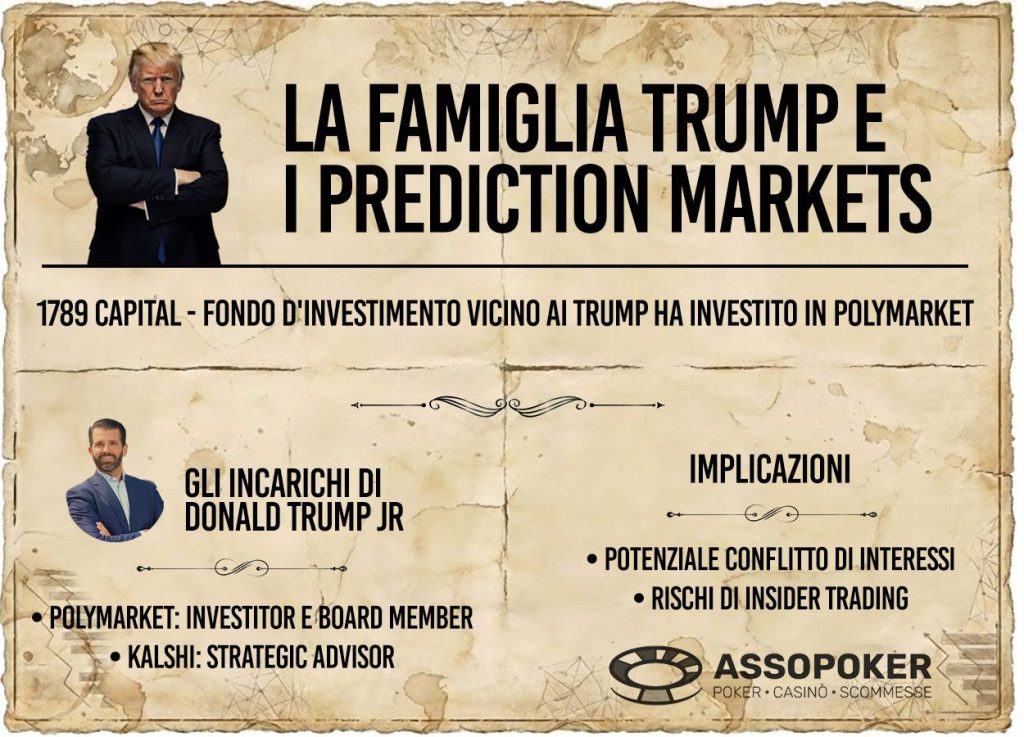
One of the most important knots in the Trumps’ involvement in prediction markets is the role of Donald Trump Jr.:
This direct presence of the Trump family in two of the main global operators in the predictive segment has attracted the attention of observers and regulators, not only for potential financial returns but also for possible political-economic conflicts of interest.
Trump Jr.’s appointments came after substantial investments in Kalshi and Polymarket by a fund close to the MAGA movement: 1789 Capital.
In addition to investments and prestigious positions, the Trump family has entered directly into the digital predictive betting market with its own project:
Truth Predict is a new service announced by Trump Media & Technology Group (TMTG) — the company that controls the social network Truth Social — which will integrate cryptocurrency-based predictive bets directly into the social platform. Users will be able to bet on the outcomes of political, sporting, and other future events, using tokens and blockchain technology.
According to project executives, the goal is not just entertainment, but the “democratization of information“: that is, transforming the collective aggregation of opinions into economic and probabilistic signals.
The platform is born from a partnership with Crypto.com, one of the world’s leading cryptocurrency exchanges, and is designed as an innovative way to combine social networks, blockchain, and prediction markets into a single digital experience.
The growing influence of the Trumps in this sector raises regulatory and market integrity questions:
The direct entry of a political and media brand like the Trump family into prediction markets speaks to a broader trend: that of transforming the prediction of future events — which was once the domain of pollsters and analysts — into real economic markets open to everyone.
This opens up new channels for economic and social participation, but also poses regulatory and governance challenges: how to ensure fairness, prevent abuses, and define the boundary between predictive betting, financial trading, and gambling.
The fund close to the Trump family that has invested in both Polymarket and has connections with Kalshi is 1789 Capital.
1789 Capital Management, LLC is an American venture capital firm based in Palm Beach, Florida. Among its partners is Donald Trump Jr., son of the current President of the United States, who is actively involved in the fund’s management and strategies.
👉 Key features of 1789 Capital:
📍 1789 Capital and prediction markets
🚀 Investment in Polymarket:
1789 Capital made a multi-million dollar investment in Polymarket (in the order of “double-digit millions“, i.e., tens of millions), one of the world’s leading prediction markets, and at the same time Donald Trump Jr. joined the company’s advisory board.
📈 Role in Kalshi:
In parallel, Trump Jr. was appointed strategic advisor of Kalshi, the main competitor platform to Polymarket in the United States, although there is no direct investment from the 1789 Capital fund in Kalshi (at least according to publicly available information).
💡 Therefore, the link with both major operators of prediction markets — Polymarket and Kalshi — passes mainly through Donald Trump Jr. and his position in 1789 Capital, which invested in Polymarket and brought Trump Jr. as a key figure also to Kalshi.
📌 Why it is relevant
This link between a fund connected to the Trump family and the main prediction market operators has attracted attention for several reasons:
Prediction markets, due to the subject of their bets, open up an enormous potential risk for insider trading incidents. One of the most striking examples occurred with the arrest (for some observers, it is actually the kidnapping of a head of state) of Venezuelan President Nicolas Maduro.
On Polymarket, some accounts began betting on the blitz and arrest of Maduro a few hours before the secret operation by US special forces in the South American country began.
The fact is that, since the market on the potential capture of the Venezuelan president by January 31 was opened, the probabilities provided were very low. The event was judged improbable. But a few hours before the US special forces’ raid in Caracas, on Polymarket, the probabilities suddenly moved, and the event — quite suddenly and “unexpectedly” — became increasingly likely, while on other platforms everything remained unchanged.
The numbers speak for themselves and “predict” the future: an account created just a few hours earlier invested $30,000 and cashed out over $436,000. Not a stroke of luck, but seemingly a surgical operation, timed with a disquieting precision by some well-informed source. The witch hunt has also begun: some pointed fingers at officials close to Trump, while exponents close to the US administration accused Venezuelan insiders (did they know beforehand?).
That insider trading is one of the dangers of predictive betting markets is like discovering hot water, but after this episode, the red light has flashed.
One of the revealing details is the comparison with competing platforms like Kalshi, where probabilities remained low until the last moment, almost indifferent to the impending earthquake.
Two markets, two readings of reality. And an inevitable question: who knew what, and when?
It should also be noted: Kalshi treats the exchange of user predictions as financial instruments and is under the supervision of a federal agency, the Commodity Futures Trading Commission (CFTC), which oversees derivatives (as predictive markets are also treated by some states in the USA). Therefore, it is much more difficult to carry out operations that could arouse suspicion. The real risk is ending up in jail.
Polymarket is still in a regulatory limbo. At the moment, it operates in a sort of unregulated market, but it is close to federal commission CFTC supervision.
Among traders, opaque practices by some users are known: from “wash trading” to artificially inflate volumes, to suspiciously accurate bets on technological events, corporate decisions, and even updates to platform algorithms and search engines. Each time, the same shadow: the use of confidential information by some accounts, given that there is the problem — on most of these platforms — of anonymous accounts.
The Maduro case, however, raises the stakes. Here we are not talking about quarterly profits or product launches, but about a militarily explosive geopolitical operation and arrest that few knew about. This is the point where the market stops being a thermometer and risks becoming an insider club.
It is no coincidence that Democratic Representative Ritchie Torres has announced a new legislative proposal, the Public Integrity in Financial Prediction Markets Act of 2026, aimed at prohibiting or limiting the participation of public officials and political figures in these markets. The principle is simple: those with access to power should not be able to monetize advance knowledge of their decisions.
Prediction markets were born as transparency tools, capable — at least in theory — of predicting the future better than polls and traditional intelligence. But when the future becomes a source of income for a well-informed few, the line between prediction and manipulation becomes dangerously thin. And at that point, it is democracy, more than the market, that demands guarantees.
As we have seen, prediction markets (predictive markets) are markets where users buy and sell financial contracts that pay out based on the outcome of real events — such as political elections, economic results, sports, etc. — with the aim of translating the implicit probability of an event into prices. Let’s discover the main players, the most important platforms.
Polymarket — as you have gathered — is the American prediction market platform based on blockchain technology, founded in 2020 by Shayne Coplan with headquarters in New York City. Unlike traditional online bookmakers, Polymarket offers a decentralized prediction market where users can buy and sell shares (“shares”) related to the outcome of future events — from politics and the real economy, to sports, weather, and pop culture — using stablecoins (USDC) on the Polygon network, a scaling layer of Ethereum.
Polymarket’s operational structure is inherently decentralized and crypto-native, with transactions on the markets occurring on-chain and share prices reflecting the implicit probability of outcomes based on the “wisdom of crowds”. Users buy “Yes” or “No” positions, and if the outcome is correct, each share resolves to $1 USDC, while incorrect ones expire at zero — a mechanism similar to a binary contract that serves as a real-time probability signal.
Polymarket has attracted significant institutional investment, including a deal with Intercontinental Exchange (ICE) — owner of the New York Stock Exchange — which brought a commitment of up to $2 billion, valuing the platform at around $8 billion and marking one of the largest endorsements from a traditional financial institution in the prediction market sector.
Regulators and markets, however, have represented a complex terrain: after an initial agreement with the CFTC in 2022 that limited access for US users due to registration issues, Polymarket has taken steps towards regulatory compliance by acquiring a licensed derivatives exchange (QCEX) to fully re-enter the US market and expand its reach into regulated markets.
In summary, Polymarket positions itself as the world’s largest blockchain-based prediction market, combining Web3 technology, crypto liquidity, and collective market signals to transform future events into tradable assets, but always operating on the edge between financial innovation and global regulatory complexity.
The currency that holds everything together is USD Coin (USDC), a stablecoin pegged to the US dollar. It is the silent fuel of the platform: deposit, medium of exchange, and settlement instrument. Every contract goes through it, as if it were a digital dollar flowing faster and without intermediaries. The technical infrastructure relies on networks like Polygon, chosen for its low costs and execution speed: fundamental characteristics when the market needs to react in real time to breaking news or election results.
Everything works through smart contracts. No discretion, no cash. If the event occurs, payment is automatic. A binary logic, almost mathematical: yes or no. 1 or 0. It is this simplicity that makes Polymarket global and immediate, capable of attracting users from all over the world, even if not all jurisdictions look upon it favorably. Some countries and several US states, as well as stricter regulatory markets like France, the UK, or Singapore, limit or block direct access, reminding us that the line between financial prediction and betting remains politically very sensitive.
The real breakthrough, however, is not technological. It is regulatory, as we have just mentioned. In 2022, Polymarket had to close its doors to US users after an intervention by the Commodity Futures Trading Commission, which contested its operation without registration. Fine, forced stop, exit from the richest market in the world. For a platform born in the USA, it was almost an exile.
Politics in the USA influences everything, even business and justice. The President has — among his powers — significant influence (with ad hoc appointments) over the federal Attorneys General of the Department of Justice, and under the Biden administration, Polymarket did not fare well. In 2024, an FBI raid under a warrant from the DOJ itself destabilized the company.
Fortunately for the platform, in July 2025, the Department of Justice (DOJ) and the Commodity Futures Trading Commission (CFTC) officially closed the civil and criminal investigations into the company without proceeding with further charges.
The investigations were initiated after Polymarket received a visit from the FBI in 2024 and underwent searches for suspected continued acceptance of bets from US users, despite the previous agreement with the CFTC in 2022 which had required it to cease operations in the USA and pay a $1.4 million fine for operating as a derivatives market without registration.
The core of the accusation was that Polymarket had violated that agreement by continuing to access the US market — a potential infraction both civilly and criminally.
With the Trump administration, the wind changed. In the summer of 2025, both the DOJ and the CFTC notified Polymarket of the closure of their respective investigations and the decision not to file further charges. This was a significant turn of events, especially considering that one of the investigations also included a criminal component.
The authorities did not release details on the outcome of the investigations or the specific reasons for the decision, but the epilogue marked the end of months of regulatory uncertainty for the company.
The closure of the investigations came at a time of strong growth for the platform and regulatory change in the prediction market sector.
Not long after, Polymarket concluded the acquisition of the US derivatives exchange and clearinghouse QCX for approximately $112 million — a fundamental strategic move to re-enter the US market in compliance with CFTC regulations.
In fact, Polymarket not only avoided criminal or civil charges but is now on the path to re-establishing its presence in the USA in a more rigorous and formally approved regulatory context.
Three years later, the return. In November 2025, the CFTC granted Polymarket formal approval, an Amended Order of Designation that allows it to re-enter the United States as a regulated operator. No longer a gray area, no longer offshore. But the same legal perimeter as US derivatives exchanges. In practice, Polymarket can operate as a true exchange, offering trading to US users through authorized intermediaries, traditional brokers, and futures commission merchants. In 2026, Polymarket is in a due diligence phase in the USA.
This is a step that changes perception even more than numbers. Because it means institutional legitimacy.
To get there, the company chose a strategic shortcut: the acquisition — as we recalled — of QCX LLC, an exchange and clearinghouse already holding a CFTC license. By buying the regulated infrastructure, Polymarket also bought the legal basis to operate in the United States. A textbook finance operation, rather than a crypto startup.
Since then, the project has changed its skin. Strengthened compliance systems, internal supervision, clearing, regulatory reporting: everything needed to speak the language of federal authorities. The goal is clear: to transform a market born on the fringes into an infrastructure capable of dialoguing with Wall Street.
The implications go beyond the single company. Polymarket’s return signals growing acceptance of prediction markets by US regulators and suggests a possible increase in the sector’s overall liquidity. More legal certainty, less reputational risk, more institutional capital. In other words: more volumes.
Now, the final stretch remains, the operational one. Before regulated trading is fully active, Polymarket will have to complete integration with US intermediaries and define precise procedures for mediated user access. But the direction is set.
From a frontier platform to a recognized financial infrastructure.
And for a market that sells probabilities about the future, it is perhaps the most important prediction of all.
Polymarket is considered one of the leading global prediction markets with a crypto-native approach.
Currency/Asset used:
➡️ USD Coin (USDC), a stablecoin pegged to the US dollar. Users buy and sell contracts using USDC as a deposit and settlement medium, with technical scaffolding on networks like Polygon. After three years of suspension, Polymarket was authorized in 2025 to re-enter the official US market.
Key features:
👉 Polymarket continues to operate with stablecoins (USDC) as the “base currency” for international predictive contracts.
Polymarket obtained, in November 2025, CFTC approval for a regulated return to the US market (U.S. Commodity Futures Trading Commission). It had blocked access to US users in 2022 after a regulatory action and a fine from the CFTC for operating as a derivatives market without registration.
✅ After three years, the CFTC issued an Amended Order of Designation allowing Polymarket to:
Why this step is important
🔹 The approval allows Polymarket to operate under the same regulatory framework as US exchanges (at the federal level, but we will see the problems encountered in individual states)
🔹 US users will be able to access prediction markets through regulated channels (no longer just offshore).
🔹 The platform has already enhanced its compliance, supervision, clearing, and regulatory reporting systems to meet the required standards.
How it got there
➡️ Polymarket acquired QCX LLC, a CFTC-licensed derivatives exchange and clearinghouse, thus providing the legal basis to operate in the US market.
Broader implications
👉 The move signals greater regulatory acceptance of prediction markets in the USA (undoubtedly Trump’s election facilitated this process).
👉 Potential increase in trading volume in the sector compared to the previous situation.
👉 Polymarket’s return contributes to pushing prediction markets into the traditional financial ecosystem.
Next steps
⏳ Before regulated trading becomes fully active, Polymarket must:
Kalshi is a fully regulated predictive contract exchange by the Commodity Futures Trading Commission (CFTC) in the United States, becoming one of the most important compliant infrastructure exchanges for institutional and retail traders.
Kalshi, Inc. is a US prediction market platform founded in 2018 by Tarek Mansour and Luana Lopes Lara, two former financial analysts who met at MIT (Massachusetts Institute of Technology). Today it is headquartered in New York City and is a private company with a market valuation of approximately $11 billion after a $1 billion funding round, with investors including Sequoia Capital, Paradigm, Y Combinator, and asset managers like Charles Schwab and Henry Kravis.
Kalshi is not a normal betting site: its offering is based on “event contracts”, financial contracts that allow users to buy/sell predictions on the outcome of real events — from climate and economic data, to politics, as well as sports and legislative results — with the contract price reflecting the market’s perceived probability. Unlike traditional bookmakers, Kalshi does not bet against the user but acts as an organized market where buyers and sellers meet, and it earns profits through transaction commissions.
The company operates as a regulated exchange in the United States under the authority of the Commodity Futures Trading Commission (CFTC), which in 2020 approved Kalshi as a Designated Contract Market — the first platform of its kind to obtain this federal recognition for predictive markets. This status allows it to offer tradable events, but it also entails legal challenges with individual states (especially when Kalshi began offering markets on sports results), because some state regulators believe that certain contracts constitute actual unauthorized sports betting.
In summary, Kalshi is seeking to redefine the boundary between predictive finance and regulated gaming, attracting both institutional liquidity and the attention of regulators, and positioning itself as a global market infrastructure for trading in advance on the outcome of real events.
The currency used by Kalshi ➡️ USD fiat — the main market is in US dollars.
Kalshi also allows deposits via stablecoins or cryptocurrencies in some cases, but these are automatically converted to USD before absorbing trading contracts.
Fiat currency means, from Latin, both made (by decree). When we talk about fiat currencies, we are talking about traditional currencies like the dollar, euro, yen, ruble, etc.
Key features:
👉 Although Kalshi may accept crypto deposits → USD, its core operation is tied to fiat currency markets, not native tokens or stablecoins as the primary market medium.
| Platform | Main Currency | Features | Typical User Type |
|---|---|---|---|
| Polymarket | USDC (stablecoin) | In transition, under CFTC compliance, decentralized structure | Global traders, crypto-native |
| Kalshi | USD (fiat) | CFTC regulated | Institutional / US retail traders |
| PredictIt | USD | It is a site focused on politics | Political bettors |
| Opinion.Trade | Crypto (e.g., BNB Chain token) | Decentralized | Crypto traders / dApp users |
| Crypto.com Markets | Crypto / stablecoin | Integrated exchange | Crypto Ecosystem |
✔️ The main prediction markets use a combination of currencies:
✔️ In the United States, it’s not that platforms have completely eliminated stablecoins, but Kalshi structures the use of cryptocurrencies as a gateway to convert them into fiat market, while Polymarket is trying to balance the use of stablecoins and regulatory compliance to fully re-enter the US market.
Within a few months, the advance of prediction markets (Kalshi, Polymarket, and the “event contracts” ecosystem) has forced the two giants of US betting — FanDuel (Flutter) and DraftKings — to make a choice: suffer competitors who bypass the state borders of traditional betting, or enter it with a proprietary product.
And the answer, today, is clear: they have entered it.
A stablecoin pegged to the dollar is, in essence, a digital dollar: a cryptocurrency designed to maintain a stable value (1 token = 1 USD) thanks to reserves in cash, government bonds, or liquid instruments held by the issuer. It is used to move money on the blockchain with the speed of crypto trading but with the stability of fiat currency, thus becoming the “cash” of digital markets, from payments to prediction markets. The most common are USDT (Tether), the queen for global volumes, USDC (Circle/Coinbase), perceived as more regulated and transparent in the US, and DAI, decentralized and collateralized on-chain. But their weight goes beyond finance: stablecoins have also become a geopolitical tool, as they effectively export the dollar outside the traditional banking system, allowing millions of people — and sometimes countries under sanctions or with weak currencies — to use “digital USD” without going through SWIFT or central banks. For Washington, it is monetary soft power; for regulators, it is also a systemic risk and a control issue: too many dollars circulating outside the banking perimeter mean fewer levers on capital, sanctions, and monetary policy. In short: fintech technology on the surface, but a struggle for economic sovereignty flows underneath.
The question on the minds of many keen observers is: “Are traditional bookmakers just watching while platforms operating (in most cases in markets not yet regulated) ‘eat up’ market share?”
In October 2025, the stock market crash of Flutter (owner of the leading US bookmaker Fanduel) and DraftKings sounded like an alarm bell.
Some stock market analysts were quick to draw a connection between the financial markets’ reaction and the new competition from Polymarket and its peers in sports.
There is also a significant detail, given that the decisive battle for the future of global betting is being fought in the USA (with substantial investments and strong “bets” and investments from Wall Street).
In important states (like California), betting is not legally permitted, but with the loophole of “financial” derivative contracts (recognized at the federal level), Polymarket and Kalshi are effectively collecting bets where no other betting operator is allowed. In the long run, this gap risks becoming insurmountable.
Other observers, however, attributed the causes to the negative results recorded by the house in the NFL (National Football League) in the last quarter, with many favored teams winning. Certainly, the unfavorable payout did not help the big players.
It’s difficult to give definitive answers, but one thing is certain: since then, the two main US bookmakers have announced that they are entering the predictive betting market with their own proprietary platforms.
FanDuel and DraftKings decided to move at that moment.
As I said, event contracts — framed as federally regulated derivatives/contracts — have allowed prediction markets to offer “bets” on sports and events even in states where online sports betting is not legal (California and Texas are among the wealthiest and most populous states). This has created a new competitive front and a jurisdiction war between federal regulation and state authorities.
Initially, prediction market platforms only offered binary options (yes or no, for example), but since 2025, they have introduced multiple options, including for sports, effectively becoming true betting platforms, but unregulated or operating in gray markets, thus having a competitive advantage.
When this step was taken, especially by financial exchanges — as I anticipated — Wall Street reacted negatively and also penalized stocks related to traditional betting, such as Flutter.
Precisely for this reason, the two main US bookmakers, Fanduel (owned by Flutter) and DraftKings, have adapted and are launching their own platforms.
FanDuel has not copied the Polymarket model: it has chosen a hyper-institutional path. At the end of December 2025, FanDuel and CME Group announced the launch of FanDuel Predicts, with an initial rollout in some states, under the umbrella of the federal financial derivatives oversight commission.
In the press release (and in the first public details), the approach is very clear: contracts on financial benchmarks (like stock indices and commodities) and economic indicators, in addition to the “event-based” perimeter. It is a way to:
When FanDuel decided to launch FanDuel Predicts, it didn’t just add a new feature to its app. It did something more subtle, and potentially more disruptive: it tried to shift the cultural boundary between betting and finance. For years, online betting has been presented as entertainment, adrenaline, cheering. Here, however, the grammar changes. You no longer bet on a match: you trade probabilities, buy scenarios, sell expectations. It’s the lexicon of markets, not betting slips. The collaboration with CME Group, the Chicago derivatives giant, is not a technical detail but a political manifesto: it means telling investors and regulators that these contracts resemble simplified futures more than bar bets. And indeed, the regulatory umbrella is not that of state gambling, but that of the federal Commodity Futures Trading Commission, the same authority that oversees commodities and financial markets. Inside FanDuel Predicts, you will find binary markets, yes or no, which can concern the outcome of a match but also the trend of the S&P 500, inflation, the price of oil. It is a silent mutation: the sportsbook becomes a small popular stock exchange, accessible from a smartphone, where the user is not just a fan but a micro-trader. And above all, it is a strategic move to circumvent the fragmented geography of US betting laws: where sports betting is still prohibited, federally regulated event contracts can still pass. Thus, FanDuel not only expands its offering but the very perimeter of the market, intercepting an audience that is not looking for stadium thrills, but for tools to monetize opinions about the world. If prediction markets truly become a new asset class, FanDuel Predicts is the signal that Wall Street and Las Vegas have stopped looking at each other with suspicion and have discreetly started talking to each other.
CME Group is a leading US global derivatives market company, operating major exchanges such as the Chicago Mercantile Exchange (CME), Chicago Board of Trade (CBOT), New York Mercantile Exchange (NYMEX), and COMEX. Through these platforms, it offers trading in futures and options on a wide range of assets — from interest rates and stock indices to currencies, commodities, and energy — enabling institutional investors and traders worldwide to manage risk, hedge positions, and access global benchmarks in financial markets.
DraftKings opted for the intermediary route with its own app. The well-known bookmaker officially entered prediction markets on December 19, 2025 with DraftKings Predictions, explaining that the operation is carried out through a subsidiary registered as an Introducing Broker and NFA member (National Futures Association), and is available in 38 states (including major markets).
For DraftKings, the value is twofold:
It is no coincidence that, as early as 2025, CEO Jason Robins openly spoke about the opportunity in “non-sports-betting states“.
Ultimately, setting aside the dust kicked up by tweets, stock market alarms, and regulatory anxieties, a rather American truth remains: prediction markets make a lot of noise, but little real damage. At least for now.
According to a report released by Citizens Equity Research, prediction markets have diverted about 5% of the regulated gaming volume from traditional bookmakers. Translated into dollars: about $8 billion per year. A figure that seems impressive only until you remember that the handle — the volume of bets — is not revenue, is not margin, is not profit. It’s movement. Like highway traffic: it doesn’t say how much the toll booth earns.
The analysis is signed by Jordan Bender, who immediately gets to the point: that 5% is slightly higher than previously estimated, but it is not an event capable of changing the fundamentals of the sector. No hemorrhage, no systemic business theft.
From the companies’ perspective, says Bender, the impact is a wash, a break-even. DraftKings, FanDuel (and therefore the parent company Flutter Entertainment) are not losing sleep: they are already present, directly or indirectly, in the world of prediction markets. If the game changes form, they change tables.
Some more trouble might come for those who have remained on the sidelines: Bet365, BetMGM, Caesars, Penn Entertainment. But even here, in the analyst’s words, we are talking about “slightly negative” scenarios. Nothing structural, nothing that justifies hysterics.
An exception is Rush Street Interactive: little exposure to prediction markets, excellent stock performance in the last year, and a strategy more focused on iGaming, which offers a certain immunity. On the contrary, paradoxically, the company could even benefit from the phenomenon: if yes/no markets erode the tax revenue from sports betting, they could push more US states to legalize traditional iGaming. The usual America: you lose on one side, you gain on the other.
But if companies manage, players do not. And this is where the story changes tone.
Data shows that retail users of prediction markets burn through money faster than any other form of gambling. In the first 90 days of entering these platforms, the average loss is 7% of bets, compared to 1% recorded in the rest of the online gambling ecosystem.
The reason is simple and cruel: in prediction markets, ordinary players do not compete against the house, but against other players, often much more prepared. “Sharp” bettors — those with models, official data, sophisticated pricing — find an ideal ground here, especially since platforms like Kalshi actively incentivize them.
The damage is amplified by another detail: the average bet. In prediction markets, it exceeds $185, more than triple the average of $55 in regulated sportsbooks. Losing more, more often, and with higher stakes is a lethal combination.
Bender synthesizes it without poetry but effectively: prediction markets are creating worse losses for the worst players, while the more skilled ones win more. Furthermore, the odds are generally worse than traditional bookmakers. Throughout the 2025 NFL season, for example, the prices offered by Kalshi consistently proved less favorable than those of DraftKings and FanDuel.
So why all this panic in the financial markets?
According to the analyst, because the reaction was disproportionate. DraftKings and Flutter stocks lost 33% and 30% respectively from their 52-week highs, but the real impact of prediction markets does not justify such cannibalization even remotely.
To be clear: a single bad Monday Night Football game can have a negative impact on EBITDA equal to — or greater than — everything that prediction markets are currently subtracting from the sector. And in the long run, Bender adds, the expansion of legalized online sports betting will tend to further restrict the space for these alternative markets, simply by offering a better product.
Finally, the map. Not all of America is the same. According to Juice Reel data, Florida, Georgia, and Texas remain on the sidelines of this phenomenon. Leading the way are the usual suspects: New York, New Jersey, California, Washington, and Ohio.
Prediction markets are not the end of bookmakers, nor the beginning of a new golden age. They are a noisy, fascinating, often ruthless experiment for the less equipped. And as always, in the great American casino, the real losers are not those who play the game, but those who think they have understood the rules without ever having read them thoroughly.
In summary:
One thing is evident happening on Wall Street: investors are desperately seeking listed companies that have a connection — even indirect — with this new segment.
The problem concerns the big names in prediction markets, such as Kalshi and Polymarket, which remain private companies. Conversely, some listed companies orbiting the theme, such as Robinhood Markets, are highly diversified financial groups, not platforms dedicated to trading predictive contracts.
The same applies to betting operators like DraftKings and Flutter Entertainment: they are now entering the world of prediction markets, but it is likely that, at least in the short term, this activity will represent only a marginal fraction of their revenues.
In the USA, there is one stock that has caught investors’ attention: High Roller, a company that manages online casinos in Scandinavian markets and is based in Malta.
Investors’ hunger for opportunities in this sector also explains the recent enthusiasm around the High Roller stock. It is not a “pure” prediction market company, but it is one of the few listed companies that allow investors to get close to that world.
When a new idea meets the market, it often happens like this: first euphoria, then selection. The price rises, falls, settles. And in the end, as always, only one question remains: how much of that promise will actually become revenue?
2026 has only completed one month, and the High Roller stock has already given its investors a rollercoaster experience. At the beginning of the year, the price hovered around $2. Then, in a matter of days, the surge: almost $24. Today, the value has halved.
A large part of that rally is concentrated on a single date, January 14, when the stock recorded an incredible +688 percent. That day, High Roller announced a partnership on prediction markets with Crypto.com. From that moment on, many traders began to look at the company not just as a simple online casino operator, but as a possible indirect bet on the world of event contracts.
“We are excited to bring High Roller to the United States through this strategic partnership with Crypto.com,” said CEO Seth Young. “Combining the huge appeal of prediction markets with our distribution capabilities is an extremely exciting opportunity.”
High Roller manages the online casino brands High Roller and Fruta and went public on Wall Street in October 2024, after reducing the size of its initial public offering just a month earlier.
How much of prediction markets will actually enter High Roller’s accounts, and with what margins? Today, no one knows, but the investors’ interest in these stocks remains tangible.