









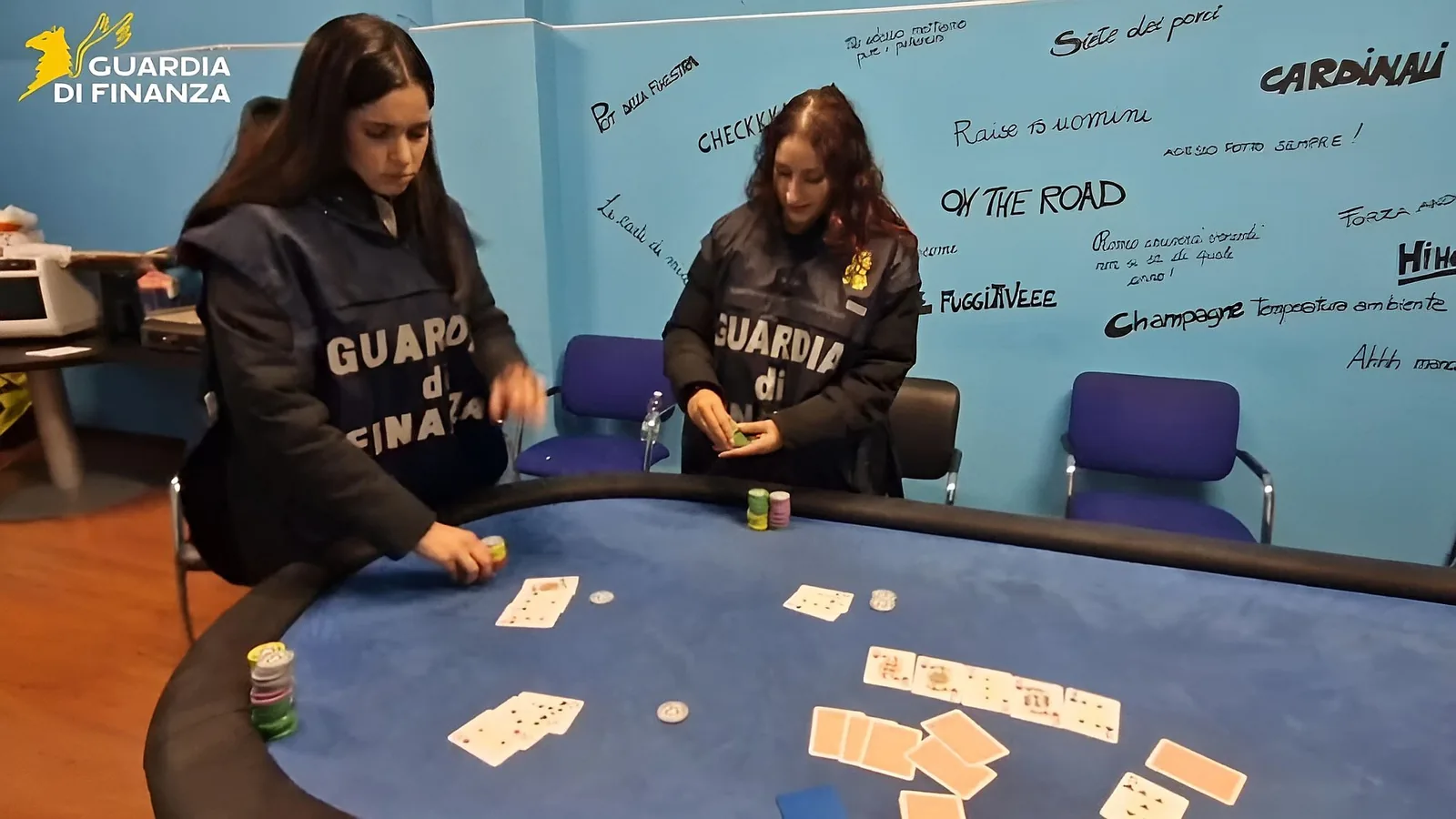
Poker returns to the headlines for two very different events that occurred in recent days: a club under investigation in Gallarate and an illegal game in a bar in Turin.
In the Varese case, the existence of an illegal gambling den as described by newspapers that dusted off old clichés about old Italian-style poker can be ruled out. A normal Texas Hold’em poker club was subject to an inspection by the Guardia di Finanza in Gallarate, with a complaint filed for reasons unrelated to poker.
A case of a completely different nature in Turin, in a bar in the Borgo Vittoria district, where seven people were caught starting a private and illegal game. However, let’s try to clarify because these are two very different episodes.
The Gallarate club
Inside an amateur sports association (which is generally the classic configuration of every club in Italy), a room with tables, chips, and people sitting down to play Texas Hold’em poker, yet reading the newspapers there is talk of gambling and the usual clichés.
The “Fiamme Gialle” (Financial Police) detected the presence of about 20 enthusiasts participating in a tournament, but investigations will reveal the judicial truth of the matter; at the moment, any headline or comment is premature.
Not only players from Gallarate were present, but also from adjacent provinces and some who arrived from Piedmont. Checks revealed that some of them had specific precedents for gambling-related crimes.
The mystery of the missing authorizations
A scene that, for those who know the poker world, has nothing exotic about it: tables, a dealer distributing cards and managing the game. However – according to local reports – authorizations were missing. Authorizations for what?
It is not clear whether they were of an administrative nature (for example, an internal bar) for the management of certain activities or authorizations of another nature related to the game itself. In that case, we know well that in Italy, they do not exist because the sector has not been regulated. In this case, the topic would be much broader; it is no coincidence that it has been debated for 20 years now (since at least 2006).
It is on this ridge that the story moves. Not on that of blatant violations, but on a more subtle and typically Italian ground: one where a widespread social practice – gaming among enthusiasts – collides with an uncertain regulatory system that leaves many intermediate spaces between what is permitted and what is forbidden.
Gallarate Club: the facts and a controversial detail
During the Guardia di Finanza checks, the presence of twenty players, some in their early twenties, was found (with requests for identification documents), intent on participating around three green tables, with chips managed by dealers. Among the latter, an individual was also recognized who had already been reported in the past by the Fiamme Gialle for undue receipt of the Citizens’ Income, which emerged precisely in relation to numerous online bets and winnings. However, this matter is completely unrelated to the dynamics of the club.
Some journalistic sources also indicate another detail (which would change the picture). According to Varese News: “During the entry, 20 people were identified, some in their early twenties, intent on participating in Texas Hold’em games around three tables with green carpets, with chips in plain sight and money managed by the croupiers“.
Cash game hypothesis?
This detail reported only by Varese News needs to be verified; it is necessary to wait for the development of the investigation because it is the only source reporting it. There is talk of money on the table. In this case, we are not within the limits indicated by the established jurisprudence of the Court of Cassation. Could it be cash games instead of a spin and go? We cannot know; we can only wait for the outcome of the ongoing investigations and whether the “money managed by the croupiers” was in plain sight like the chips or not.
The logic of the innocentist thesis prevails
However, the aspect that seems to favor a more innocentist thesis is that only the manager of the premises was reported and for another type of problem (which we will see shortly). Had the Fiamme Gialle caught the players playing cash games, an immediate report would have been filed for all players caught in the act. This did not happen; therefore, it is right not to exclude any hypothesis and wait for the outcome of the investigations, but it is possible to hypothesize that if no one was reported, it was just normal sit and gos or a multi-table tournament.
The reports from the Guardia di Finanza will be fundamental.
The only report against the manager, “investigations continue into money flows”
Also according to the detailed article by Varese News: “during the intervention, thanks to the drug-sniffing dog “Lorys” of the Malpensa Group, a dose of cocaine was also found in the pockets of the manager, who was reported”.
As mentioned before, it is therefore inferred that the only person reported is the manager, while the other people present were only identified and, at least from an initial analysis, this detail favors the innocentist thesis regarding the poker players.
Read also: Juventus, thigh injury for Bremer against Galatasaray: possible recovery times
“Investigations continue to reconstruct the organization and the money flows linked to the illegal activity” write the Varese journalists.
What does the Varese case teach us?
Poker continues to divide public opinion and live, outside of casinos, with a double nature: a mental sport for some, gambling for others, entertainment for many.
A complete regulation is missing for clubs, a regulation that no one wants anymore. Without rules, ambiguous stories like these can arise, filling the reports of local newspapers and websites. However, the rulings of the Court of Cassation remain and, within those limits, from the point of view of criminal law, no relevant conduct exists.
In Gallarate, more than a story of rule-breaking, a portrait of a gray area emerges: one where the social nature of the game meets the limits of bureaucracy. And where, often, the difference between passion and violation is written more in the codes than in the cards dealt on the table.
Over the years, poker in Italian clubs has become much more than a simple matter of cards and chips. It has become a legal, almost philosophical issue: where does the game end and where does gambling begin? Jurisprudence has drawn a fairly clear boundary, and not everyone has understood it yet. But it is clear.
The position of the established jurisprudence of the Cassation
To this question, the legislator has not responded, even though they had promised – as far back as 2009 – an organic regulation of live sports poker in clubs. Instead, jurisprudence has responded. In particular, the Court of Cassation. And it is precisely there that the true watershed is found.
According to the Supreme Court, poker is not automatically gambling. It is not by definition, it is not by nature, it is not simply because it is played with chips or because a final prize exists. What matters is not the green table, but the structure of the game.
The Cassation clarified that Texas Hold’em, in its tournament form, can be considered a game of skill. This is because the result does not depend exclusively on luck, but on the management of probabilities, strategy, and the psychology of opponents. In other words: on the player and their skills and discipline.
When poker takes the form of a tournament – with a fixed entry fee, an initial stack equal for everyone, and a prize pool formed by the participation fees themselves – one of the essential elements of gambling disappears: direct and progressive economic risk.
The difference between tournament and cash game for the Cassation
Freezeout tournaments, according to the Cassation, are legal even in clubs.
One is no longer “betting money” in the traditional sense of the term. One is participating in a competition. And it is here that poker leaves the criminal orbit and enters the sporting one.
.
The Cassation has established that tournaments structured in this way do not constitute the crime of operating gambling. There is no house, there is no organizational advantage linked to the outcome of the game, and there is no possibility of indefinitely fueling one’s economic exposure.
The case of cash games is different. When the game takes place with money directly on the table, with the possibility of raising and reinvesting without limits, the true legal distinction returns to the scene: the profit motive combined with economic chance. In that context, poker falls fully within the definition of gambling provided by the criminal code.
It is no longer a competition, but an immediate financial risk. And this is why the Cassation has continued to consider cash games illegal outside of authorized casinos. The result is a system that lives on a delicate balance, but for experts and professionals, it is a defined limit.

In clubs, tournament poker is criminally lawful
On one hand, jurisprudence has recognized the competitive and not necessarily random nature of tournament poker. On the other hand, a complete administrative regulation that clearly governs the activity of clubs is still missing. And this should be remembered by a part of the media and the general press that often splashes poker on the front page under a negative lens.
Many clubs operate within a zone defined more by rulings than by regulation. They are compatible with the Cassation’s orientation when they organize fixed-fee tournaments, without unlimited rebuys and without a direct economic interest linked to the players’ win or loss. They are not when they introduce dynamics typical of gambling, such as cash games or forms of continuous reinvestment of money.
In essence, poker in clubs is not forbidden in itself, and we know this well. It is the way it is practiced that determines its legality. And this is perhaps the most Italian paradox of all: while justice has drawn the line between skill and gambling, politics has not yet built the ground on which to place it stably.
In Turin, an illegal gambling den in a bar
A different case that does not concern the dynamics of clubs is what happened in Turin according to the reconstructions of the Agimeg news agency.
On February 7th, the State Police, through the P.A.S. Division of the Turin Police Headquarters, discovered an illegal poker activity inside a bar in the Borgo Vittoria district.
During the raid, officers identified a room in the basement where seven people were playing a game of Texas Hold’em; a 70-year-old Italian man was identified as the organizer, in possession of chips, notes with game values, and a register with names and sums of the participants. During the operation, thousands of euros in cash were seized, as well as an air pistol and a blank-firing gun found among those present.
The organizer and the husband of the bar owner – accused of having facilitated the activity and taken part in the tournament – were reported, while the premises, equipment, chips, and decks of cards were seized. The investigations are in the preliminary stage, and the suspects remain presumed innocent until any final conviction.
In this case, we are well beyond the limits drawn by jurisprudence.
For the cover photo, we thank the Guardia di Finanza of Varese and Gallarate-Malpensa.
Read also: ISOP Campione: Corinaldesi wins the Main Event after a deal with Astone