








There are decisive moments in the history of poker that did not take place at the green table, but rather in corridors, on stairs with decisions made in seconds. One of those moments happened at the Commerce Casino in Los Angeles and started with 3.000 dollars.
In those months, in Las Vegas, something was happening that had never happened before. But let’s proceed in order with our story.
Read more Roland Garros 2026 favorites and predictions: is there life beyond Sinner and Alcaraz?
Andy Beal’s raid on Las Vegas
Andy Beal — banker, oilman, billionaire — was doing something that amateur poker players weren’t allowed to do: he was winning. Not against a single player, but against everyone in Sin City. The Corporation, the group of America’s strongest professionals, was losing millions. Not due to incompetence, but because Beal had stopped being an amateur.
He had studied, eliminated tells, and understood that in poker, money isn’t just for playing: it’s for enduring. And those who endure the longest often win. Someone was needed. Phil Ivey was needed to avert the defeat of the professionals, of skill against vile money. But let’s rewind the tape to understand how the legend was born.
How the challenge of the century was born
In the early 2000s, while televised poker was growing and becoming a spectacle, a game was being played in Las Vegas that had no audience. No cameras, no commentary.
Only real money. On the other side of the table, there isn’t a professional: there is a visionary, a mathematician, a man who builds banks, buys oil fields, finances medical research. Andy Beal.
A Texan billionaire who decides to do what every great American ego has always dreamed of: demonstrating that money can beat talent with the typical arrogance of the wealthy.
Beal and the challenge to the Dream Team
Beal enters the Bellagio in 2001 almost out of curiosity. In the Bobby’s Room, the strongest players on the planet challenge wealthy billionaires. His first experience at those tables is lucky: he wins. He thinks Lady Luck has kissed his forehead, so he studies the game and returns. And returns again.
He wants to play against the best. Not all together. One at a time.
Thus The Corporation is born to support the heavy million-dollar effort to stem such a wealthy man. The world’s greatest professionals pool their bankroll and take turns at the table against the Texan banker.
Brunson. Reese. Harman. Forrest. Lederer. The Las Vegas dream team, the strongest high-stakes poker players (considering Jennifer Harman) in the world. Against a banker. What a story!
Beal and the power of money
Beal doesn’t play to win money. He plays to prove that poker isn’t art, that it’s mathematics, but that the power of money rules over everything.
And for a while, he seems to be right: he wins millions. He dismantles the professionals.
He returns to Texas with over 10 million dollars kindly donated by The Corporation. Las Vegas is not used to losing.
And for the first time, professional poker realizes something terrible: if the billionaire continues to win… the myth collapses. When Beal returns in 2004, the group is tired. It has lost too much.
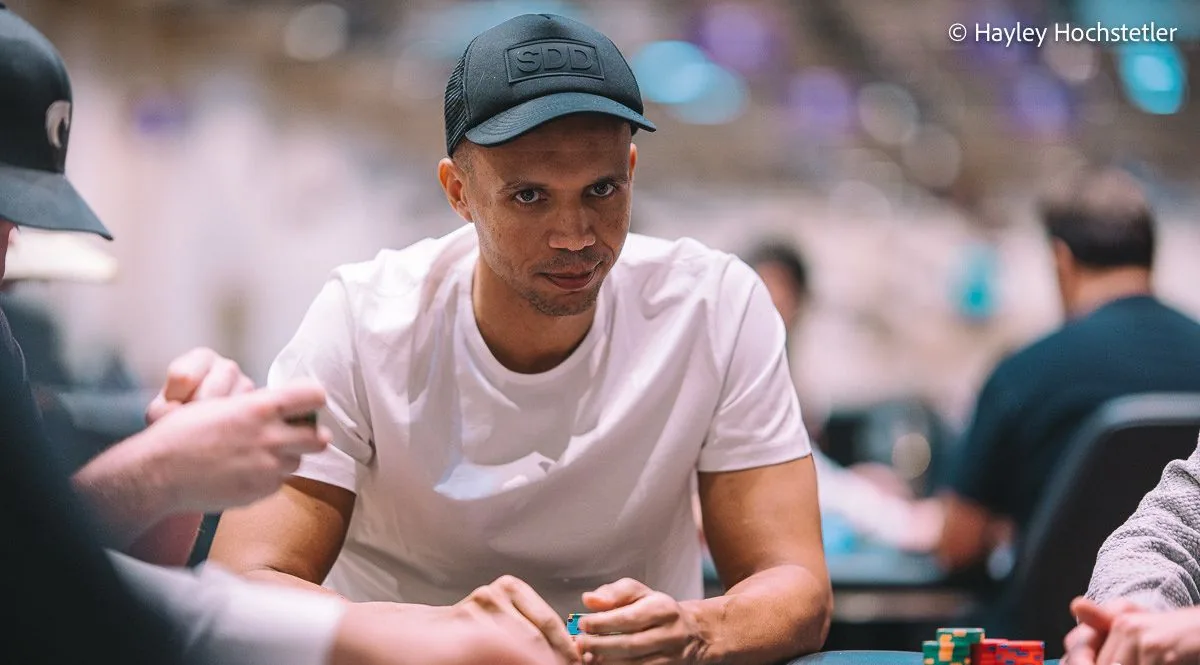
Someone is needed who doesn’t play for pride. Someone is needed who doesn’t play with fear, someone is needed who doesn’t play for money. Someone cold as an iceberg is needed. Phil Ivey is needed.
In Los Angeles, Phil Ivey “sends” a friend into the money
Meanwhile, in Los Angeles, Raymond Davis was playing a 1.000 dollar buy-in tournament. Nothing epic, just one of many.
The bubble was close, about forty eliminations away. Then something normal happens that occurs many times during a tournament break: two friends meet on the stairs. Phil Ivey is going up, Davis is coming down. “What are you doing?”. “I’m playing a tournament”. An ordinary conversation, until Davis mentions the bubble is near. Ivey stops, doesn’t smile, and asks what the minimum prize is. “About 3.000 dollars”. Then something happens that makes no sense: Ivey takes 3.000 dollars from his pocket, puts them in Davis’s hand and says: “Congratulations, you just made the money.”
Davis is confused. Why do it? Ivey doesn’t explain much. He’s not the type. He just says: “You can’t play the tournament anymore, you have to take me somewhere.” It’s not a request between friends, it’s something more.
Davis goes to get the car and when he returns, Ivey is ready: under his arm he has an elegant suit, in his hand a briefcase. Inside, millions.
“Take me to the airport,” he tells him. Then he adds, almost as if it were anything: “I have to go challenge Andy Beal before I’m forced to find a normal job to live again!”
During the journey, Ivey is not as impassive as at the table. He is unusually tense, asking several times if they haven’t taken the wrong road. Davis tries to reassure him, then asks how much money he has in that briefcase. “A lot,” Ivey replies. A few million.
When the silent man (Ivey) meets the rich man (Beal)
Ivey flies to Las Vegas and sits across from the man who had already put the professional poker world to the test with the weight of his own wealth.
He doesn’t make speeches. He sits down with his usual cold and ruthless gaze. The stakes are unreal: 25.000 / 50.000 then 50.000 / 100.000.
Every decision is worth something important to a normal man. Every mistake can be costly, but not for them. One is a banker and the other plays with the money of all the Las Vegas professionals.
For three days they play heads-up. Three days away from the spotlight but in absolute privacy. In Bobby’s Room (the legendary room at the Bellagio) there is only tension.
And in the end, something happens that all of Nevada hoped for: the boy who spoke little beats the billionaire. Not just once, but enough to turn everything around.
Over 16 million dollars return to the Corporation. The system is saved, the honor of the game as well, and so is that of the professionals.
Up to that point, Beal had won 13 million. Sembrava la fine. After those three days, he stops playing. He announces that poker is not for him. He retires. Like defeated kings do.
Read more «Pastaepatate1» devours the Explosive Sunday for over 8k€
Ivey: “I had a good session”
There’s no need to recount every hand to understand the meaning of that night. For hours they play, and in the end, the billionaire loses. Phil Ivey wins a lot. The Corporation triumphs. Poker breathes, the Las Vegas pros don’t go broke.
The next day Davis calls him and asks how it went. Ivey responds as if he had just won a sit&go: “I had a good session.” Only later is the truth discovered: 12 million won.
They meet again at the Commerce the following day. Ivey gives him 10.000 dollars in chips. Not for the ride, but for his silence. Then they go to see the Clippers and finally to dinner. And while they eat, Ivey simply says he had “a good week.”
Ivey saved The Corporation and poker
There are players who become great for what they win and others for what they represent. That night Phil Ivey didn’t just save The Corporation: he saved an idea. In those years, the cash game was still the reference game, tournaments were not yet so popular, they would become so from Moneymaker onwards. The passion for sports poker would explode.
But in the context of Las Vegas professionals, high-stakes cash games were the game, and not just in the Texas Hold’em version.
In those three days, Ivey saved the idea that poker didn’t belong to the wealthiest, but to those with the most skill and resistance to pressure. And sometimes, to change history, 3.000 dollars, a briefcase, and a quickly taken flight are enough.

The true legacy
That game is not the most famous. It’s not the most televised, it doesn’t even have a precise date in the collective memory.
But it is perhaps the most important. Because for a moment, poker was at risk.
Not of losing money, but of losing its meaning, of being labeled as a game of skill. If the billionaire had won definitively, cash game poker would have become just a challenge between capitals. Not a challenge of talent, not of reading, not of nerves.
Phil Ivey didn’t just save the Las Vegas bankroll. He saved an idea: poker doesn’t belong to those with the