







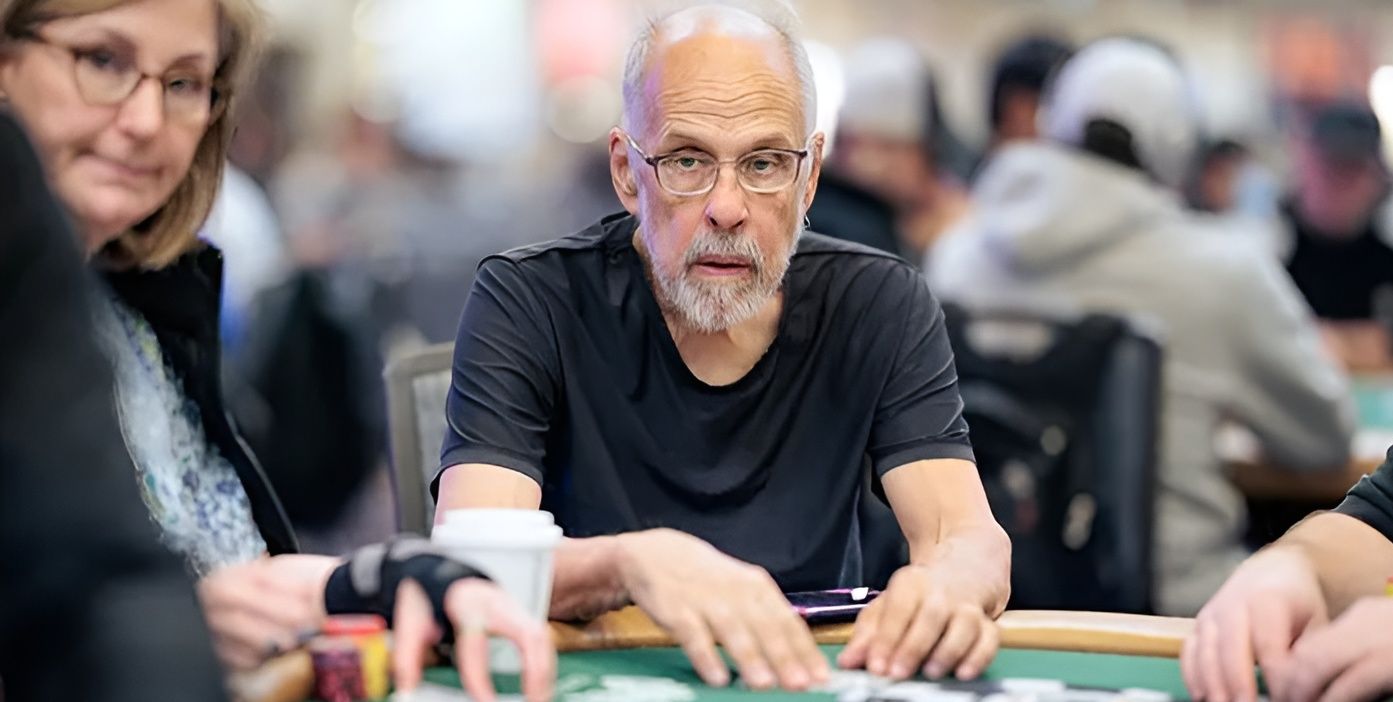
A name that for decades has been synonymous with study, mental discipline, and mathematics applied to the game, ends up in a judicial news column. David Sklansky, seventy-eight years old, author of fourteen books on gambling and above all of The Theory of Poker — a text that generations of players have treated as a manual of logic even before cards — was arrested in Las Vegas on a preliminary and serious charge of domestic violence.
Читайте также: Casino, on Marathonbet the Playtech Race starts: prize pool, how to participate and bonus details
The details are not known. The police have not provided any information about the incident. Public documents are limited to the essential facts: entry into the detention center on January 29, first hearing scheduled for the afternoon, bail set at $3,000.
Then, the next day, a second line of news: the release. And above all, the decision of the district attorney to not press formal charges.
The rest is silence.
In Nevada, a first charge of this type can also represent a “minor” offense, but it remains a serious matter: fines, mandatory counseling, social services. It is not a bureaucratic detail, but an issue concerning people’s private safety, life within homes. For this reason, it deserves prudence, not gossip, considering all the black and tragic news stories we are told every day. But maximum prudence.
Sklansky: he is one of the greatest scholars in the history of poker
Sklansky, nicknamed “The Mathematician,” belongs to a generation that transformed poker from intuition to calculation. Three World Series of Poker bracelets, millions of hands played, a reputation built more on books than on the spotlight. His 1994 volume is often compared to Doyle Brunson’s “Super System,” as one of the cornerstones of modern strategic culture.
This bad news clashes with his calm image as a poker scientist, scholar, and theorist. However, behind cards and books, there are always lives, often fragile, contradictory, sometimes opaque.
And as long as there are no formal charges, only the bare facts remain: an arrest, a release, no indictment.
The rest belongs to caution. And respect.
The Theory of Poker – the hidden grammar of the game
For the younger generation, it is right to remember him as one of the most theoretical and also winning players of his era.
There are books that teach you how to play. And then there are books that teach you how to think. David Sklansky’s The Theory of Poker definitely belongs to the second category, naturally, however, in relation to the reality of the 90s and early 2000s, but it was a revolutionary book for its time.
Читайте также: Tour de France 2026, the antepost odds for the race with Pogacar still the big favorite
For those who do not know poker well, we warn them that it is not a manual that promises shortcuts, or deludes with easy victories, it does not give magic formulas. It is something more severe — and more precious: an education in reasoning.
The underlying idea: poker as a science of decisions
When it was released in the 90s, poker was still described as instinct, tells, and poker face, saloon psychology.
Sklansky did something almost heretical: he stripped it of folklore. He essentially said: it’s not the one who “feels” the cards better who wins, but the one who makes decisions with positive expected value. In 2026, these sound like repetitive and ancient principles, but for the time it was a revolution.
And those concepts — expected value, pot odds, implied odds, semi-bluff, opponent errors as the primary source of profit — have become the mother tongue of modern poker. Today we take them for granted. At the time, they represented almost heretical and revolutionary concepts (for those who had the intelligence to appreciate and understand them).
The text is not tied to a specific variant. And this is precisely its strength. Sklansky does not talk about Texas Hold’em or Stud as separate worlds: he seeks universal principles, valid in any form of play.
He introduced the mathematics of probability applied to choices, he was a sort of GTO of the 90s. He also writes about the value of bluffing and semi-bluffing and introduces the concept of “opponent errors” as the true engine of profit. He also talks about psychology, yes, but subordinate to numbers. It is a book that does not tell you what to do in that hand. It explains how to reason in all hands.
His chart has gone down in poker history
The Sklansky Hand Groups, the classification of initial preflop hands devised by David Sklansky in the book Hold’em Poker for Advanced Players, is an idea before it is a chart. You need to understand the context: as mentioned, in the 80s, poker was played “by feel.” He asked himself a simple, almost scientific question: “which hands, on average, make money in the long run?”. From there, the classification was born. Not all starting hands are equal. Some print value. Others burn it slowly. The chart served to bring order to chaos. It was a first stone in the theory of poker.
From a certain point of view, it is still relevant…
In today’s poker, dominated by solvers, GTO, databases, and HUDs, some might think his books are outdated. It’s the opposite. Because solvers have done nothing but mathematically prove what Sklansky had intuited by doing calculations by hand. Reading him today means understanding the foundations. And without foundations, even the most sophisticated technology collapses. It is logical that it is an outdated concept because today’s geniuses have managed to break down every hair and every detail of the game, but his theories are a first stone and a way to change the game.
And after all, his books are not just about cards. They are about decisions, risk, probability. They are about real life, but then in real life, weaknesses and fragilities can emerge. The hope is that nothing serious has happened (the charges have been dropped).
Читайте также: PokerStars Open Campione 2026: Favotto flies live too, he leads with 15 left
Cover photo courtesy of Pokernews and Danny Maxwell