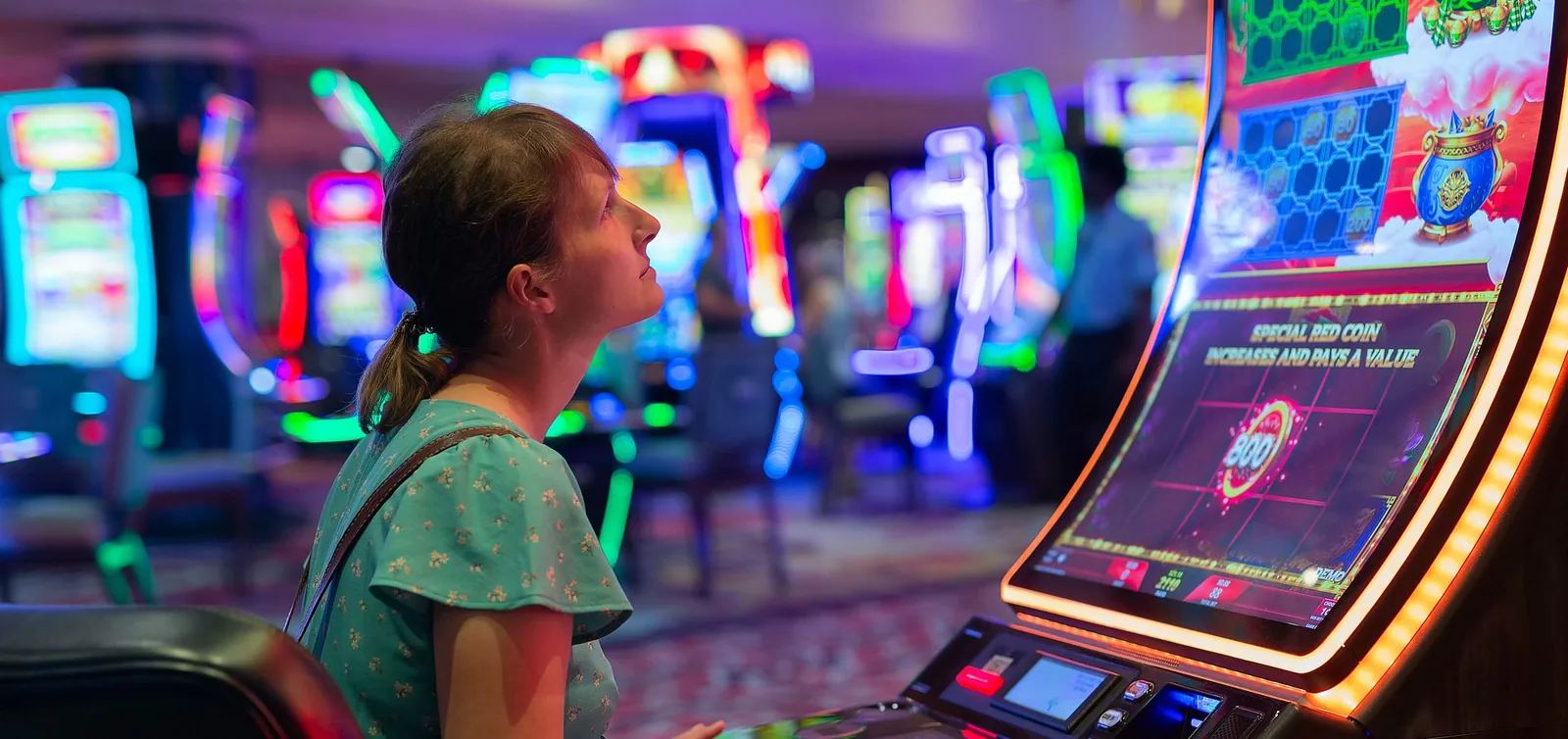









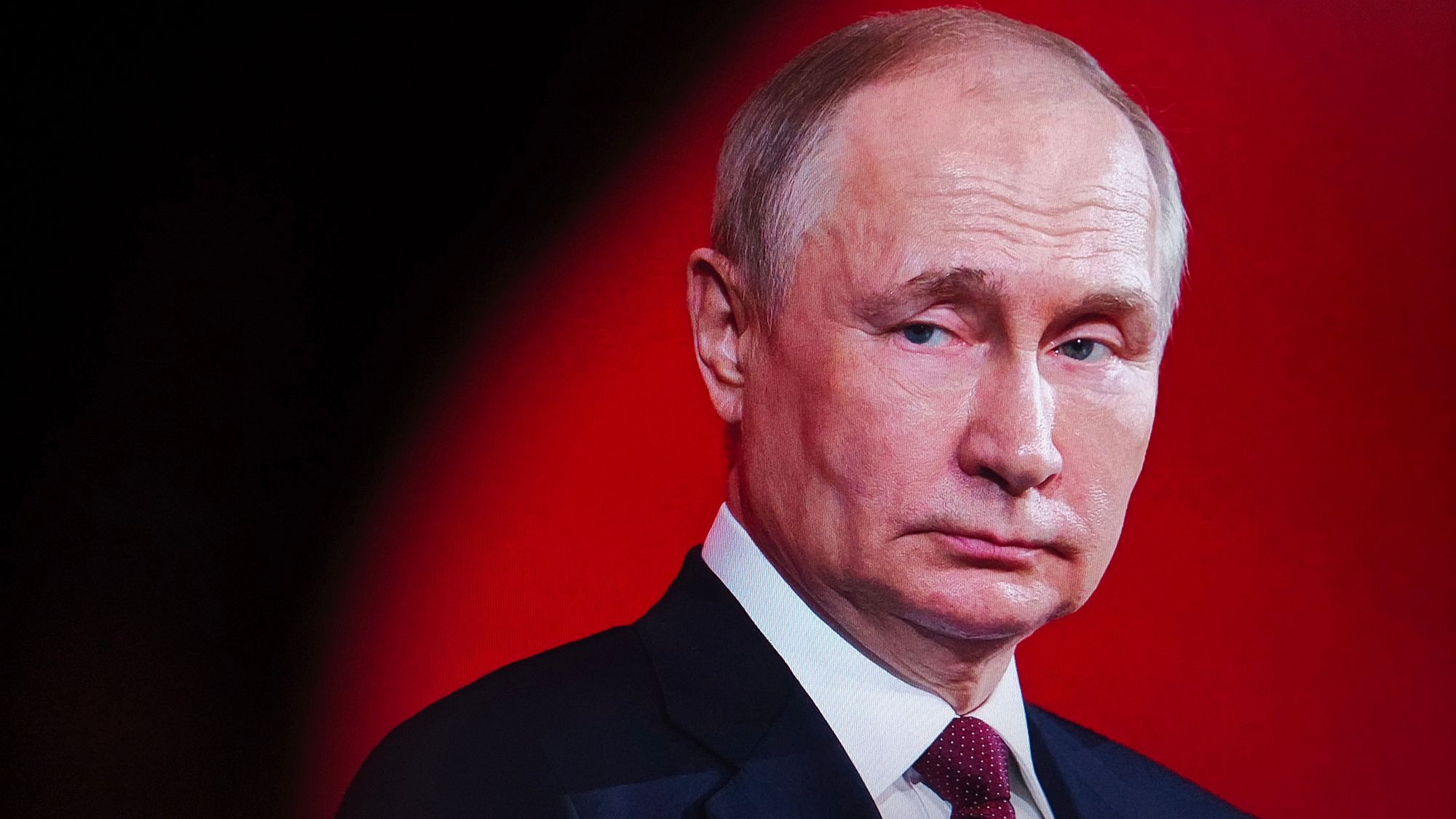
In a Kremlin marked by economic pressures (due to Western sanctions) and a war that is dragging Russia into a vortex of prolonged military spending, a proposal has emerged that goes against the grain of Russian gambling policies: legalizing online casinos, which have been banned until now, to generate new tax revenues that could partially finance the war economy growth desired by Putin and his generals through the reconversion of various industries.
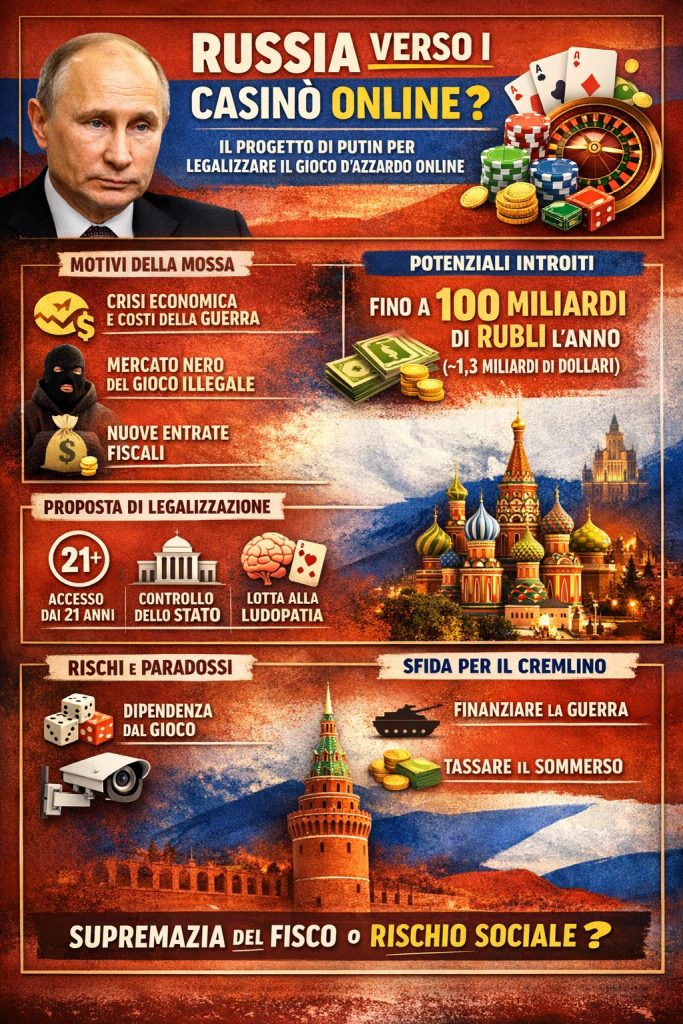
The idea – according to Russian press sources – was put forward by the Minister of Finance Anton Siluanov, a key figure for the state budget’s stability, who suggested that Vladimir Putin consider a radical revision of the digital gambling regulations. According to official estimates, a regulated market could yield over 100 billion rubles per year (about 1.3 billion dollars) for the state if taxed at a significant rate.
War Economy
A projection that is perhaps too ambitious, but we are still talking about a vast country of 143 million inhabitants, and we know that online slots have, in recent years, distorted the online gambling market.
Wars are costly, even for an economy primarily dependent on energy revenues, with falling oil prices on global markets complicating matters. The growing burden of war financing on the public budget, coupled with uneasy international relations with the Western world and increasingly heavy long-term sanctions.
From Prohibition to the Opening of Online Casinos
The paradox is that Putin and his ministers have always been inclined to combat gambling, with the closure of dozens of casinos in Moscow about 20 years ago.
It is no coincidence that the talk is of opening up now: Russia has banned online casinos and online poker outside of specific designated land-based zones since 2009, the result of a wave of restrictive laws aimed at limiting “free” gambling.
Online Poker: How the Market Was Regulated with PokerStars
Regarding online poker, one of the few authorized rooms was Pokerstars, which held a license in partnership with its strategic partner Casino Sochi (also the venue for several EPT editions), until the war in Ukraine broke out in 2022 and Flutter decided to withdraw to avoid being hit by international sanctions.
Russia had always been one of The Stars Group’s main global markets, until 2022.
Today, the talk is of online casinos, but they will only be Russian operators.
Here lies the irony of history: a country that has suppressed gambling for almost two decades, seeing that repression transform into a vast black market (unofficial estimates speak of thousands of illegal operators and trillions of rubles in circulation), might now backtrack. The reason? Even taxing the prohibited is better than foregoing certain revenues in a stressed economy.
The Project and Future New Rules
According to the proposal, legalization would be accompanied by limits such as a minimum access age of 21, centralized controls, and a single regulator to mitigate risks of gambling addiction and fraud.
This is where the economic narrative intersects with the social one: Moscow seeks to channel enormous financial flows to the state, but it does so in a country where state control is already tight, and where the “public health” budget is often subordinated to basic cash needs. The stakes, therefore, are not just fiscal: it is the ability to transform an underground phenomenon into a controllable and, above all, taxable sector.
Beyond Borders: Global Lessons and Geopolitical Reflections
This possible step by Russia is part of a global landscape where more and more states are redefining the boundaries between prohibition, regulation, and the digital market. In Europe and the United States, the regulation of iGaming and betting has become a ground for fiscal and regulatory competition, intertwining security, public revenue, and consumer protection.
In other words, Putin’s decision – whatever it may be – should be read as a sign of profound transformations in post-pandemic and post-Cold War economic governance models: states large and small are seeking new ways to finance internal and external ambitions, and they often do so by looking at sectors previously considered marginal. Wars have a cost; the United States knows this well with Iraq and Afghanistan. For Russia, it will be the fourth year of war, but it has been ongoing in Donbas for over a decade.
Economic Crisis Due to Too Low Oil Prices
In recent years, the price of oil has generally fallen compared to expectations and the levels seen up to the 2022–2023 period, with direct effects on Russia’s revenues and its economy, which is heavily dependent on hydrocarbon exports.
Market and Price Trends in Recent Years
- International Brent crude prices have fluctuated recently around USD 60–70 per barrel, being significantly lower than the peak levels recorded in the early period of the war in Ukraine (when they exceeded $100).
- The Urals crude commodity, the most relevant benchmark for Russia, has fallen even further and has experienced quotations even around ~$36 per barrel in some recent phases, the lowest level at least in recent years.
- The average price in 2025 was below Moscow’s budget expectations and official forecasts, with many analysts estimating average quotations lower than those incorporated in state spending plans.
Online Casinos in Russia: The Reasons
The proposal to legalize online casinos – far from being a mere technical act – reflects deeper motivations:
Read also: Monster 50: all satellites online scheduled for Sunday’s event
- a Russia struggling to balance military spending and economic stability (with very high inflation);
- as seen, hydrocarbon prices are historically low;
- a clandestine market that has evaded state control for years;
- an implicit reflection on the state’s function as a regulator and beneficiary of previously prohibited activities.
In this sense, the move proposed to Putin is as pragmatic as it is symbolic: to legitimize what is widely practiced in the shadows, to make it useful for the treasury, in an era when every margin of revenue counts – both within and outside Russia’s borders.
Putin’s Axe on Moscow Casinos
In the 2000s, after the fall of the Berlin Wall, the casino sector in Russia grew exponentially and with little regulation, especially in large cities like Moscow, where in 2005 there were dozens of casinos and hundreds of slot machine halls.
Faced with this expansion and the social and organizational problems related to gambling, Vladimir Putin – then President – promoted a federal law approved in 2006 that aimed to ban casino and gaming hall activities throughout the national territory, except in special isolated zones designated by the state.
The First Offensive in 2009 Against Gaming Halls
This regulation gradually came into effect, and starting from July 1, 2009, all casinos and slot machine halls in Moscow and other Russian cities were closed: the law prohibited the opening and operation of these establishments outside the four authorized gaming zones, forcing operators to cease operations or relocate.
The decision was justified by the government as a way to control the gambling phenomenon, reduce access to casinos in urban areas, and shift the industry’s concentration to remote regions with the aim of taxing and regulating the activity more strictly.
In practice, from mid-2009, all casinos in Moscow and major Russian cities ceased operations, marking a radical turning point in the country’s gambling policy: only in special gaming zones (such as Kaliningrad, Altai, Primorye, and others) were legal casinos subsequently allowed.
Land-Based Casinos: How They Are Regulated, Permitted Zones in Russia
After 2009, traditional gambling (casinos and slot machines) is legal only within specific “gambling zones” designated by the state: outside these areas, any casino is prohibited, and the law imposes closure and penalties for unauthorized operators. This regulatory framework stems from Federal Law No. 244-FZ of 2006 (in force since 2009), which shifted all casino activity from cities and scattered areas of the country to special zones intended to concentrate the legal offering.
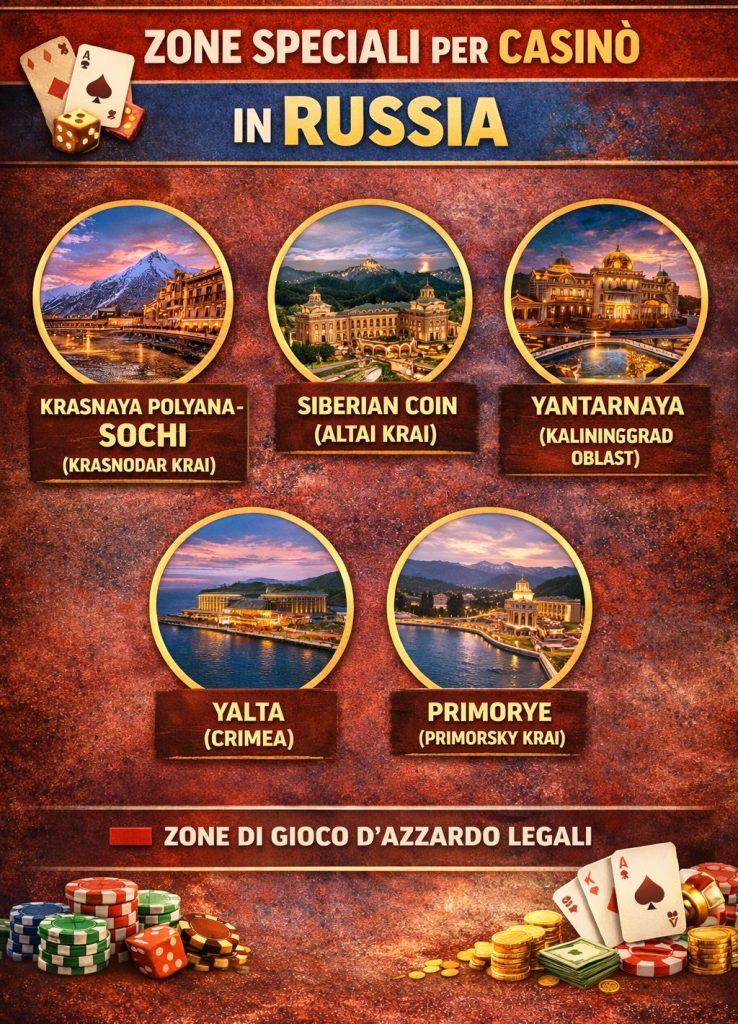
Currently, the main zones where land-based casinos operate legally in Russia are:
- Krasnaya Polyana – Sochi (Krasnodar Krai), one of the most visited gaming areas with integrated tourist infrastructure;
- Siberian Coin (Altai Krai), an area around the Altai Palace complex in southern Altai;
- Yantarnaya (Kaliningrad Oblast), in northwestern Russia, with tourism development also linked to events;
- Primorye (Primorsky Krai), near Vladivostok, also oriented towards international clientele from Asia;
- Yalta (Crimea), a relatively new zone integrated into the legal gambling system;
These special zones are created to concentrate gambling in delimited territorial areas, with the stated goal of controlling and taxing the activity, as well as developing tourism and complementary services (hotels, resorts, entertainment).
Main rules for operation:
- Casino activity is permitted only within these designated zones;
- Online casino games remain prohibited throughout Russian territory, unless the current reform proposal is accepted.
- Entry is reserved for those at least 18 years old, and the operation of casinos is subject to specific licenses and state controls;
- Casino licenses are issued by competent authorities and are accompanied by financial, fiscal, and compliance requirements with federal and regional laws.
In this system, the offering of physical gaming is highly localized and regulated, while any form of casino outside authorized zones and digital gaming remains illegal under current legislation.

Sports Betting: The Legal Situation
In Russia, sports betting is a legal and regulated form of gambling, with a regulatory framework distinct from that of other gambling activities such as casinos and slot machines. The regulation of the betting market (bookmaking) began in the early 2000s: since 2002, the sports betting sector has been formally regulated, with specific rules introduced in subsequent years (2006–2007) to govern licenses, financial requirements, and operating conditions for authorized operators.
Since July 2009, it has been mandatory for all betting activities (both in physical outlets and electronic ones) to obtain a license issued by the Federal Tax Service to operate legally in the country.
But it was only from 2016 that the legal market took off, when a very complex centralized system was created.
👉 Land-based and online betting: unlike many other forms of gambling, sports betting is permitted both in physical locations (betting shops) and through electronic online systems, provided that operators are duly licensed and adhere to fund and transaction control rules (including the use of central systems like TSUPIS to manage online bets).
Read also: Pronostico Antepost Premier League: quale squadra è favorita per la vittoria finale? Le quote oggi